There is a polite story we tell about scientific and entrepreneurial progress.
The hero is curious. The work is intrinsically rewarding. The arc is upward. Doubt is a brief visitor. Resolve is calm and clean.
Then you try to build something hard for twelve years.
You discover a different kind of fuel hiding in the system: the chip on your shoulder. The memory of being underestimated. The anger that arrives when someone says "that will never work," especially when you have already done the work to see that it might. The stubborn insistence to keep going when the rational spreadsheet says to stop.
Many people treat that energy as toxic. The mindfulness tradition frames anger as dysregulation, something to observe and release. Startup culture preaches building from love, not fear. The productivity discourse warns that if you are grinding, you are doing it wrong. Optimize for joy. Follow your curiosity. Let go of what does not serve you.
These views contain truth. Chronic anger corrodes. Fear-based decisions tend toward the defensive. Grinding without recovery breaks people.
And yet the view is incomplete.
It assumes that clean fuel is always available. That curiosity will sustain you through year four of a hardware company when nothing works and no one is buying. That "letting go" is an option when the problem matters and you are the only one still in the room.
Sometimes the only fuel available is the chip. The question is whether you can use it without being used by it.
The more accurate view is that this fuel behaves like rocket propellant. It can generate enormous thrust. It also produces heat, residue, and instability. The question is when it helps, when it harms, and how to metabolize it into something sustainable.
This is an essay about giving that energy its rightful place in progress, without romanticizing it.
I will give you one example from my own trajectory.
A few years ago, we were told that we would never figure out how to design the sensor circuitry in a way that would obviate mechanical connections between neighboring sensors. The problem was real. The constraint was hard. But then he made it personal: he told me I would never figure it out, specifically, me.
That sentence was music to my ears.
What had been a difficult technical problem became a challenge I could not walk away from. "Fuck you, watch me" is not a phrase you put in a grant application, but it is an accurate description of what happened inside my head. Being pushed into that corner of doubt pulled every fiber of my energy into deepening the chip on my shoulder.
We solved the problem. The solution became core IP. And I am not sure I would have stayed in the room long enough to find that solution if the challenge had remained polite.
That is the phenomenon this essay tries to explain.
1. Two Kinds of Motivation, One Messy Human Engine
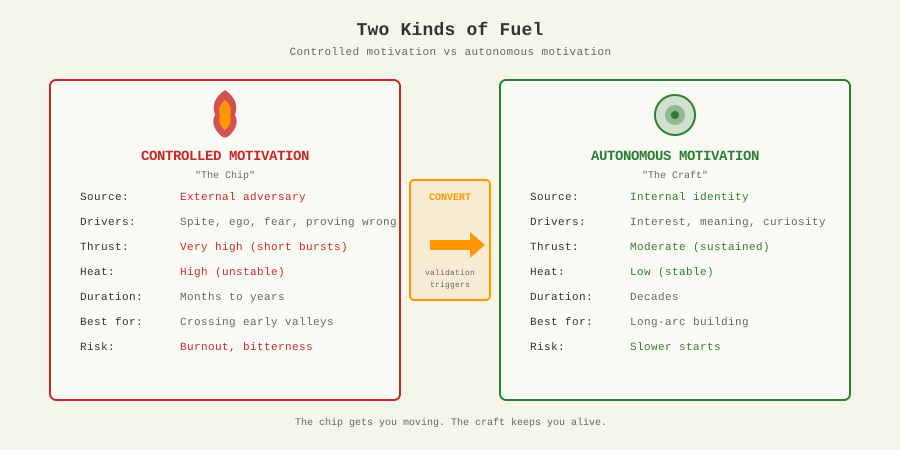
Motivation is not a single thing. The research tradition behind Self-Determination Theory distinguishes between more autonomous forms of motivation (driven by interest, meaning, identity) and more controlled forms (driven by pressure, ego, fear, approval, proving someone wrong). The key idea is that "quality" matters, not just quantity. Different fuels can produce very different long-run outcomes for persistence, wellbeing, and performance.
A chip on your shoulder often starts as controlled motivation. It is an external adversary moved inside your own head.
That makes it volatile rather than useless.
Controlled motivation can be high-octane in the short run, especially when the task is hard, uncertain, and socially loaded. It can also be corrosive if it becomes the only fuel source.
If you want a respectful argument for its place in progress, you need to explain its functional role.
2. Anger is an Approach Signal
A lot of people conflate anger with loss of control. In the lab literature, anger is often linked to approach motivation: it can mobilize energy toward overcoming an obstacle, particularly when a challenge is in your way.
A recent set of experiments found that anger, compared to a neutral state, increased effort and goal attainment in tasks involving challenges, although it also came with tradeoffs in some contexts.
This matters because the chip-on-shoulder energy is frequently an anger-adjacent state: not rage, but a focused "no" directed at a constraint.
In scientific work and product development, the constraint is often real:
- "This cannot be manufactured at scale."
- "This will never be adopted."
- "The signal will be too noisy."
- "Your distribution channel will not work."
- "The unit economics will not close."
Sometimes those critiques are correct. Sometimes they are lazy priors that deserve to be updated.
In that second case, anger can play a legitimate role. It increases the probability that you will run the next experiment, build the next iteration, or call the next partner, even when social feedback is negative.
Not forever. But long enough to get traction.
3. The Productive Version of Spite Has a Narrow Target
There is an unhelpful form of spite: punitive, outward-facing, concerned with humiliation, status, revenge. It is socially expensive and often self-destructive.
But there is also a productive form that looks almost boring from the outside. It has a narrow target:
"I will keep working on the thing until reality, not opinion, decides."
That form is less about hurting someone else and more about refusing to accept early dismissal as evidence.
It creates a useful bias: an over-weighting of experiments over narratives.
Science and entrepreneurship both reward this, within limits, because the environment is full of false negatives:
- ideas that are correct but poorly timed
- signals that are real but hard to measure early
- products that are valuable but initially illegible to buyers
- methods that work but require infrastructure that does not yet exist
A chip on your shoulder can be a counterweight to premature consensus.
It functions as stamina rather than epistemology.
3.5 The Fuel We Do Not Talk About
There is a social cost to admitting you were powered by spite. It sounds petty. It sounds reactive. It does not fit the narrative of the serene genius or the mission-driven founder.
So we sanitize it. "Resilience." "Determination." "Passion." These are the acceptable words. The chip gets edited out of the keynote.
But talk to long-arc builders in private, after the conference, after the close, after the champagne, and many will say some version of the same thing: someone told me it would never work, and I refused to let them be right.
That refusal was structural rather than a footnote.
Acknowledging this matters because suppression has costs. If you cannot name the fuel, you cannot manage it. You cannot ask whether it is helping or hurting. You cannot decide when to transition off it. You just feel vaguely ashamed of something that kept you alive.
4. Grit is Real, But It is Not Magic
"Grit" became a popular shorthand for long-term perseverance. The scientific picture is more nuanced.
Some work argues that grit predicts performance partly when it combines perseverance with genuine passion for the goal, and not as a standalone virtue. Other reviews and meta-analytic critiques suggest grit overlaps heavily with conscientiousness and is often overclaimed as a unique predictor.
That nuance actually strengthens the argument here.
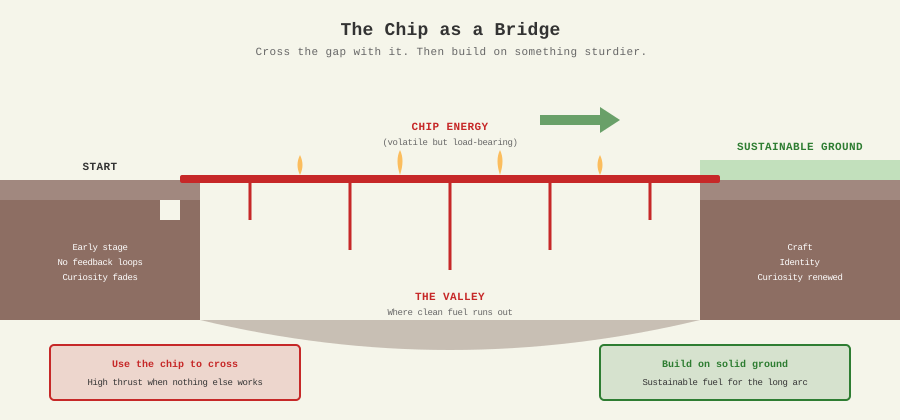
The chip-on-shoulder energy functions as a catalyst that can initiate grit-like persistence, distinct from grit itself. It can help you cross the early valley where curiosity is not yet rewarded, where the world has not given you any positive feedback loops.
But long projects cannot be sustained on catalyst alone.
What survives is the conversion:
- from spite to identity ("this is who I am and what I do")
- from anger to craft ("I know how to run the next iteration")
- from proving others wrong to proving the system right ("the thing works in the field")
In other words, the chip can get you moving. The work has to become intrinsically or identifiably meaningful if you want to survive the decade.
That framing aligns with SDT evidence showing that more autonomous forms of motivation tend to correlate with healthier engagement and outcomes over time, while controlled motivation often carries costs.
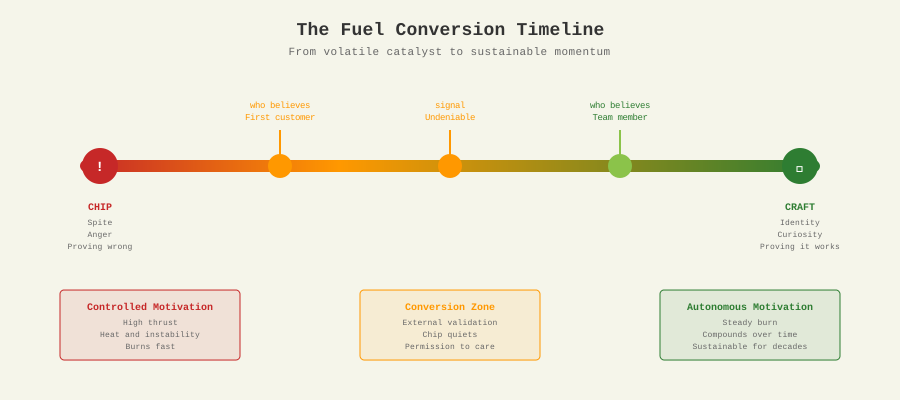
The conversion rarely happens all at once. It tends to arrive in stages, often triggered by external validation that the spite was no longer needed to keep you going.
The first real customer who pays without needing to be convinced. The first dataset where the signal is undeniable. The first team member who joins because they believe in the thing, not because you persuaded them. These moments quiet the chip. They give you permission to care about the work for its own sake.
What happens to people who never convert? Some burn out. The fuel runs hot for too long and the engine fails. Others succeed but stay bitter. They win the battle and spend the rest of their careers relitigating it. The acquisition closes, the paper publishes, and they are still arguing with a critic from 2014.
The goal is to use the chip as a bridge rather than a foundation. You cross the gap with it. Then you build on something sturdier.
5. The "Spite Trap" in Scientific Productivity
Here is the respectful warning label.
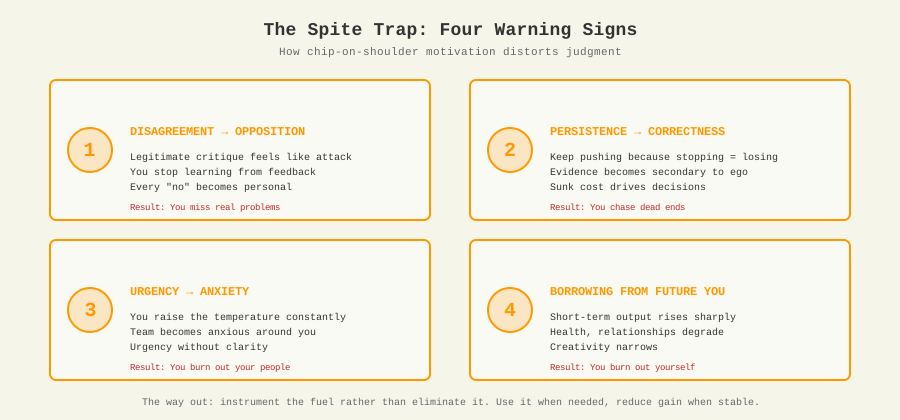
Chip-on-shoulder motivation tends to distort judgment in predictable ways:
- You over-interpret disagreement as opposition. A legitimate critique feels like an attack, so you stop learning.
- You confuse persistence with correctness. You keep pushing because stopping would feel like losing, not because the evidence improved.
- You raise the temperature of your environment. Teams can become anxious around you. You create urgency without clarity.
- You borrow energy from future you. Short-term output rises. Long-term health, relationships, and creativity degrade.
The way out is to instrument the fuel rather than eliminate it.
Treat that motivation like a high-gain control input. Use it when the system needs a kick. Then reduce gain when the system stabilizes.
6. A Practical Framework: Converting Chip Energy into Compounding Momentum
Step 1: Aim the chip at a measurable claim
Rather than "I will succeed," aim for specific claims: "This sensor can survive X environment." "This model improves Y metric." "This product closes Z unit economics."
Step 2: Build a loop that does not require emotion
Emotion is a starter motor. Build a flywheel:
- weekly shipping cadence
- continuous customer calls
- metrics you trust
- experiments with clear stop conditions
Step 3: Keep one channel for dissent
If your chip makes you allergic to criticism, you lose the main advantage of long timelines: learning.
Step 4: Convert antagonists into boundary conditions
Let skepticism define the test, not the identity. A good critic gives you free QA.
Step 5: Transition the fuel
When the work starts working, swap fuels: craftsmanship, responsibility, curiosity, duty to your team.
This is the mature form of the chip: it becomes quiet. It becomes procedural.
Step 6: Know when to let go
There comes a point where the chip has served its purpose. The doubters were wrong. The thing works. The acquisition closes, the paper replicates, the product ships at scale.
At that moment, the chip has nothing left to prove. If you keep carrying it, you are no longer building. You are relitigating. You become the person who won and cannot stop arguing with ghosts.
Letting go is graduation rather than betrayal. The energy did its job. Thank it, quietly, and move on to the next problem with cleaner fuel.
Closing Thought
A chip on your shoulder is a form of psychological potential energy, neither inherently noble nor inherently unhealthy.
In hard scientific and technical work, where feedback is delayed and the world hands out premature verdicts, that energy can serve a legitimate purpose: it keeps you in the game long enough for reality to weigh in.
But it has to evolve.
The best long-arc builders use spite to cross the early desert, then convert it into something that compounds: disciplined loops, sharpened judgment, a taste for evidence, and a deep attachment to craft.
Progress rarely comes from pure serenity.
It often begins with a refusal.