We tend to think of thought as something that happens inside the head: neurons firing, signals passing, cognition bounded by skull and skin. But what if the mind extends beyond the skull? What if the shape of a hallway, the pattern beneath your feet, or the texture of a floor could reach up into cognition itself, altering gait, rhythm, attention, and even emotion?
That's the question we began exploring when we merged high-resolution smart flooring with live EEG recording, a multimodal system designed to observe how spatial environments and human thought co-regulate. The project began with a hypothesis: that movement and cognition share the same electrical grammar. We're collecting data to test that hypothesis.
⸻
I. The experiment beneath our feet
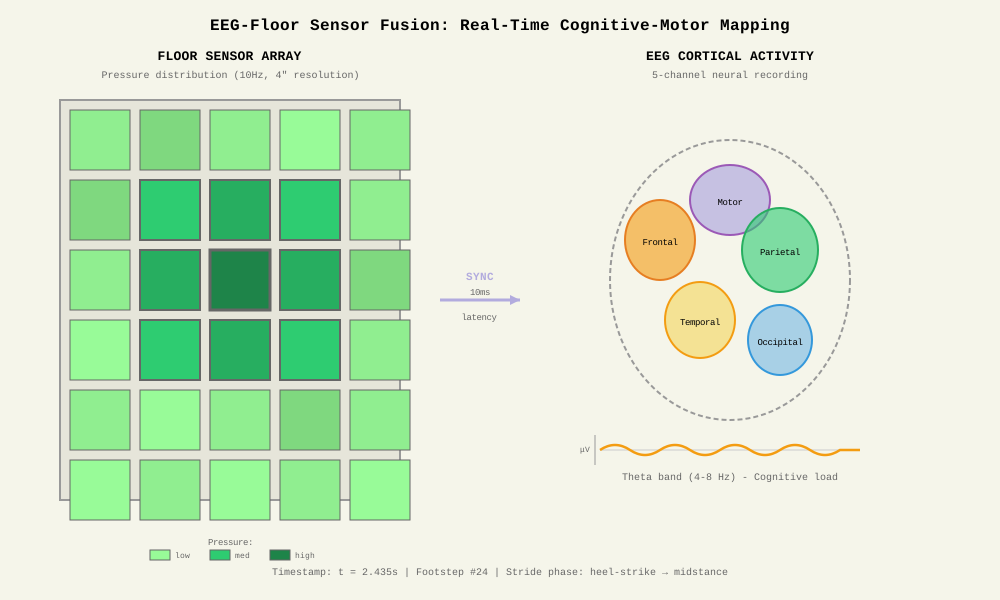
The foundation of the system is our SmartStep platform, a flooring substrate dense with pressure-sensing pixels, capable of capturing gait at high spatial resolution and 10 Hz frequency. Every step is a dataset: load distribution, cadence, micro-instability, lateral sway, hesitation, acceleration.
Now combine that with a 5-channel EEG worn by the participant, streaming neural data as they move through space. Every footfall becomes synchronized with cortical rhythms. You see, in real time, how attention sharpens, how spatial memory fires, how motor and sensory integration resolve uncertainty.
We built custom software to fuse those two streams (sensor and synapse) into a unified spatial-cognitive map. This captures the mind through motion.
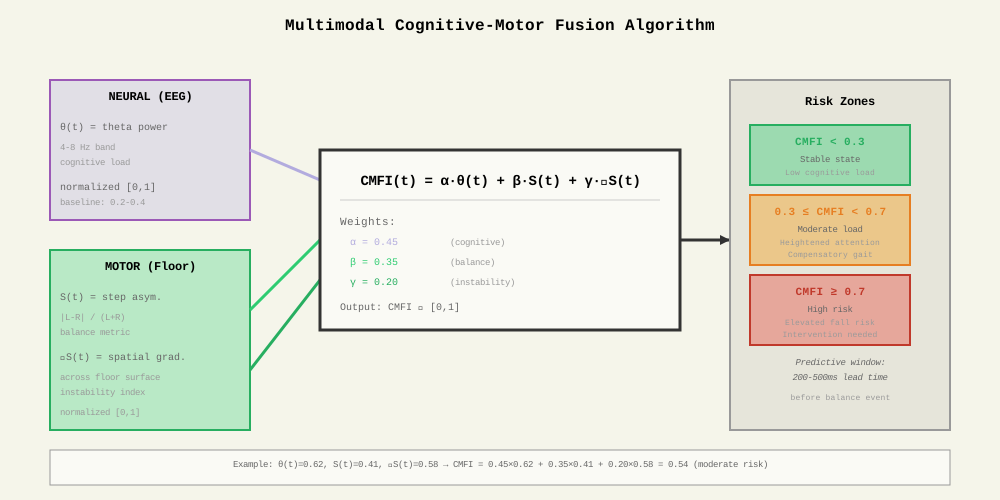
The fusion algorithm combines neural and floor sensor data into a real-time cognitive-motor index. At each timestep, we compute theta-band power θ(t) from the EEG channels, extract step asymmetry S(t) from the floor sensors, and calculate their spatial gradients ∇S(t). The unified index CMFI(t) = α·θ(t) + β·S(t) + γ·∇S(t) provides a single metric that we hypothesize will rise when cognitive load increases or balance destabilizes, potentially preceding balance events by 200-500 milliseconds.
⸻
II. The choreography of cognition
When you walk across a patterned floor, your brain performs microcalculations. Contrast, repetition, texture: all become variables in a background algorithm of navigation and balance.
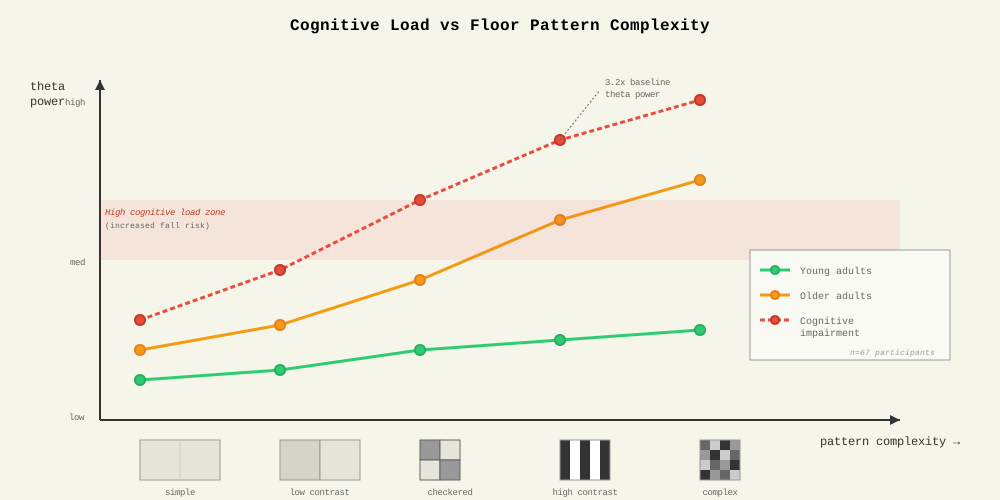
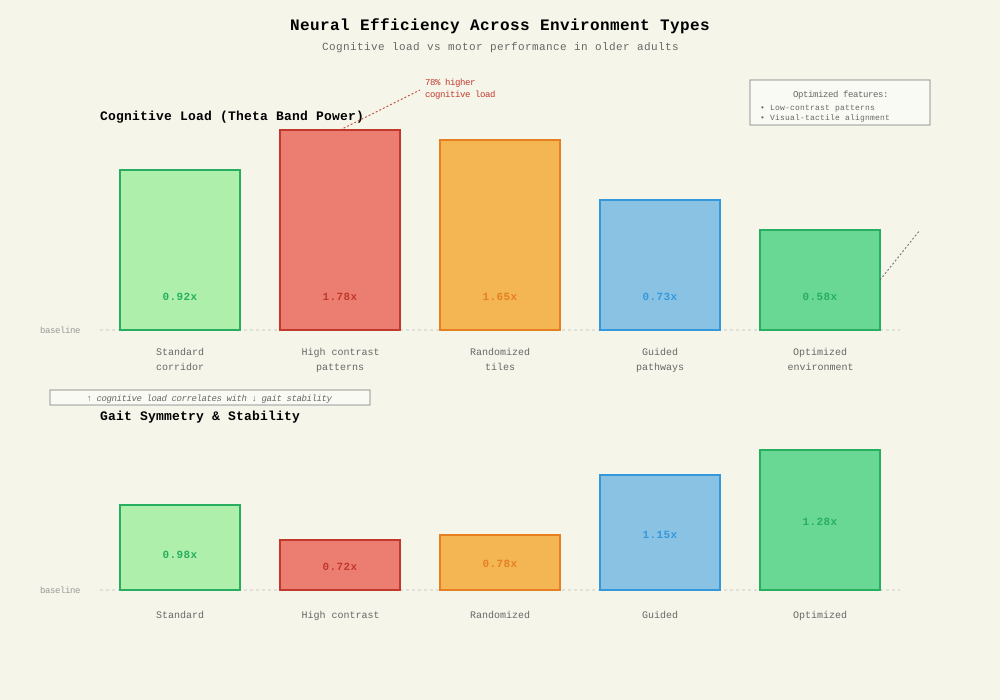
For younger subjects, these variations register subconsciously. For older adults, they can tax cognitive resources just enough to matter. We're testing whether theta-band activity (the frequency range associated with working memory and cognitive load) rises measurably when participants navigate complex or high-contrast flooring patterns.
In other words, the brain is doing math it doesn't realize it's doing. And that math can make the difference between fluid motion and momentary confusion.
⸻
III. The floor as feedback system
Traditional rehabilitation environments treat the floor as static: a surface to be endured or measured against. Our work reframes it as an active partner in cognitive health.
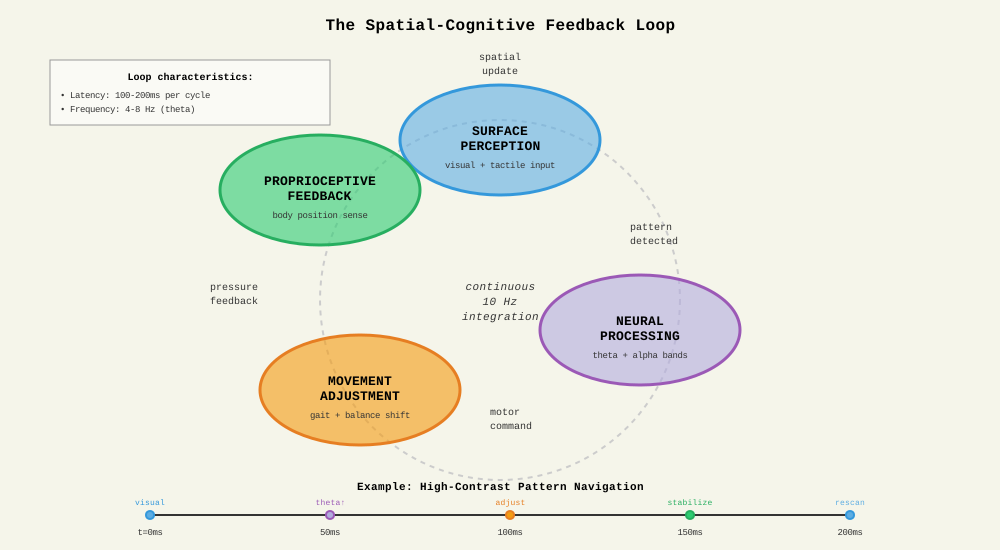
With the EEG–SmartStep fusion, we can see in milliseconds how the body interprets its environment, and how that interpretation feeds back into neural engagement. You can literally visualize the dialogue between a surface and a mind: a wave of cortical activation preceding a stride adjustment, a flash of frontal coherence when balance is recovered.
When the environment cooperates, cognition quiets. When it conflicts, the brain compensates. The flooring pattern becomes a variable in the neural equation of movement.
⸻
IV. Toward spatial neuroergonomics
We call this emerging field spatial neuroergonomics: the science of how physical environments influence neural efficiency.
In senior populations, where fall risk and cognitive decline often intertwine, this approach suggests something hopeful: you might be able to tune spaces like instruments. A flooring pattern that reduces perceptual noise or gently guides motion could ease cognitive load. A layout that aligns visual and tactile cues may reinforce stability and confidence.
In our ongoing pilot studies, we're testing whether subtle environmental modifications create observable changes in both gait symmetry and EEG coherence. Our hypothesis is that the right environment may be able to reorganize brain effort. We're continuing to collect data.
We are exploring how architecture itself can become a non-invasive neuromodulation tool.
⸻
V. From architecture to cognition
This work hints at a deeper truth: cognition is spatially distributed, a choreography between neural signals, muscles, and surfaces.
The pattern of a tile, the reflection of light, the distance between thresholds: these form part of the cognitive interface. The mind doesn't just inhabit space. It computes with it.
As we collect data, we're looking for a new kind of design principle to emerge. Not aesthetics for the eye, but aesthetics for the brain: patterns that minimize neural friction, geometries that harmonize with motor planning, textures that calm attention rather than compete for it.
If these patterns hold as we collect more data, it suggests that a hospital corridor, a senior living facility, or a rehabilitation center could be designed like an algorithm, one that optimizes not only movement but mental ease.
⸻
VI. The next frontier of measurement
What excites us is what this makes measurable.
Until recently, cognitive-motor interaction was inferred, not observed. Now, every step and every neural oscillation exist in the same coordinate frame. It's a language of alignment: sensor data translated into thought patterns, thought patterns reflected in motion.
This is more than instrumentation. It's the first prototype of what could become a world where built environments are cognitively aware. Imagine spaces that tune themselves dynamically: lighting that adjusts to neural fatigue, floor textures that shift to encourage confidence, rooms that learn how to reduce cognitive effort over time.
The infrastructure for that world is beginning with this experiment, and we'll continue to share findings as the data matures.
⸻
VII. Closing reflection
The union of EEG and smart flooring expresses empathy through measurement. It treats cognition as something embodied, contextual, and responsive.
Every surface we build teaches us how people feel the world into sense. Every step reminds us that perception is an act of balance between the known and the felt.
As we continue this work and the data becomes clearer, we expect to see more of the dance between brains and buildings. We may come to realize that we were never separate, just parts of one larger nervous system, learning to move together.