Most people think of free will as the space between a stimulus and a choice. Something happens, you weigh your options, and you act. But that description belongs to an earlier age, a time when the world was too complex and too opaque for anyone to predict what a person might do.
Prediction was coarse.
Agency felt spacious.
Choice felt open.
That gap is narrowing.
Every year, predictive systems grow better at forecasting human behavior. Large models can anticipate preferences, reactions, phrasing, decisions, and even emotional responses with uncanny accuracy. Sensors and data streams fill in details that used to be invisible. And as prediction improves, the concept of free will begins to distort.
The question is no longer whether we have free will.
The question is how free will operates when the future is increasingly knowable.
⸻
1. Free Will as a Bandwidth Problem
Free will has always been constrained by the bandwidth of your sensory input and the processing power of your mind. You make choices based on the information available and the cognitive tools you have to interpret it.
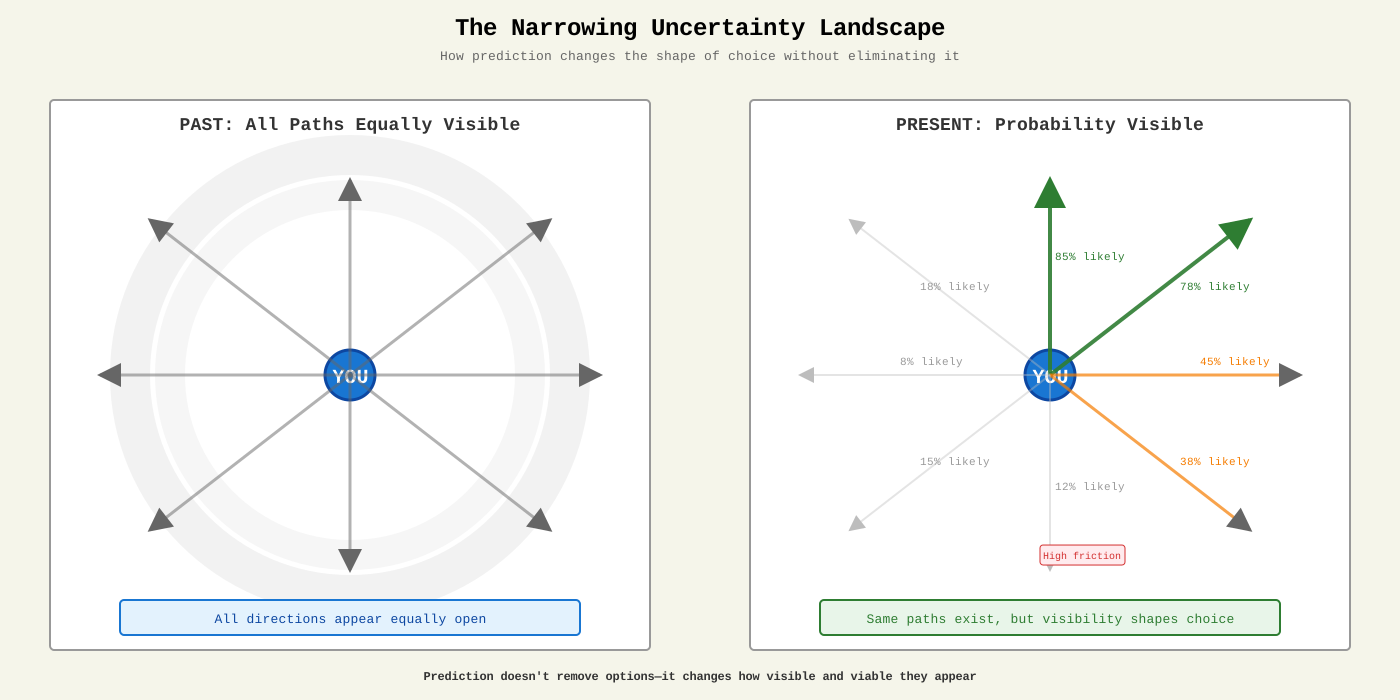
A person in a forest with no map feels free because every direction appears open.
A person with a satellite view sees the constraints: cliffs, rivers, traps, destinations.
More information changes the shape of the choice.
Prediction systems expand the informational boundary. They compress possibilities, highlight likely futures, and illuminate trajectories that used to be hidden. This narrows the uncertainty landscape rather than replacing free will.
When the world becomes more predictable, choice changes shape.
Not because freedom disappears, but because the space in which it operates becomes structured.
⸻
2. Determinism by Approximation
No predictive system can achieve perfect accuracy.
But perfect accuracy is not required to reshape behavior.
Even a rough prediction becomes a kind of scaffold that the system and the human co-evolve around. Think of autocorrect nudging your phrasing. Think of recommendation systems nudging your attention. Think of navigation systems nudging your routes.
Small nudges accumulate.
Over time, they become behavioral paths.
This is determinism by approximation.
A world where the default trajectory becomes increasingly powerful, optimized, and difficult to deviate from.
Agency remains, but it begins from a stronger baseline.
To exercise free will, you must consciously depart from the predicted path.
⸻
3. The Mirror Effect
Prediction systems do not only anticipate behavior. They reflect it back. They show you patterns you did not know you had: tendencies, habits, preferences, heuristics, biases, and blind spots. They surface the structure of your identity.
This creates the mirror effect:
the machine shows you a version of yourself you were not aware of.
For many people, this will be uncomfortable.
For others, it will be clarifying.
The philosophical shift is subtle:
You become both the subject and the observer of your own cognitive patterns.
Free will changes character.
It becomes less about spontaneous choice and more about metacognitive steering.
The ability to reflect on the predicted self becomes a form of freedom.
⸻
4. Constraint as Cognitive Infrastructure
Prediction does not eliminate freedom. It creates a new kind of infrastructure that shapes how freedom is exercised.
Example:
Before navigation apps, choosing a route felt open.
After navigation apps, choosing a route becomes an override of a recommended default.
The free choice still exists.
It is simply nested inside a predictive scaffold.
The same will happen across domains:
- Health choices supported by risk models
- Financial choices influenced by forecasting
- Social choices shaped by algorithmic matching
- Professional choices guided by productivity models
- Emotional choices influenced by mood prediction
- Creative choices shaped by generative tools
Prediction becomes the environment in which choices are made.
Free will adapts by becoming more deliberate.
⸻
5. The Paradox of Foreknowledge
Prediction produces a paradox:
The more predictable we become, the more aware we become of our predictability.
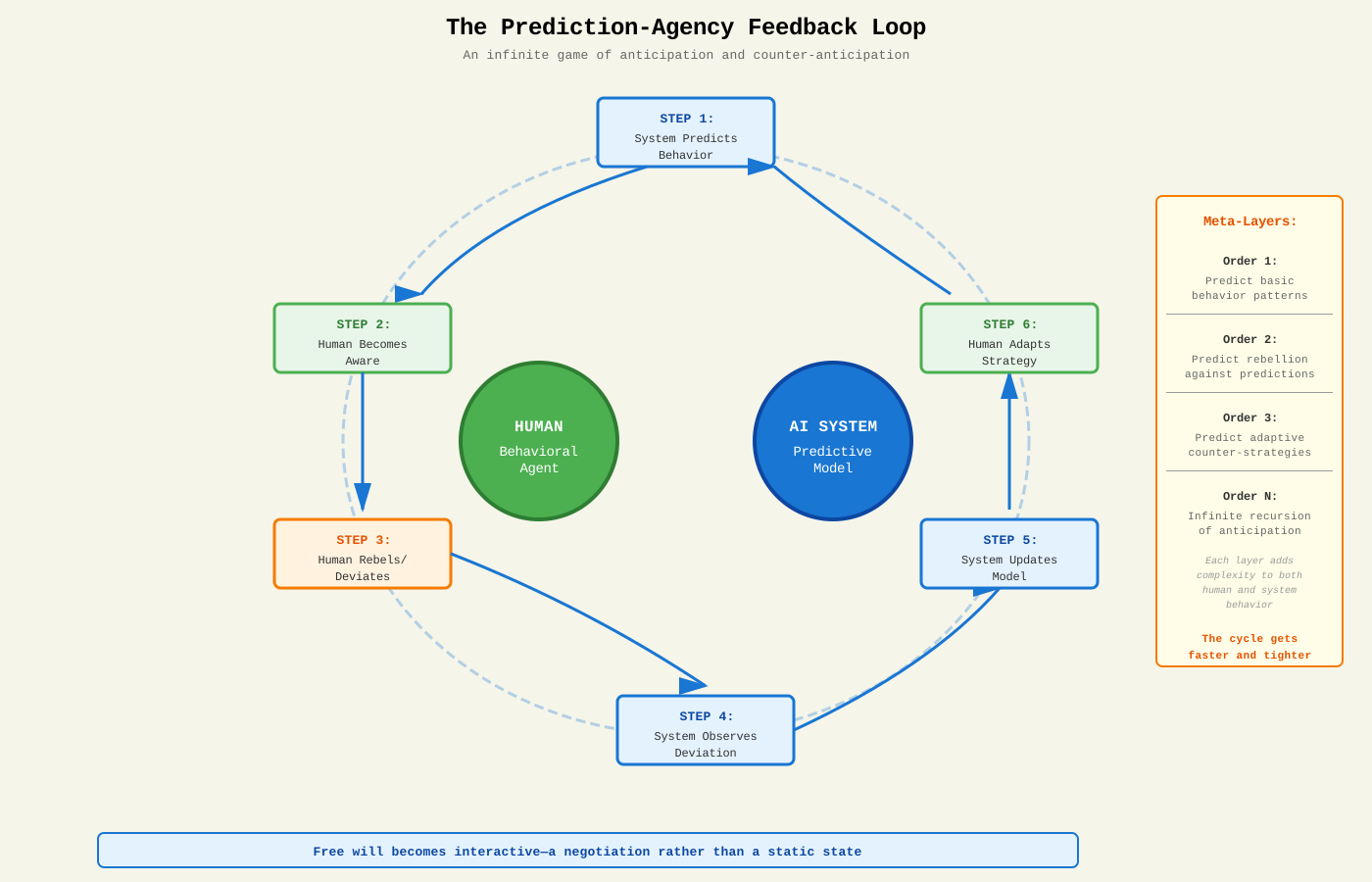
This awareness itself creates a feedback loop.
Humans can act against prediction simply to reassert autonomy.
Rebellion becomes a signal of agency.
But the loop does not stop there.
Predictive models eventually learn the pattern of rebellion too.
The dance between free will and prediction becomes an infinite game of anticipation and counter-anticipation. The system predicts, the human reacts, the system updates, the human adapts.
Free will becomes interactive.
It does not vanish.
It evolves into a negotiation.
⸻
6. Two Books, One Question: Determined and Dune
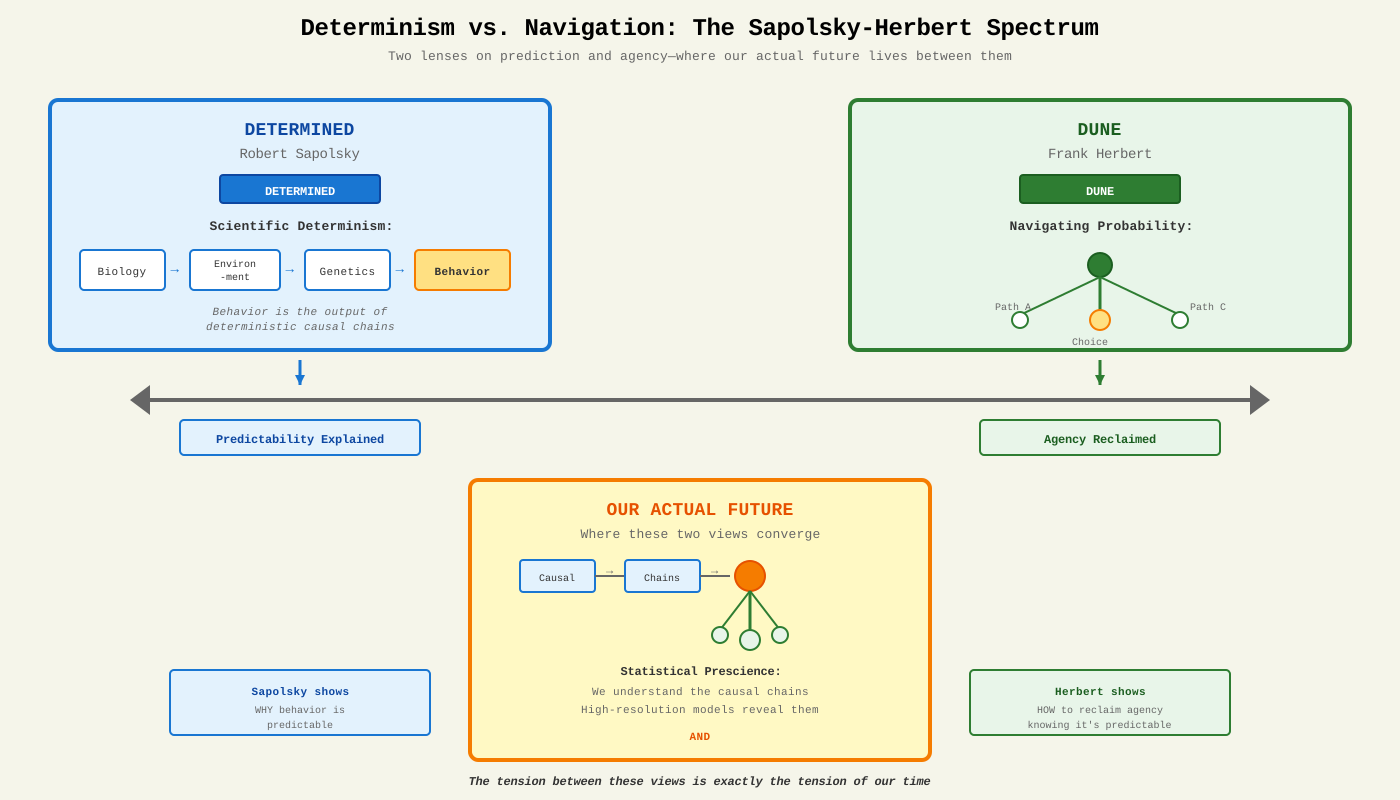
I have seen this negotiation from two very different angles in two books that were never meant to be in conversation: Determined by Robert Sapolsky and Dune by Frank Herbert.
Determined is a scientific demolition of classical free will. It presents human behavior as the output of biology, environment, genetics, and past experiences woven together into a chain of causes. In that view, prediction stands as an inevitable consequence of causal machinery. The machinery of the mind is deterministic, whether or not we can measure the full causal structure.
Dune offers the opposite lens. Paul Atreides experiences time as an expanding network of possible futures. He sees paths, but he also sees his ability to intervene, to bend trajectories, to create choice within destiny. Free will becomes a matter of navigating probability, not escaping it.
Between these two worlds lives our actual future.
We are biological beings shaped by causal chains, yet we inhabit a world where high resolution models increasingly reveal those chains. Prediction becomes a new kind of prescience, not mystical but statistical. And humans respond the same way Herbert imagined: by looking for room to move inside the narrowing corridor.
Sapolsky explains why behavior is predictable.
Herbert explains how people reclaim agency once they know it is predictable.
The tension between these views is exactly the tension of our time.
⸻
7. The Future of Autonomy
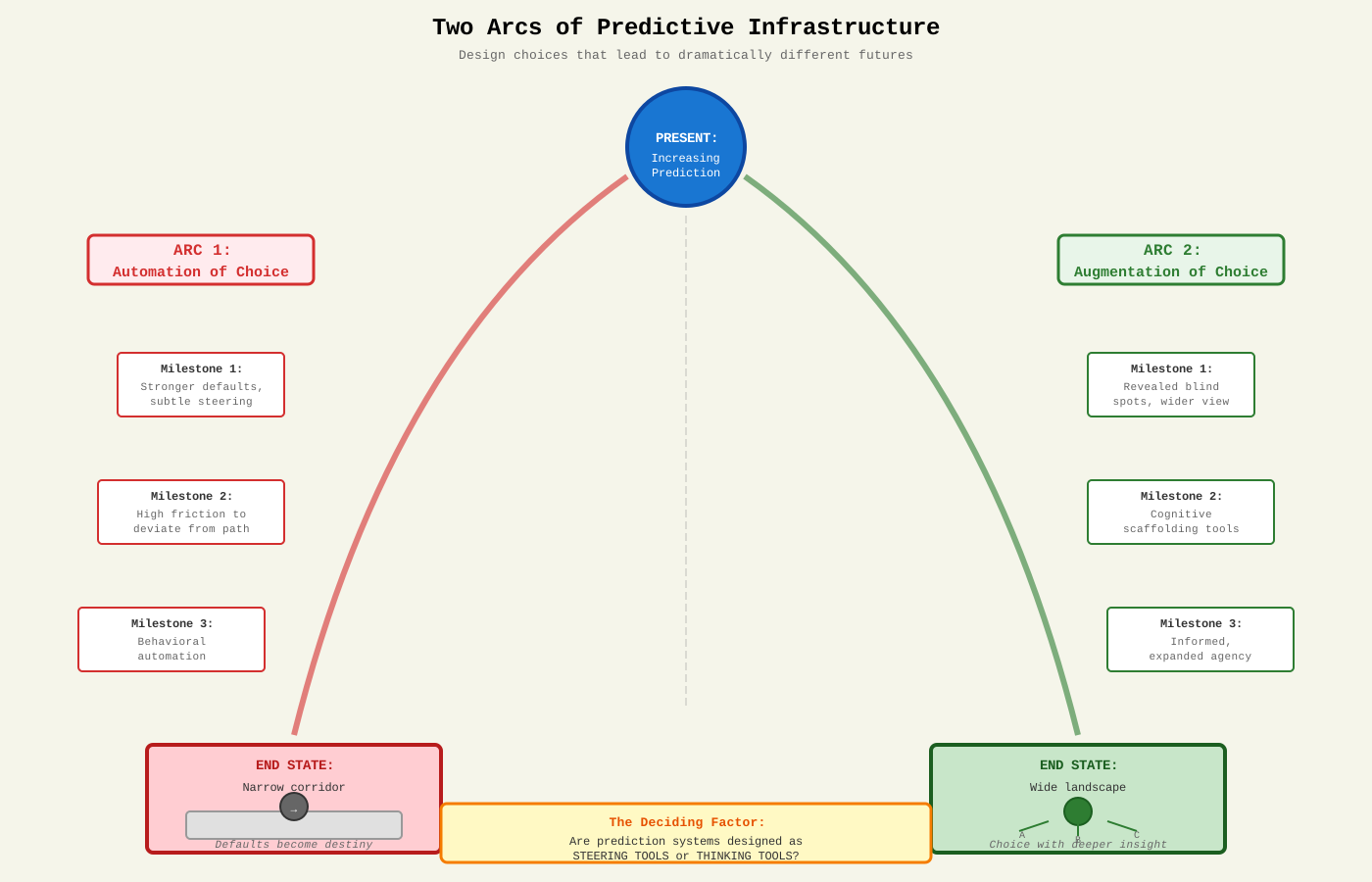
The future of free will will depend on how societies manage predictive infrastructure. There are two possible arcs:
Arc 1: Automation of choice
Prediction steers behavior subtly and continuously.
Defaults become destiny.
Agency shrinks because deviation requires conscious friction.
Arc 2: Augmentation of choice
Prediction is used as a cognitive scaffold.
It widens awareness, reveals blind spots, and expands possible futures.
Agency grows because choices are made with deeper insight.
Both futures are possible.
The deciding factor is whether prediction systems are designed as steering tools or thinking tools.
⸻
8. A New Definition of Freedom
Free will has never meant perfect independence.
It has always meant the ability to act intentionally within constraints.
Prediction changes the constraints, not the intention.
In a predictive world, free will becomes something like this:
Freedom is the ability to navigate a future that is partially visible without being dominated by what is visible.
The predictive landscape can clarify your path.
It can narrow your path.
It can distort your path.
But it cannot choose your path.
Choice remains.
It simply operates under new physics.
⸻
Closing Thought
The future of free will will not be decided by whether machines predict us. It will be decided by how we respond to the visibility they create. Prediction does not erase autonomy. It increases the resolution of the environment in which autonomy operates.
Free will survives, not as an untouched space, but as a conscious act of navigation.
The future belongs to those who can see the predicted path and still choose their own.