Industries transform when they learn to count. Blood pressure gave medicine actionable numbers. Energy ratings gave buildings comparable efficiency scores. Crash test ratings gave cars measurable safety. In each case, indices compressed complexity into numbers that decision-makers could compare, track, and act upon.
The gap between research observation and practical utility is often the absence of such compression. Neuroscience has generated extraordinary insight into how movement and cognition interweave, how spatial environments shape neural load, how balance emerges from a continuous negotiation between perception, prediction, and proprioception. What it has not produced is a thermometer.
This essay proposes a family of indices designed to fill that gap. Built on synchronized data from high-resolution floor sensing and portable EEG, these metrics aim to translate the embodied mind into numbers that manufacturers, architects, employers, and healthcare providers can use.
⸻
1. Why Indices Matter
An index is a compression function. It takes high-dimensional, noisy, continuously varying data and projects it onto a scale that humans can interpret and act upon. The art lies in choosing what to preserve and what to discard.
Good indices share certain properties:
- Legibility: A non-specialist can interpret the output.
- Sensitivity: The index moves when the underlying state changes.
- Specificity: It does not move when other things change.
- Actionability: Different values imply different responses.
- Trackability: Repeated measurements reveal trajectory.
An energy efficiency rating works because an A means something different from a D, and that difference changes what you specify. The goal for cognitive-motor indices is the same: numbers that compress complexity into actionable signal.
The indices described here emerge from a specific measurement architecture: pressure-sensing floor arrays synchronized with portable EEG. But the framework is generalizable. As sensor modalities expand, the index family can grow.
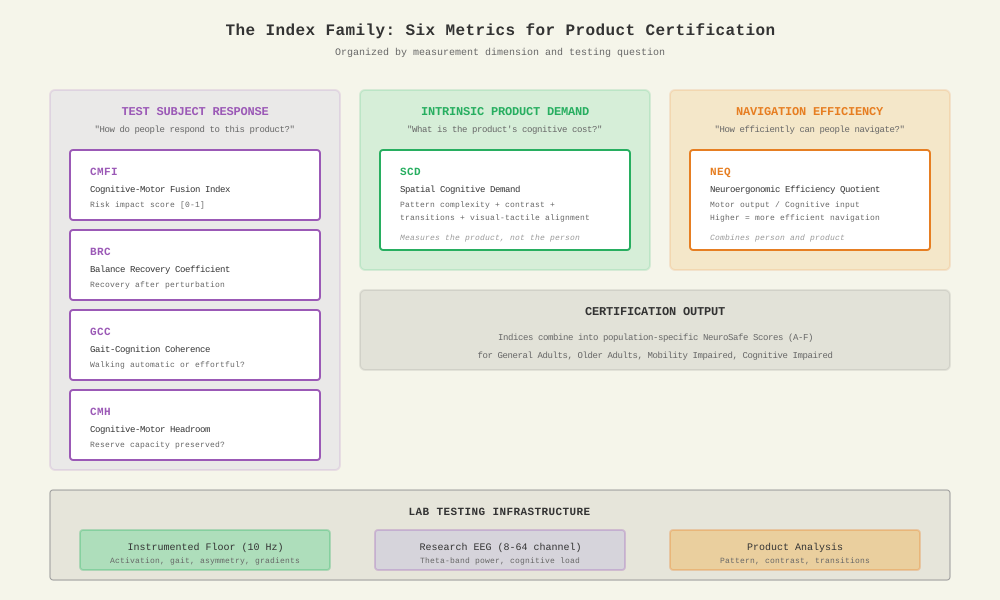
Figure 1: The index family organizes six metrics across three dimensions: individual state (CMFI, BRC, GCC), environmental demand (SCD), and system efficiency (NEQ, CMH). Each index answers a different question about cognitive-motor interaction.
⸻
2. The Measurement Gap
We can measure blood pressure in seconds, but we cannot measure whether a building is making someone's brain work too hard. We can track heart rate continuously, but we cannot track whether a flooring pattern is exhausting an aging mind. This gap has consequences.
2.1 What We Cannot See Today
Architects and designers make choices every day that affect cognitive-motor load: flooring patterns, lighting schemes, corridor widths, transition materials, signage placement. They have no feedback on impact. A space can be fully ADA compliant and still exhaust an aging brain. A corporate headquarters can win design awards and quietly drain every employee who navigates it. Compliance sets minimums; it says nothing about optimums. Designers follow aesthetic judgment, institutional tradition, and cost constraints. Whether their choices help or harm cognitive-motor function remains unknown until complaints accumulate or incidents occur.
Manufacturers sell flooring, furniture, and fixtures into diverse markets (healthcare facilities, corporate offices, retail spaces, educational institutions) with no way to quantify cognitive-motor impact. A beautiful high-contrast checkered floor might perform well in focus groups and fail catastrophically for someone with mild cognitive impairment. An open-plan office carpet with bold geometric patterns might look modern while forcing every worker to spend cognitive resources parsing their path to the coffee machine. No rating system exists. No testing protocol. No way to know until problems emerge in the field.
Employers and corporate real estate teams manage environments where people spend most of their waking hours. An open office with polished concrete floors, glass partitions, and dynamic wayfinding graphics might photograph beautifully while quietly exhausting every worker who navigates it. Burnout is typically attributed to workload, management, or culture. The possibility that the physical environment is taxing cognitive resources all day, every day, rarely enters the conversation. A trading floor, a hospital ward, an Amazon fulfillment center: each demands constant navigation, and each remains unmeasured for cognitive cost.
Healthcare providers face acute versions of the same problem. Clinicians rely on periodic snapshots (the Timed Up and Go test, the Berg Balance Scale, the annual cognitive screen) that capture moments, not trajectories. A patient can decline for weeks between appointments, and the deterioration remains invisible until the next visit, or until a fall forces attention. Falls have become the primary metric of cognitive-motor health in older adults, but falls are failures, not early warnings. By the time someone falls, the intervention window has often closed.
Families and individuals navigate blind across contexts. Is this senior living facility better than that one for mom? Is the new office layout making work harder? Is the apartment with the beautiful patterned floors actually a good choice? The answers are invisible. People rely on intuition, marketing, and hope.
2.2 The Cost of Blindness
In healthcare, the visible costs are staggering: falls are the leading cause of injury death among adults 65 and older, generating over $50 billion in annual medical costs in the United States alone. But these statistics capture only the catastrophic failures. The invisible costs are larger: the near-misses that erode confidence, the environments that quietly accelerate decline, the interventions we cannot evaluate because we cannot measure their effects, the designs we cannot optimize because we have no feedback signal.
In workplaces, the costs manifest differently but no less consequentially. Cognitive fatigue accumulates throughout the day, degrading decision quality, reducing creative capacity, and contributing to burnout. When employees struggle to concentrate, the default explanation is distraction, stress, or insufficient motivation. The possibility that the physical environment itself is consuming cognitive bandwidth rarely surfaces. Yet the same neural systems that falter before a fall are taxed by environments that demand constant low-level processing: navigating complex visual patterns, compensating for poor acoustic separation, adapting to inconsistent lighting.
Every unmeasured interaction between a brain, a body, and a building is a missed opportunity, whether for fall prevention or sustained cognitive performance.
2.3 Why Now
Three changes have made this problem newly solvable:
Sensor economics. High-resolution floor sensing and portable EEG have crossed feasibility thresholds. The hardware to capture the dialogue between brains and buildings now exists at price points that enable deployment beyond research labs. What was once a multi-million-dollar laboratory capability can now be embedded in testing environments and worn comfortably for extended sessions.
Demographic imperative. Ten thousand Americans turn 65 every day. The population of adults over 80 will double in the next two decades. The built environment will either support this population or tax it. Healthcare facilities, senior living communities, and multigenerational homes all need better evidence for design decisions.
Workplace reckoning. The post-pandemic return to office has forced a question that was always lurking: does this space actually support the work? Burnout rates are at historic highs. Employers are spending billions on office redesigns with no way to measure whether the changes help. Meanwhile, workers' compensation claims for repetitive strain and fatigue continue to climb. The cognitive cost of environments has never been more relevant to the people paying for real estate.
The sensors exist. The need is acute across sectors. What has been missing is the translation layer: a vocabulary that converts raw data streams into numbers that architects, manufacturers, employers, healthcare providers, and families can understand and act upon. That is what these indices provide.
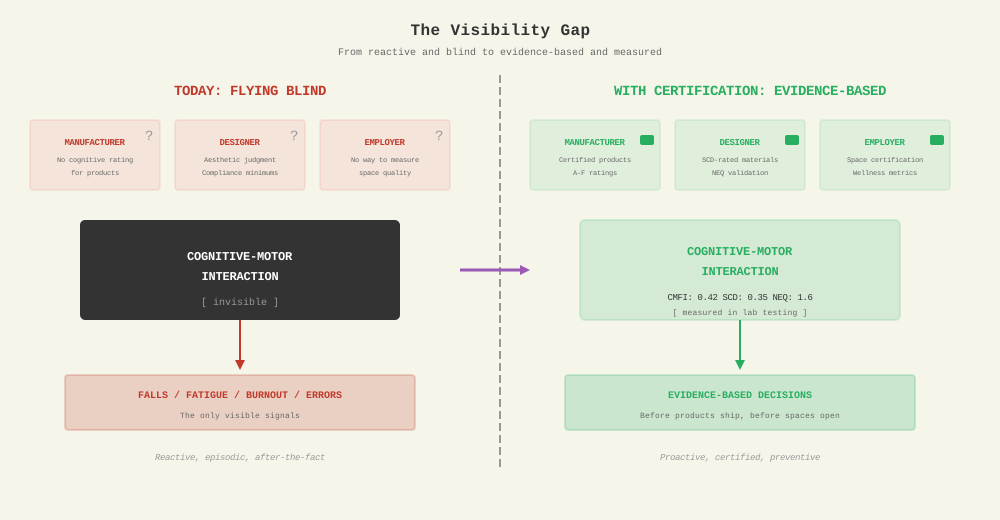
Figure 2: The visibility gap. Today, the cognitive-motor interaction between people and environments is a black box; we see only the failures (falls, fatigue, burnout, errors). With lab-based certification, the interaction becomes measurable, enabling evidence-based decisions before products ship and spaces open.
⸻
3. The Primary Index: Cognitive-Motor Fusion Index (CMFI)
The Cognitive-Motor Fusion Index is the flagship metric. It fuses neural and motor data streams into a single real-time risk score.
3.1 Mathematical Foundation
At each timestep t, the CMFI combines three components:
Where:
- θ(t) is normalized theta-band power (4-8 Hz) from EEG, a proxy for cognitive load. Theta activity rises when working memory is engaged, when attention is taxed, when the brain is doing math it does not realize it is doing.
- S(t) is step asymmetry, computed as |L - R| / (L + R) from sequential footfall activation patterns. This measures balance: symmetric steps yield low S, asymmetric steps yield high S.
- ∇S(t) is the spatial gradient of sensor activation across the sensing surface, capturing moment-to-moment instability as weight distribution shifts.
The weights α, β, and γ determine how much each component contributes. In our current implementation:
The weights sum to unity, ensuring CMFI remains bounded. These weights emerged from iterative calibration against clinician assessments and near-fall events. They are not universal constants; different populations or use cases may require retuning.
All inputs are normalized to [0,1], so the output CMFI also lives in [0,1].
3.2 Clinical Interpretation
The CMFI maps to three risk zones:
- CMFI < 0.3: Stable state. Low cognitive load, symmetric gait, minimal instability. The individual is navigating comfortably within their capacity.
- 0.3 ≤ CMFI < 0.7: Moderate load. Elevated attention, compensatory gait adjustments, heightened vigilance. The system is working harder but remains compensated.
- CMFI ≥ 0.7: High risk. Cognitive resources are saturated, balance is compromised, the probability of a near-fall or fall increases substantially. Intervention may be warranted.
The thresholds are not arbitrary. They correspond to inflection points where fall risk accelerates nonlinearly.
3.3 Sensitivity for Product Testing
The most valuable property of CMFI for product certification is its sensitivity. Because neural signatures of cognitive load shift before visible motor changes occur, CMFI can detect subtle differences between products that would be invisible to observation or self-report. A flooring pattern that slightly elevates cognitive demand might produce no observable gait change, but CMFI registers the neural cost.
This sensitivity enables meaningful product differentiation. Two flooring products might look equally safe in traditional testing, but CMFI reveals that one imposes 15% more cognitive load on older adults. That difference matters when extrapolated across thousands of steps per day, hundreds of days per year. Small cognitive taxes compound.
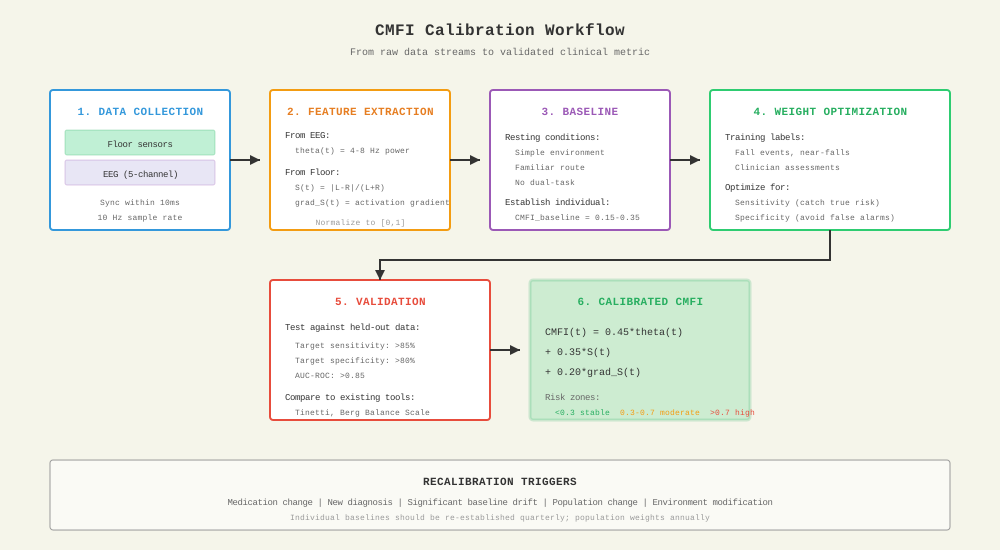
Figure 3: Calibrating the CMFI requires synchronized floor and EEG data, baseline establishment, event labeling (falls, near-falls, clinician assessments), and iterative weight optimization. The goal is a metric that balances sensitivity (catching true risk) against specificity (avoiding false alarms).
⸻
4. The Environmental Index: Spatial Cognitive Demand (SCD)
CMFI measures the person. SCD measures the place.
Every environment imposes a cognitive tax. A simple corridor with uniform lighting and minimal pattern contrast demands little. A busy intersection with reflective surfaces, competing visual flows, and irregular ground texture demands much. SCD quantifies this demand.
4.1 Components
SCD is computed from environmental features that are known to affect cognitive load during navigation:
- Pattern complexity (PC): Spatial frequency analysis of floor and wall patterns. High-frequency, high-contrast patterns increase cognitive processing.
- Luminance variance (LV): The range and rate of change in lighting. Shadows, reflections, and uneven illumination add cognitive overhead.
- Transition density (TD): The number of material, color, or texture changes per meter. Each transition requires reprocessing.
- Visual-tactile alignment (VTA): Whether what the eye sees matches what the foot feels. Misalignment (a carpet that looks like tile) creates prediction errors.
The fourth term is inverted because high alignment is good (reduces demand), so we measure its complement.
4.2 Applications
SCD enables several practical uses:
- Environment rating: Score existing spaces (hospital corridors, senior living facilities, public transit stations) on their cognitive demand.
- Design guidelines: Establish target SCD ranges for different populations. A memory care unit might target SCD < 0.3; a stimulating rehabilitation gym might intentionally target 0.4-0.6.
- Intervention measurement: Quantify the before/after impact of environmental modifications. Did replacing the checkered floor with solid color actually reduce demand?
The key insight: SCD measures neural cost independent of aesthetics. A beautiful space can have high cognitive demand; a plain space can have low demand. Visual preference and neural cost are separate axes.
⸻
5. The Efficiency Index: Neuroergonomic Efficiency Quotient (NEQ)
Some people navigate complex spaces with apparent ease. Others struggle in simple ones. NEQ captures this efficiency: how much motor performance do you achieve per unit of cognitive expenditure?
5.1 Concept
The numerator combines gait velocity, step symmetry, and stability into a composite motor score. The denominator is theta-band power (cognitive load). Higher NEQ means more efficient navigation.
A young, healthy adult in a simple environment might achieve NEQ > 2.0: good motor performance with minimal cognitive investment. An older adult with mild cognitive impairment in a complex environment might show NEQ < 0.5: modest motor performance despite high cognitive effort.
5.2 Applications
- Cross-environment comparison: How does the same individual's efficiency change across different spaces? This reveals which environments are neurally costly for them specifically.
- Rehabilitation tracking: Is therapy improving efficiency? An individual might maintain the same gait speed while reducing cognitive effort, a gain invisible to traditional measures.
- Design optimization: Which design variants maximize NEQ for the target population?
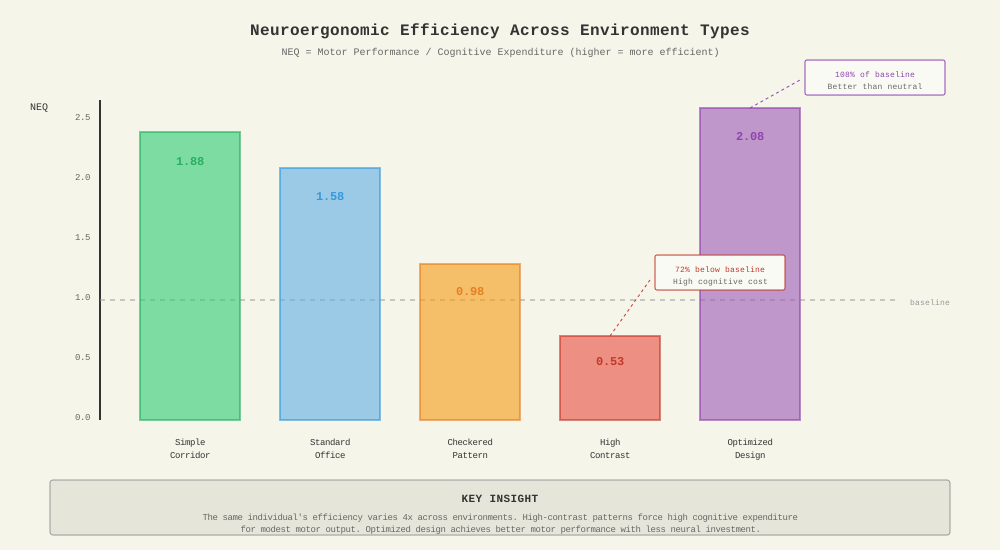
Figure 4: Neuroergonomic efficiency varies dramatically across environment types. The same individual may show NEQ of 1.8 in a standard corridor but only 0.6 in a high-contrast patterned space. Optimized environments can push NEQ above baseline by reducing cognitive demand without sacrificing motor challenge.
⸻
6. The Resilience Index: Balance Recovery Coefficient (BRC)
Steady-state stability is not the whole story. What matters clinically is often what happens after perturbation: how quickly and completely does the system recover?
6.1 Concept
BRC measures recovery dynamics following a balance challenge. When something destabilizes gait (a stumble, a visual distraction, an unexpected surface change), the floor sensors detect the activation redistribution and the EEG captures the neural response. BRC quantifies how long it takes to return to baseline.
Where amplitude is the magnitude of the initial perturbation and t_recovery is the time to return to baseline stability. High BRC means fast recovery from large perturbations: a resilient system. The ratio captures intuitive resilience: recovering quickly (small t_recovery) from large perturbations (large amplitude) yields high BRC.
6.2 Components
- Activation redistribution latency: How quickly does the center of activation return to normal gait trajectory after deviation?
- Theta spike duration: How long does elevated cognitive load persist after the challenge?
- Recovery coupling: Do motor and neural recovery happen in sync, or does one lag the other?
6.3 Applications
BRC distinguishes between individuals who fall after near-falls and those who recover. Two people might have identical steady-state CMFI, but vastly different BRC. The one with lower recovery resilience is at higher longitudinal risk.
Training interventions can be evaluated by their impact on BRC. Does balance training improve steady-state stability, recovery speed, or both?
⸻
7. The Coupling Index: Gait-Cognition Coherence (GCC)
In healthy young adults, walking is automatic. Cognitive resources are available for conversation, wayfinding, planning. In older adults or those with impairment, walking increasingly demands attention. The automaticity erodes.
GCC quantifies this coupling.
7.1 Concept
GCC measures the statistical relationship between neural rhythms and gait rhythms. When movement is automatic, the two streams are loosely correlated. When movement requires attention, they become tightly coupled.
The coherence measure captures how tightly theta-band power fluctuations are locked to the gait cycle. Alternative formulations use phase-locking value or mutual information between the EEG and floor sensor streams, but spectral coherence at the gait frequency provides a robust single-number summary.
7.2 Clinical Implications
High GCC in a simple environment suggests that walking is consuming cognitive resources that should be available for other tasks. This may be an early marker of decline, visible before gait speed or CMFI show obvious changes.
GCC also helps distinguish motor from cognitive contributions to fall risk. Two individuals with similar CMFI might have very different GCC profiles: one has a motor problem (high asymmetry, low cognitive load), the other has a cognitive problem (symmetric gait but high neural effort to maintain it). The interventions differ.
⸻
8. The Reserve Index: Cognitive-Motor Headroom (CMH)
How much capacity remains before the system enters the high-risk zone?
8.1 Concept
CMH measures the gap between current state and threshold:
If the high-risk threshold is 0.7 and current CMFI is 0.4, then CMH is 0.3. There is headroom for additional challenge before risk becomes unacceptable.
More informatively, CMH can be measured as the delta between resting CMFI (in a simple environment) and stressed CMFI (in a challenging environment):
This delta reveals how much an individual's system is stressed by environmental complexity. Someone with a small delta has reserve; someone with a large delta is already operating near capacity in simple environments.
8.2 Applications
- Pre-frailty detection: Individuals with low CMH may appear functional but have no margin for error. A minor illness, medication change, or environmental challenge could tip them into crisis.
- Environment matching: Match environment difficulty to individual capacity. Don't send someone with CMH of 0.1 into a space with SCD of 0.8.
- Training effects: Does intervention expand reserve? Track CMH over time to see if the gap between capacity and demand is growing.
⸻
9. Lab Testing Protocol
Product certification requires a standardized testing environment, representative test subjects, and rigorous measurement protocols. Our laboratory is purpose-built for cognitive-motor assessment of environmental artifacts.
9.1 Testing Infrastructure
The measurement system integrates multiple sensor modalities:
- Instrumented floor: Pressure-sensing arrays at 10 Hz with 4-inch spatial resolution covering the full test area. From this: step timing, gait asymmetry, weight distribution patterns, spatial activation gradients.
- Research-grade EEG: Multi-channel neural recording (configurations from 8 to 64 channels depending on protocol requirements) with real-time theta-band extraction. From this: cognitive load measurements, attention allocation, recovery dynamics.
- Environmental controls: Standardized lighting, temperature, and acoustic conditions. The test environment isolates the product under evaluation from confounding variables.
All streams are hardware-synchronized within 10 ms. Products under test are installed in controlled zones where test subjects complete standardized navigation tasks.
9.2 Test Subject Protocol
Certification requires testing across representative populations:
- General adults (18-64): Baseline population establishing typical cognitive-motor response.
- Older adults (65+): Population with reduced reserve, more sensitive to environmental demand.
- Mobility impaired: Individuals using assistive devices or with documented gait abnormalities.
- Cognitively impaired: Individuals with MCI or early dementia, tested with appropriate consent protocols.
Each population cohort includes sufficient subjects for statistical power. Test subjects complete tasks on both a neutral baseline surface and the product under evaluation. The difference in index scores between conditions constitutes the product's cognitive-motor impact.
9.3 Certification Report
Manufacturers receive comprehensive certification reports including:
- Population-specific scores: A-F ratings for each demographic category, with numerical index values.
- Comparative analysis: How the product performs relative to category benchmarks and competing products (anonymized).
- Index breakdown: Individual scores for CMFI, SCD, NEQ, and BRC, identifying specific strengths and weaknesses.
- Design recommendations: Where applicable, suggestions for modifications that could improve scores.
- Certification materials: Approved language and graphics for marketing use, including the NeuroSafe certification mark.
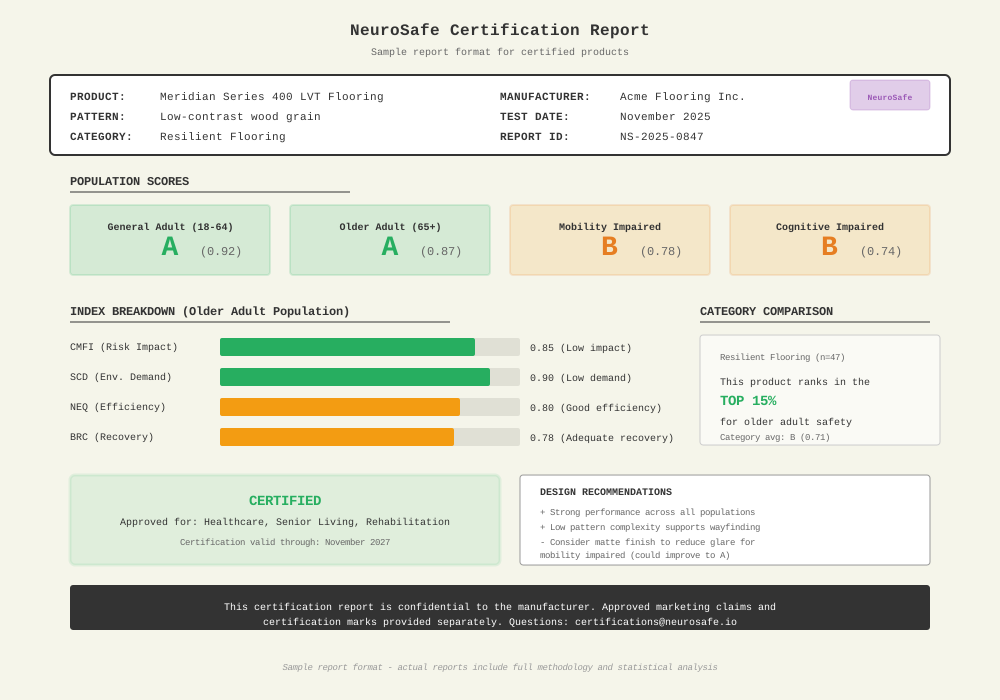
Figure 5: A certification report summarizes test results for manufacturers. Population-specific grades enable targeted marketing. Index breakdowns identify design strengths and improvement opportunities. The report becomes both a sales tool and a product development feedback mechanism.
⸻
10. Choosing the Right Index for Product Testing
Different product testing questions call for different indices. When a manufacturer submits a product for certification, the testing protocol selects indices based on what needs to be evaluated.
- "Does this product increase cognitive-motor risk?" Use CMFI. Compare test subjects' risk scores on the product versus a neutral baseline. Higher CMFI on the product indicates greater cognitive-motor burden.
- "What is the intrinsic cognitive demand of this product?" Use SCD. Quantify the product's pattern complexity, contrast, and visual-tactile properties independent of any test subject.
- "Do test subjects navigate efficiently on this product?" Use NEQ. Measure whether the product allows efficient movement or forces excessive cognitive investment for basic navigation.
- "Can test subjects recover from perturbations on this product?" Use BRC. Induce standardized balance challenges and measure recovery dynamics. Some surfaces facilitate recovery; others impede it.
- "Does this product make walking effortful?" Use GCC. Measure whether test subjects can walk automatically on the product or must devote attention to locomotion.
- "Does this product consume cognitive headroom?" Use CMH. Test subjects in baseline and challenged conditions. Products that preserve headroom score higher.
The full certification battery typically includes CMFI, SCD, NEQ, and BRC. GCC and CMH provide additional depth for premium certification tiers or specialized applications.
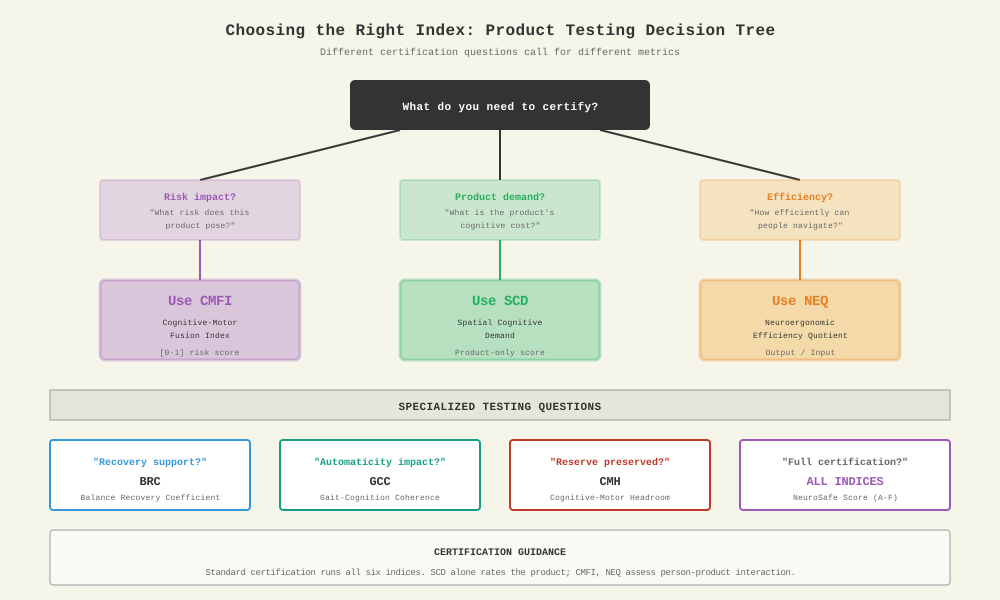
Figure 6: Different testing questions call for different indices. The decision tree guides index selection based on what aspect of cognitive-motor interaction the product affects.
⸻
11. Toward Spatial Neuroergonomics
Taken together, these indices point toward a new discipline: spatial neuroergonomics. The science of how physical environments influence neural efficiency, and how to design spaces that support rather than tax the cognitive-motor system.
The implications extend beyond fall prevention:
- Healthcare architecture: Design guidelines for hospitals, clinics, and senior living based on measurable neural cost, not just aesthetic preference or accessibility compliance.
- Rehabilitation: Environments as therapeutic tools, spaces calibrated to challenge without overwhelming.
- Aging in place: Home modifications guided by certified materials, targeting the specific environmental features that create unnecessary demand.
- Workplace design: Office environments optimized for sustained cognitive performance. Material selection that reduces background cognitive load, preserving mental resources for the actual work. Evidence-based choices between flooring options, furniture configurations, and spatial layouts.
- Retail and hospitality: Environments that welcome rather than exhaust. A store where customers can browse comfortably, a hotel lobby that orients rather than disorients.
- Educational facilities: Learning environments where the physical space supports rather than competes with cognitive engagement.
Challenge has value. It maintains capacity, prevents deconditioning, and supports engagement. The goal is to match demand to capacity, to ensure that the spaces people inhabit support their flourishing rather than their decline.
⸻
12. Who Benefits
A shared measurement language creates value across an entire ecosystem. Different stakeholders gain different advantages from standardized cognitive-motor indices.
12.1 Clinicians and Healthcare Systems
Healthcare providers benefit indirectly but substantially. When a geriatrician recommends a senior living facility, they can now ask whether the flooring and common areas are NeuroSafe certified. When a physical therapist designs a home modification plan, they can specify materials with documented low cognitive demand. When a hospital system renovates, they can require certified products in the specification. Clinicians do not use these indices as diagnostic tools for individual patients; rather, they benefit from an ecosystem where the environments their patients inhabit have been objectively evaluated. The indices enable evidence-based facility recommendations and informed advocacy for environmental improvements.
12.2 Architects and Designers
Design decisions have always affected cognitive-motor load, but designers have had no way to measure the impact. These indices close that loop. A designer can now test whether a proposed flooring pattern actually reduces demand for older adults, whether a lighting scheme improves navigation efficiency, whether a corridor layout preserves cognitive headroom. Design becomes evidence-based, with measurable outcomes rather than aesthetic intuition alone.
12.3 Manufacturers
Product differentiation in commodity markets is difficult. A flooring manufacturer competing on price alone faces constant margin pressure. But a manufacturer who can demonstrate that their product scores A for cognitive-motor safety across all populations has a specification advantage. Architects can justify the choice. Facility operators can document their due diligence. The indices create a new axis of competition: neural cost.
12.4 Facility Operators
Senior living facilities, hospitals, and rehabilitation centers face constant pressure to reduce falls and improve outcomes. These indices enable targeted material selection rather than blanket policies. Instead of replacing all flooring based on age or appearance, operators can specify products with documented NeuroSafe ratings appropriate for their population. When renovating, they can prioritize zones where current materials score poorly. Procurement becomes evidence-based: choose the certified option, document the choice, demonstrate due diligence.
12.5 Individuals and Families
For individuals making decisions about their living environments, and families helping aging parents, certification provides clarity. Which senior living facility has invested in certified flooring and furniture? Which home modifications are worth the expense? When comparing options, NeuroSafe ratings offer an objective basis for decision-making that transcends marketing claims and aesthetic impressions. Families can advocate for certified environments with data rather than intuition.
12.6 Insurers and Payers
Healthcare payers have long struggled to measure prevention. These indices make prevention legible. An insurer can incentivize facilities that specify certified materials, or offer reduced premiums for environments that meet NeuroSafe thresholds. Workers' compensation insurers can evaluate workplace environments. Outcome-based coverage becomes possible when environments can be objectively rated.
12.7 Employers and Corporate Real Estate
For organizations investing in workplace environments, these indices offer something new: objective evidence that material choices affect cognitive load. An employer renovating office space can specify certified flooring and furniture, demonstrating commitment to employee wellbeing with measurable standards rather than wellness theater. Corporate real estate teams can evaluate buildings and fit-outs against cognitive-efficiency criteria. The indices create accountability: did this renovation actually reduce environmental cognitive burden, or just look better?
12.8 Workplace Designers and Fit-Out Firms
Interior designers and fit-out contractors serving corporate clients gain a new value proposition. Rather than competing solely on aesthetics and cost, they can offer evidence-based material selection. A designer who specifies certified products can justify choices with data. A fit-out firm can differentiate by guaranteeing NeuroSafe-rated environments. The indices create a market for cognitive-conscious design services.
12.9 Commercial Real Estate Developers
Building developers and landlords can differentiate properties through certification. A Class A office building with NeuroSafe-certified common areas and recommended fit-out specifications offers tenants something competitors cannot: documented cognitive efficiency. As awareness grows, certification becomes a competitive advantage in tenant attraction and retention.
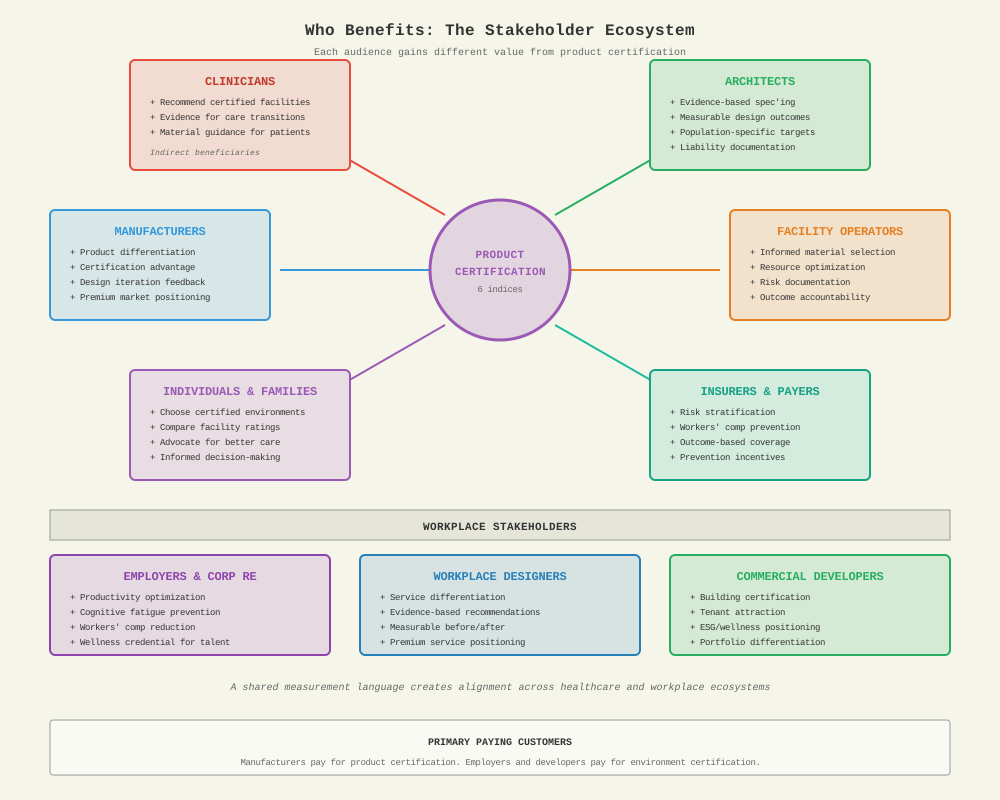
Figure 7: The index framework creates value across an ecosystem of stakeholders. Each audience gains different benefits, but all share a common measurement language that enables coordination and accountability.
⸻
13. Product Certification: The NeuroSafe Score
If these indices can measure environments, they can also rate products. Every flooring pattern, furniture design, wall color, and lighting fixture contributes to the total cognitive demand of a space. Manufacturers of these products currently have no objective way to know whether their designs support or tax the cognitive-motor system. That gap creates an opportunity.
13.1 The Certification Framework
The NeuroSafe Score translates our index framework into a product rating system. Manufacturers submit products for laboratory testing. We install the product in a standardized environment and measure cognitive-motor response across a representative population using synchronized EEG and floor sensors.
The testing protocol captures:
- CMFI response: How much does the product elevate cognitive-motor load compared to a neutral baseline?
- NEQ impact: How does the product affect navigation efficiency?
- BRC effect: Does the product interfere with balance recovery after perturbation?
- GCC shift: Does the product increase the cognitive effort required for automatic movement?
These measurements are aggregated into a single NeuroSafe Score on an A-F scale, computed separately for different populations: general adults, older adults (65+), mobility impaired, and cognitively impaired individuals.
13.2 Product Categories
The certification framework applies to any environmental artifact that influences spatial cognition:
Flooring: Pattern complexity, contrast ratio, texture, visual-tactile alignment, transition density. A high-contrast checkered pattern might score well for general adults but poorly for older adults with cognitive impairment. A low-contrast textured solid might score A across all populations.
Furniture: Shape legibility, edge contrast, height appropriateness, stability cues, and layout navigation cost. Furniture that blends into backgrounds or creates ambiguous edges increases cognitive load. Furniture with clear visual boundaries and predictable placement reduces it.
Lighting and Walls: Luminance uniformity, color contrast with adjacent surfaces, shadow patterns, and depth perception cues. Uneven lighting creates cognitive overhead. Walls that provide clear spatial reference reduce disorientation.
Space Designs: Entire room configurations can be certified. A hospital corridor layout, a senior living common area, a rehabilitation gym: each can receive a composite score based on how all elements interact.
13.3 The Business Case
Manufacturers gain several advantages from NeuroSafe certification:
- Differentiation: In commodity markets, a NeuroSafe A rating distinguishes products that otherwise look similar.
- Specification advantage: Architects and designers increasingly face requirements to reduce fall risk and support cognitive health. A certified product simplifies specification.
- Liability protection: Products with documented cognitive-motor profiles provide defensible design choices.
- Premium positioning: Products optimized for vulnerable populations (memory care, rehabilitation) command higher margins.
The certification also creates a feedback loop for product development. Manufacturers can test prototypes, identify cognitive-motor weaknesses, and iterate before production. The indices become design tools, not just evaluation tools.
13.4 Score Interpretation
A NeuroSafe Score is not a single number but a profile:
| Product: Meridian Series 400 LVT Flooring |
| Pattern: Low-contrast wood grain |
| NeuroSafe Scores: |
| General Adult (18-64): A (0.92) |
| Older Adult (65+): A (0.87) |
| Mobility Impaired: B (0.78) |
| Cognitive Impaired: B (0.74) |
| Certified for: All populations |
| Recommended use: Healthcare, senior living, rehabilitation |
The score reflects how much cognitive headroom a product preserves for each population. An A rating means the product imposes minimal cognitive demand, leaving capacity available for other tasks. A D or F rating means the product consumes significant cognitive resources, reducing safety margins.
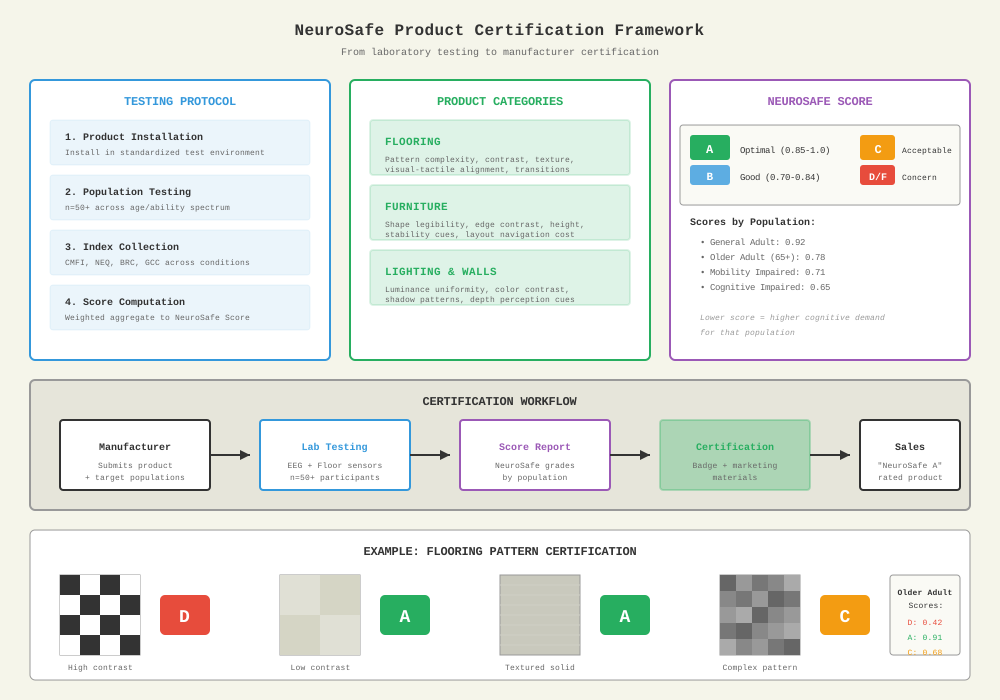
Figure 8: The NeuroSafe certification framework: from laboratory testing through manufacturer certification. Products receive population-specific scores that manufacturers can use in sales and specification materials.
⸻
14. Quick Reference
For readers who want a single-page summary, the following table captures all six indices at a glance. Each index answers a different question, operates on a different scale, and serves a different purpose. Together, they form a vocabulary for measuring what has long been unmeasurable.
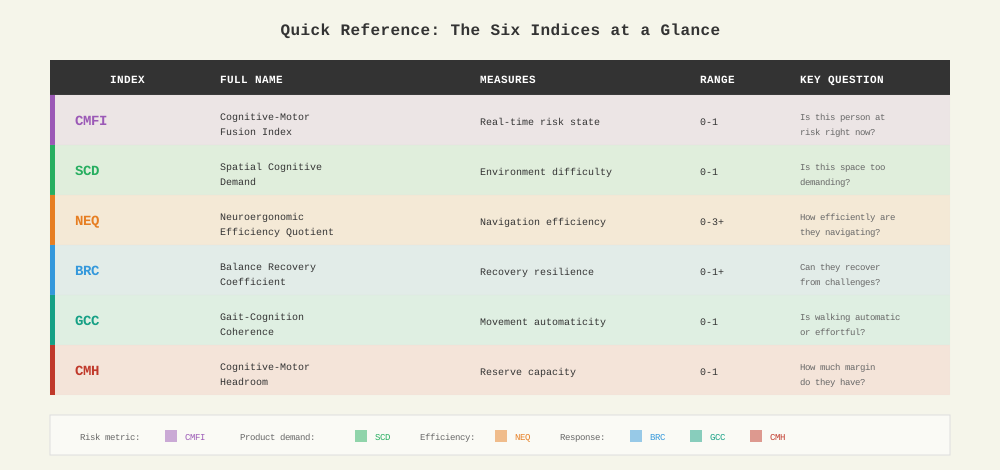
Figure 9: The complete index family at a glance. CMFI serves as the primary cognitive-motor risk metric. SCD measures the environment independent of the person. NEQ captures efficiency. BRC, GCC, and CMH provide deeper diagnostic insight into resilience, automaticity, and reserve capacity.
The indices are designed to be used in combination. A product certification might use the full battery: CMFI for overall risk impact, SCD for intrinsic environmental demand, NEQ for navigation efficiency, BRC for perturbation recovery. A designer might optimize for SCD across populations while validating with NEQ testing. A manufacturer might certify products using the standard battery, then market the headline grade.
No single index tells the whole story. But together, they make visible what has always been present: the continuous, consequential dialogue between minds, bodies, and the spaces they inhabit.
⸻
Closing Thought
The dialogue between brains, bodies, and buildings has always existed. We are only now learning to listen.
These indices are an attempt to translate that dialogue into a language that manufacturers, architects, employers, and healthcare providers can understand and act upon. They compress the rich, noisy, continuous stream of embodied cognition into numbers that mean something.
These numbers compress embodied cognition into a lens for action. Like blood pressure or temperature, they sacrifice fidelity for utility. What they gain in return is actionability: the ability to compare, track, intervene, and verify.
The built world can become an ally of human cognition, supporting both the aging mind and the productive worker, but only if we can measure the conversation. These indices are a first vocabulary.