Modern medicine has given us precision at the level of molecules but amnesia at the level of families.
Every generation starts from scratch: we fill out intake forms that ask what killed our grandparents, answer with foggy recollections, and then proceed as if biology resets itself with each birth. The truth is, human health is a continuous data stream pretending to be discrete. Our lives are nodes on a multi-generational trajectory of biology, behavior, and environment but the recordkeeping stopped at anecdote.
Myome's hereditary health artifact is an attempt to restore continuity. It's a new kind of digital object: a structured, cryptographically signed health record designed for multi-generational transfer, a lineage-level health dataset, portable and precise. This is real infrastructure for a future where families can inherit understanding alongside genes.
I. The Loss Function of Memory
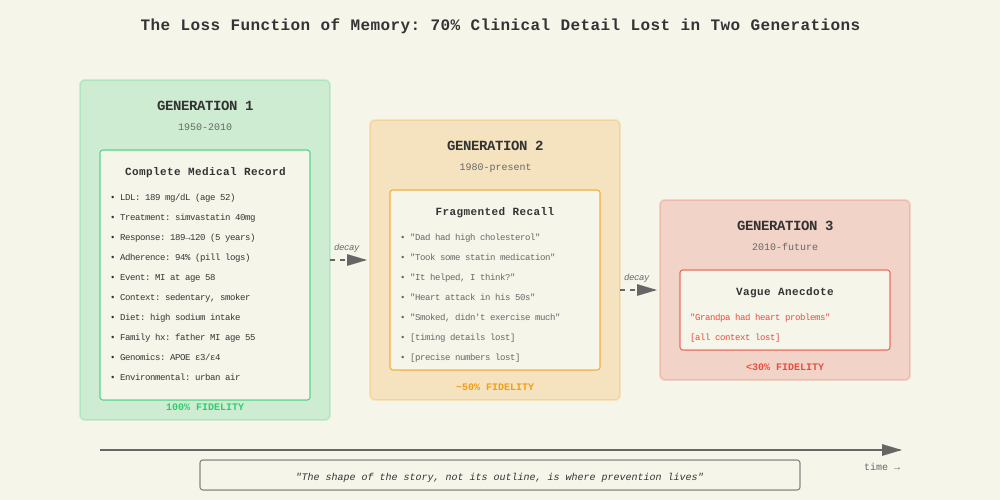
Family health history has always been an oral tradition with a brutal error rate. Studies show that within two generations, more than 70% of clinical detail is lost to time or confusion. "Grandpa had heart problems" differs vastly from LDL 189 at age 52, treated with simvastatin, reduction to 120 over five years, myocardial event at 58 despite good adherence.
That difference (the shape of the story rather than its outline) is where prevention lives. The problem is structure and continuity, which we have in abundance as raw data. Hospitals record, yet they fail to remember.
The hereditary artifact treats health information like genomic capital: something to be preserved, versioned, and transferred with integrity.
II. Building a Durable Record of the Living
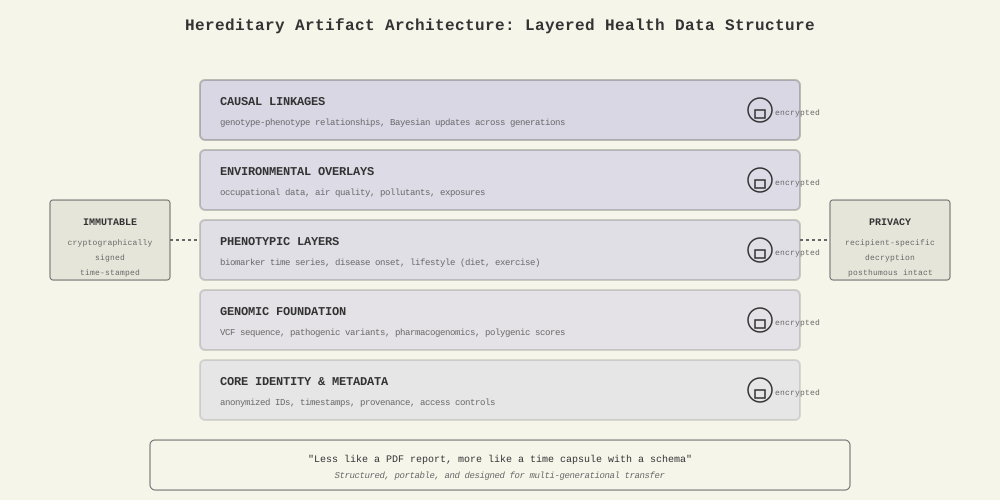
In Myome, each hereditary artifact is an immutable, signed package containing genomic data, longitudinal biomarkers, phenotype trajectories, and environmental context. It's less like a PDF report and more like a time capsule with a schema.
Its architecture includes:
- Core identity & metadata: anonymized identifiers, timestamps, provenance, and access controls.
- Genomic foundation: VCF sequence, pathogenic variants, pharmacogenomic markers, polygenic risk scores.
- Phenotypic layers: biomarker time series, disease onset markers, and lifestyle annotations (exercise, diet, exposure).
- Environmental overlays: occupational data, air quality indices, local pollutant levels, and other contextual inputs.
- Causal linkages: genotype-phenotype relationships built through Bayesian updating across generations.
Each layer is sealed and encrypted for specific recipients, meaning a descendant can decrypt only what is relevant, while privacy (even posthumously) remains intact.
III. Turning Lineage into Signal
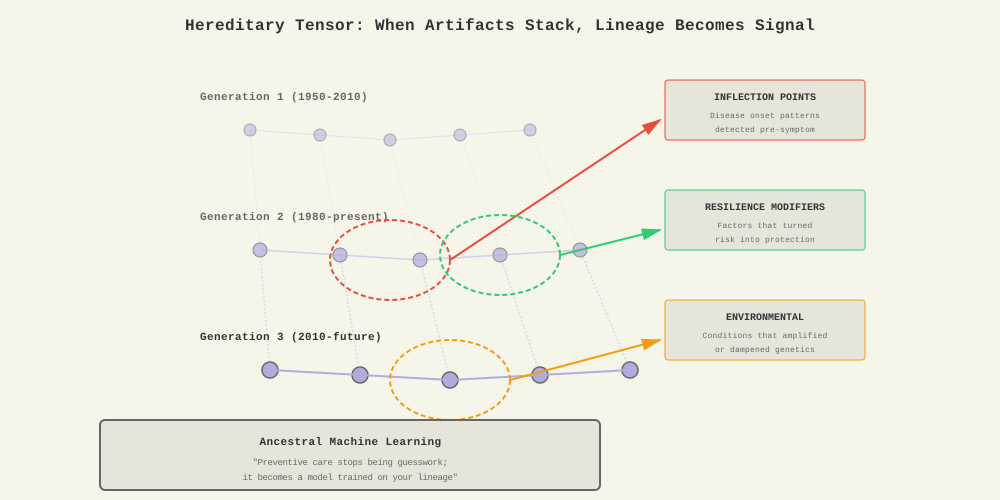
When these artifacts stack, they become a hereditary tensor: a structured dataset across generations that makes familial health computable.
Patterns emerge that no single lifetime could reveal:
- The inflection points before chronic disease.
- The modifiers that turned risk into resilience.
- The environmental conditions that amplified or dampened genetic predispositions.
Imagine a future clinician querying a secure model trained on your lineage instead of asking "What runs in your family?" Preventive care stops being guesswork; it becomes ancestral machine learning.
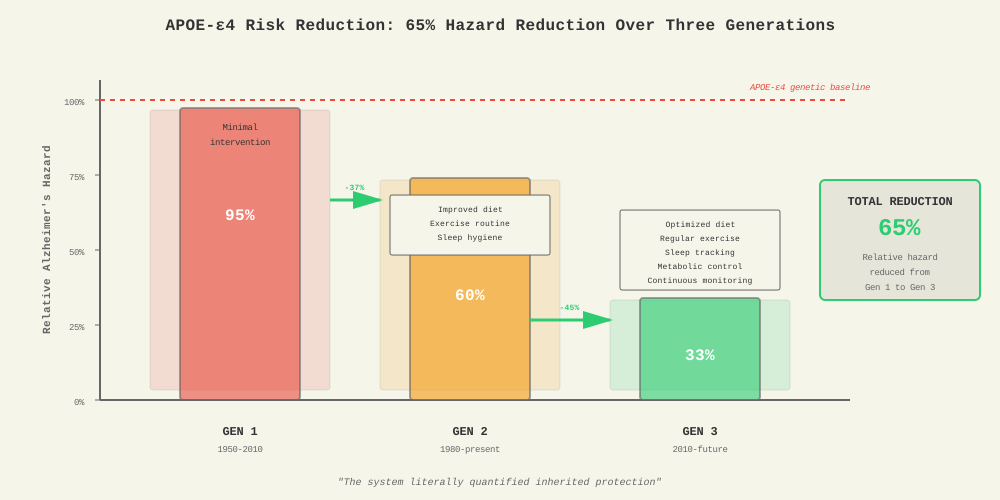
Consider a hypothetical: a family carrying APOE-ε4 risk for Alzheimer's tracked across three generations. If each generation documented their lifestyle interventions (diet, sleep, metabolic control) alongside cognitive outcomes, the system could quantify how inherited protection compounds. Early models suggest this kind of multigenerational feedback could reveal relative hazard reductions of 50-70% compared to baseline genetic risk, turning anecdote into actuarial insight.
IV. Why Now
We are entering a new phase of health computation: sensors capture thousands of biomarker points per week, genomes are cheap, and longitudinal data can be stored indefinitely. Yet without continuity, these fragments will vanish in the noise.
The hereditary artifact exists because the temporal scope of medicine is too short. Electronic health records treat death as a hard stop. Myome treats it as a handoff.
What this enables is profound:
- Families can inherit baselines instead of risks.
- Generational data can teach algorithms to predict disease decades before onset.
- Societies can study health evolution through time-linked individual biology rather than epidemiology alone.
This is about engineering memory into healthcare, beyond mere nostalgia for lineage.
V. The Philosophy of Inheritance
In biology, inheritance is transmission through code: DNA as the original database. Myome extends that principle into the informational layer: data that captures how life interpreted what genes say.
If a genome is a blueprint, a hereditary artifact is the annotated archive of how that blueprint was lived.
It reframes ancestry as documentation rather than destiny. It acknowledges that health, like culture, is cumulative and that continuity is the only way to make prevention exponential.
VI. The Road Ahead
My goal is to make hereditary artifacts a standard health primitive, something that every family can maintain, query, and pass on.
I'm open-sourcing the toolkit, publishing the schema, and designing privacy layers that make inheritance compatible with autonomy. The vision is durable decentralization: knowledge that survives institutions, platforms, and even lifetimes.
Because one day, your great-grandchild should inherit more than your DNA. They should inherit the evidence of what you learned by living in it.
We lack a cultural language for multi-generational data stewardship. That's fine. The goal of Myome is to leave better traces for whoever comes next.