Most of the systems we care about are not stable in the way we pretend.
They look stable because they change slowly. They look continuous because the measurements we take are coarse. They look predictable because the present resembles the recent past.
Then one day they do something discontinuous.
A neighborhood feels normal until it does not. A market trends until it snaps. A patient "seems fine" until they are not. A building operates smoothly until a small stressor cascades into a shutdown. A team functions until it fractures.
We typically narrate these events as surprises. The more honest description is that we were staring at a system that had already moved into a new internal regime, and we did not have the language or instrumentation to notice.
That is what I mean by a latent phase transition.
A phase transition is more than a dramatic event. It marks a change in the rules of behavior. In physics, water and ice are the same molecules in different regimes, governed by different constraints. Water becoming ice illustrates something deeper: the system crosses a boundary where new macroscopic behavior becomes inevitable.
The word latent matters here. Many systems cross boundaries invisibly. The shift happens in hidden state, not on the surface. You do not see the transition when it occurs. You see it later, when the output becomes undeniable.
This essay is an attempt to name the pattern as a practical frame for how we design sensors, models, and institutions in a world where the most important changes are often regime changes.
1. Why Discontinuity is the Default
Human intuition likes linearity. We want causes and effects to scale smoothly. If inputs change by 10 percent, we expect outputs to change by something like 10 percent. That expectation is not irrational. It is a survival strategy. In many everyday settings, it works well enough.
But the systems that matter at scale are rarely linear. They are networked, delayed, and coupled. They contain feedback loops. They store energy and information. They operate far from equilibrium.
Those are the conditions where phase transitions emerge.
A crowd becomes a stampede when the coupling between people crosses a threshold. A supply chain fails when buffering and redundancy drop below a critical level. A body enters a new health regime when compensatory systems exhaust.
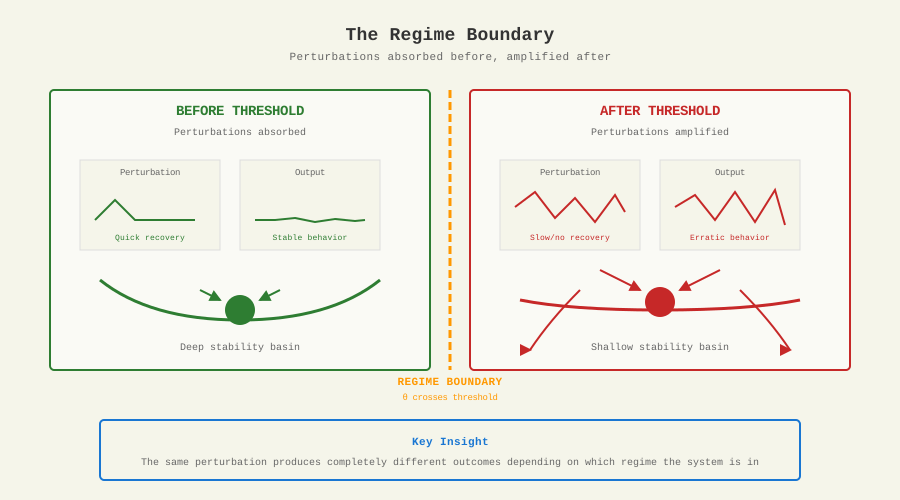
The common structure is this: there exists a boundary in state space where small perturbations stop being absorbed and start being amplified.
Once that boundary is crossed, the system behaves like a different object.
2. Latency: The Hidden Regime Shift
In textbook phase transitions, you often see the temperature crossing a point and a new phase appearing immediately. In real-world systems, the transition can be delayed or masked.
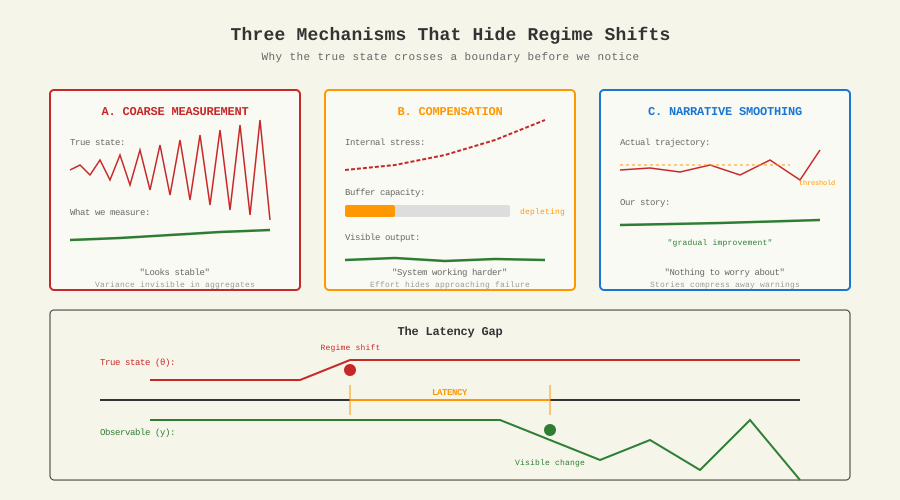
Three mechanisms create latency.
A. Coarse Measurement
We measure what is easy rather than what is structural. Many systems have internal variables that matter more than their outputs, but we only observe outputs. This is like judging the stability of a bridge by its color.
B. Compensation
Complex systems contain buffers. People compensate, buildings compensate, organizations compensate. Compensation hides regime shifts. The system works harder to appear normal.
C. Narrative Smoothing
When we observe a system, we interpret it through stories. Stories are compressions. They smooth variance. They turn gradients into categories. That cognitive compression is useful, but it blinds us to slow movement toward thresholds.
Latent phase transitions are what happens when the true state crosses a boundary but the surface behavior remains within acceptable limits for a while.
The world feels normal. The error terms are growing. The buffer is thinning. The slope is changing.
Then the visible layer catches up.
3. A Technical Definition That is Still Approachable
You can treat a system as a dynamical process with state xt, observations yt, and parameters θ that may change over time.
- xt is what the system really is, including hidden variables.
- yt is what we can measure.
- θ encodes the governing regime.
A latent phase transition is a change in θ that is not directly observable through yt until later.
Formally, it is a regime switch in the latent dynamics:
xt+1 ~ p(xt+1 | xt, θt)
where θt shifts from one regime to another, but the observation function
yt = g(xt) + εt
does not immediately reveal that shift.
This is the core technical problem hiding inside many human surprises. Our sensors and models are often trained to predict yt, not to infer θt. We become good at interpolation inside a regime and bad at detecting regime change.
4. Early-Warning Signals: Variance, Not Mean
When people look for change, they look for a drift in averages. They look for a rising temperature, a rising error rate, a rising complaint count.
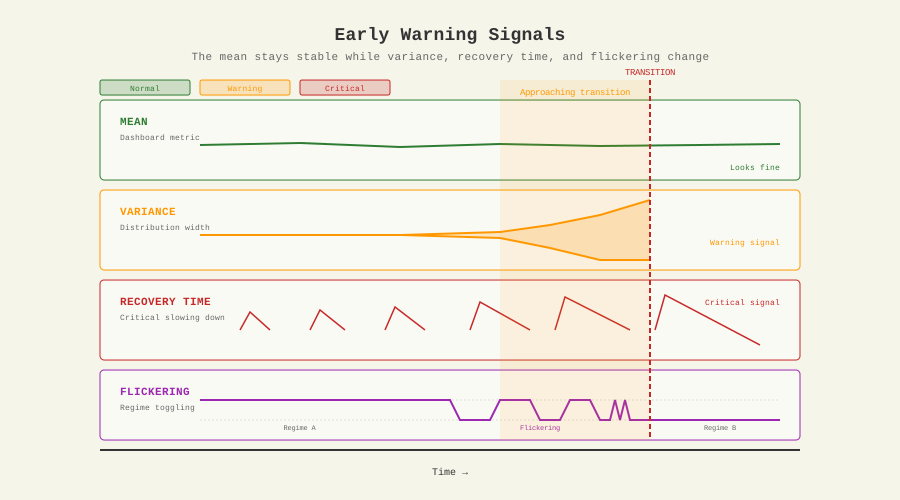
In many phase transitions, the mean stays steady while the variance changes first.
This shows up in several well-studied forms:
- Critical slowing down: the system returns to equilibrium more slowly after small perturbations.
- Rising autocorrelation: today's deviation predicts tomorrow's deviation more strongly.
- Variance inflation: the distribution widens even if the mean remains stable.
- Flickering: the system toggles between old and new regimes before committing.
These are measurable. They are also easy to miss if you only track the dashboard metrics that look like means.
A practical takeaway: if you want to detect latent regime shifts, watch the microstructure of behavior. Watch how quickly the system recovers from small stress. Watch how the tails behave.
5. Why This is a Design Problem
Most of our sensing and analytics infrastructures are built as if the world is stationary. Collect data, train a model, deploy, monitor drift, retrain.
That works for gradual change. It breaks for regime change.
In a world where latent phase transitions matter, you need systems designed to:
- Infer latent regimes, not just outputs
- Track uncertainty honestly
- Treat tails as first-class signals
- Preserve enough context to recognize a new phase
This shifts what "good measurement" means.
High-resolution sensors are not valuable only because they provide more data. They are valuable because they reveal variance, recovery times, micro-failures, and patterns that disappear in averages.
This is one reason large-area sensing in physical environments is so interesting. The built world is full of slow transitions: wear, fatigue, crowding patterns, shifting usage, evolving risk. These transitions are not always visible to human observers, because humans see snapshots and stories. A system that measures continuously can see the approach to a threshold.
Not perfectly. But earlier.
6. A Manifesto Claim: History is a Sequence of Hidden Regime Changes
We often treat history as a chain of events. Wars, inventions, crises, elections, recessions.
But many of these are surface manifestations of latent shifts. The internal regime changes first: trust decays, institutions lose legitimacy, inequality rises, supply chains become fragile, belief networks polarize, local incentives distort behavior.
Then an event arrives that reveals what was already true.
If this is correct, then the next frontier is inference of regimes rather than prediction of events. Understanding when a system has moved into a new phase before the event occurs.
That means humility with better instruments rather than omniscience.
7. Latent Phase Transitions and the Compressibility of Reality
Earlier we talked about the compressibility of reality: the fact that we compress the world into simplified representations because full fidelity is impossible.
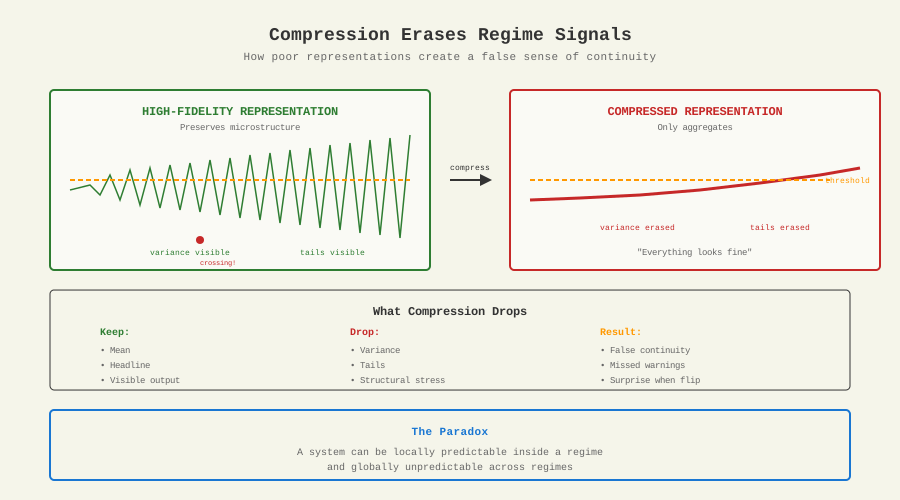
Phase transitions are where compression becomes most dangerous.
When you compress a system too aggressively, you erase the very signals that indicate a regime boundary. You keep the mean, you drop the variance. You keep the headline, you drop the tails. You keep the visible behavior, you drop the structural stress.
Then you are surprised when the system flips.
In other words, poor representations can create a false sense of continuity, beyond merely reducing accuracy.
A system can be locally predictable inside a regime and globally unpredictable across regimes. Many models fail because they excel at the first and ignore the second.
8. What to Do With This Idea
If latent phase transitions are real and common, then the agenda is practical.
- Build sensors and data systems that preserve microstructure, not only aggregates.
- Build models that detect regime boundaries, not only forecast values.
- Build institutions that treat early variance as meaningful, not as nuisance.
- Build operational habits that assume the possibility of sudden phase shifts.
At an individual level, it becomes a way to interpret the world with less surprise and more agency. Ask: what regime am I in. What regime is my team in. What regime is this market in. What regime is this building in.
At a societal level, it becomes a new literacy. Not just "what happened," but "what boundary did we cross."
Closing Thought
We are trained to think in stories, metrics, and smooth curves. But the systems we live inside often behave like matter near a critical point: stable until suddenly not, resilient until abruptly brittle, normal until the internal regime has already changed.
Latent phase transitions are a warning about how we perceive, a demand for better measurement, and an argument for models and institutions that take regimes seriously.
The most important changes in the world may arrive first as a subtle change in the laws of motion, rather than announcing themselves as events.