Cities look like concrete, steel, glass, and traffic. To the human eye, they are networks of roads, buildings, lobbies, corridors, elevators, subway platforms. To microbes, cities are landscapes.
Every step, every door handle, every escalator rail, every floor tile is part of a vast, mostly unmapped microbial terrain. People constantly reseed this terrain as they move through it. Skin, shoes, clothing fibers, breath, spills, dust. Each leaves a trace. Each trace travels.
For years, microbiologists have been telling us that indoor spaces have distinct microbiomes shaped by occupancy, ventilation, moisture, and material choices. Hospitals carry one signature. Offices another. Homes another. But most of that work has treated space coarsely: samples from a room, a ward, a building.
Now we are approaching a world where movement is measurable at millimeter and millisecond scales. High resolution floor sensors can reconstruct walking paths, dwell time, turning behavior, and occupancy patterns across millions of square feet. Once you can see the flows, you can start to ask a new kind of question.
What if we treated cities as microbial maps, and human movement as the pen that draws them?
⸻
1. Surfaces as Microbial Terrains
The first step is a conceptual shift.
Instead of thinking of a lobby floor as "clean" or "dirty," imagine it as a terrain with gradients:
- some zones are constantly reseeded by thousands of shoes
- some corners are quiet microbial refuges
- some thresholds mix populations from different buildings, transit lines, or neighborhoods
- some patches stay damp longer, or warmer, or shaded
Every surface becomes a habitat with:
- sources (where microbes arrive from people, air, or plumbing)
- sinks (where they die off faster due to cleaning, UV, dryness, or temperature)
- corridors (paths that continuously connect one habitat to another through foot traffic)
From that perspective, human movement functions as transport.
Walkers, wheelchairs, carts, strollers, luggage wheels, cleaning equipment. All act as mobile vectors that drag microbial material along specific paths and across specific interfaces.
A long hallway with a single dominant route becomes a microbial conduit.
A branching corridor with many side rooms behaves like a dispersal tree.
A stairwell that only staff use becomes a quiet, specialized niche.
If you could watch all of this as a movie, the microbes would look like colored smoke being pulled along invisible streams.
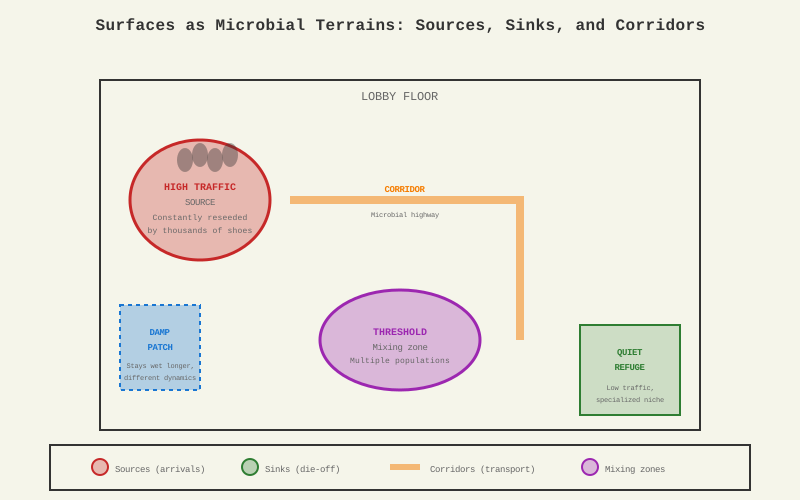
Figure 1: A lobby floor reimagined as microbial terrain. High traffic zones act as sources (constantly reseeded), quiet corners become refuges (specialized niches), corridors function as transport highways, and thresholds create mixing zones where multiple populations interact. Movement transforms surfaces from static to dynamic ecosystems.
⸻
2. Movement as the Missing Layer
We already know that built environments have microbial fingerprints. HVAC, window opening, occupant density, and materials all matter. But something critical has been missing.
The dynamic part: how people actually move.
High resolution floor sensing offers that layer. A dense pressure grid in the underlayment can tell you:
- where every step lands
- which paths dominate
- where people slow down or pivot
- where bottlenecks, queues, and gatherings form
- how patterns change by time of day, weather, or event
Once you have that, you can begin to imagine a "microbial transport model" that looks suspiciously like a traffic model:
- each footstep becomes a potential transfer event
- each route has a probability of carrying material from zone A to zone B
- each dwell zone becomes a mixing region where communities interact longer
- each cleaning pass becomes a reset operation with some efficiency, not an absolute wipe
This is where sensored flooring becomes a foundation for microbial cartography.
The floor sees the flows that microbes ride on.
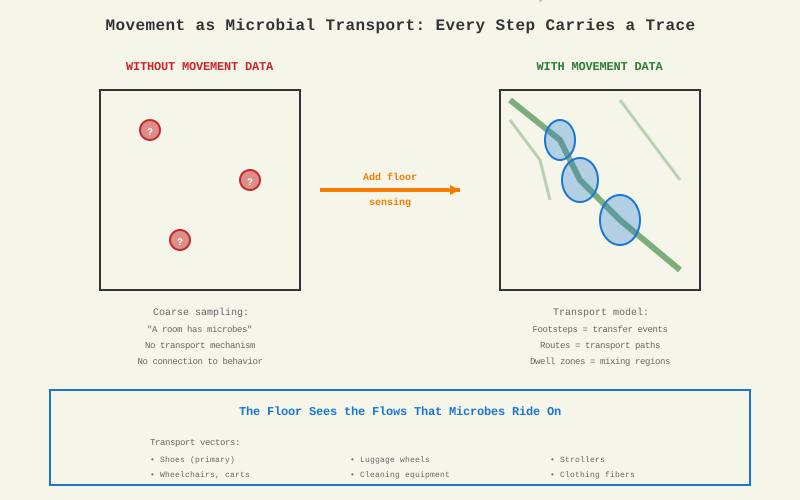
Figure 2: Without movement data, microbial sampling is coarse: "a room has microbes" with no connection to behavior. With high-resolution floor sensing, every footstep becomes a transfer event, routes become transport paths, and dwell zones become mixing regions. Shoes, wheelchairs, carts, and cleaning equipment all act as mobile vectors dragging microbial material along specific paths.
⸻
3. The Loop Between Behavior and Biology
Humans and microbes are locked in a feedback loop, even if we rarely notice it.
- People choose paths based on friction, lighting, signage, obstacles, and habit.
- Those choices determine where microbes accumulate, mix, and persist.
- Those microbial patterns, in turn, influence risk: infection, food safety, contamination.
- Perceived risk and hygiene norms then feed back into cleaning practices, layout changes, and behavior.
Without data, this loop is dominated by stories:
- "That entrance always feels gross."
- "No one uses that side corridor."
- "We clean this area enough."
Stories are often wrong.
With movement data and periodic microbial sampling, you can start correlating:
- path intensity with microbial load
- event types with community shifts
- climate conditions with persistence
- cleaning schedules with actual reset effectiveness
You may find that a rarely cleaned corridor that few people use is relatively safe, while a well-cleaned but constantly trafficked junction remains a persistent hotspot.
Behavior shapes biology, and biology shapes behavior. Measuring one without the other hides half the picture.
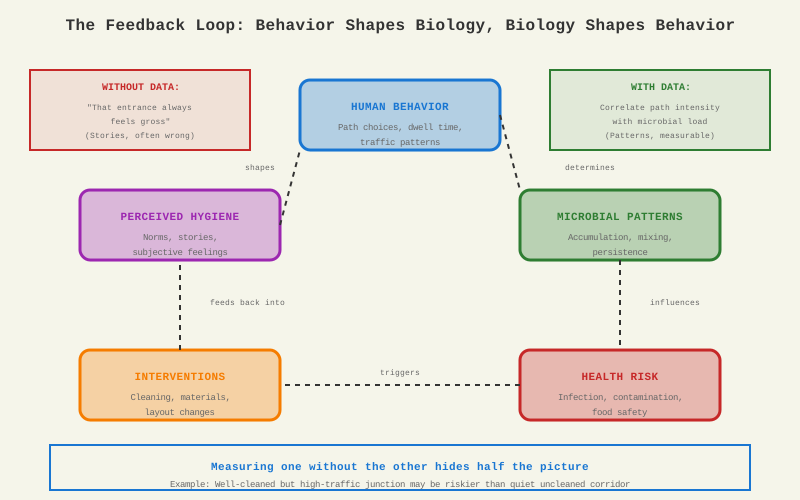
Figure 3: Human behavior determines microbial patterns (accumulation, mixing, persistence), which influence health risk, triggering interventions (cleaning, materials, layout changes), shaping perceived hygiene, which feeds back into behavior. Without data, this loop is dominated by stories that are often wrong. With movement data and microbial sampling, you can correlate path intensity with actual microbial load.
⸻
4. Indoor Microbiomes as City-Scale Systems
We are used to thinking about city microbiomes outdoors: sewage, air, soil, water. Indoor microbiomes are just as real, but more tightly entangled with us. We spend most of our lives inside them.
Now imagine using spatiotemporal movement maps at city scale:
- hospital networks
- transit hubs
- schools and universities
- senior living facilities
- office towers and co-working spaces
- convention centers and arenas
Each node has:
- a characteristic microbial signature
- inflows and outflows of people from other nodes
- time-dependent occupancy waves
Given:
- who comes from where,
- when, and
- how they move inside,
you can begin to model citywide microbial exchanges.
Not at the level of "which bacterium is on which tile every second," but at the level of:
- which routes act as microbial highways
- which buildings are net sources vs net sinks for certain communities
- how daily commuting creates loops that continually re-mix neighborhoods
Microbial cartography then looks like a layered map:
- base layer: floor plans and surfaces
- behavioral layer: movement flows and densities
- biological layer: community composition in key zones over time
It is the same logic as traffic modeling, applied to invisible passengers.
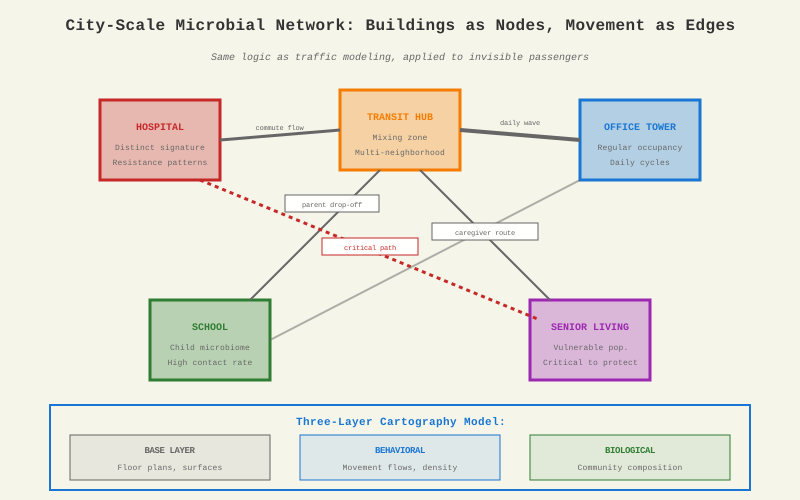
Figure 4: Buildings as nodes in a citywide microbial network. Hospitals have distinct signatures, transit hubs act as mixing zones, offices show daily cycles, schools have high contact rates, and senior living facilities need critical protection. Movement between nodes creates microbial highways. The three-layer model combines base (floor plans), behavioral (movement flows), and biological (community composition) data.
⸻
5. Cleaning as a Targeted Intervention, Not a Blanket
When you cannot see the patterns, cleaning becomes a blunt instrument. You sanitize everything as often as budgets allow, or you follow rigid schedules that have more to do with labor constraints than biological reality.
Microbial cartography suggests something different:
Treat cleaning as a precision intervention shaped by observed patterns.
If you know:
- where high-risk loops exist (for example, between an isolation ward and a cafeteria route),
- where dwell and mixing zones are strongest,
- where rare but critical flows occur (night shift routes, emergency transfers),
you can:
- focus disinfection where it breaks the most important chains
- adjust materials in key nodes (more antimicrobial surfaces, better drainage, different flooring friction)
- time cleaning to coincide with low-occupancy windows when it is most effective
There is also a crucial counterpoint.
Over-sterilizing environments can damage beneficial microbiomes, increase resistance, and weaken immune training, especially for children. A movement-aware microbial model allows for selective interventions:
- protect the vulnerable and the critical
- leave low-risk, low-contact zones to follow more natural dynamics
The goal centers on managing microbial risks with the same finesse we try to apply to traffic or energy.
⸻
6. Early Warning from Weak Signals
Major outbreaks are rare. Weak signals are constant.
Small shifts in:
- which rooms see unusual clustering of visitors
- which surfaces stay damp longer than they should
- which corridors suddenly see late-night traffic from new sources
can all indicate:
- emerging infection patterns
- maintenance issues that create microhabitats for pathogens
- behavior changes that alter exposure risk
A high resolution movement map can flag these weak structural signals. Occasional microbial sampling can check whether those patterns correlate with actual biological shifts.
Over time, this supports early warning systems:
- sensitive to deviations from normal coupling between movement and environment.
For example:
- If a specific route connecting a dialysis unit and a common area suddenly sees more cross-traffic, that may deserve scrutiny long before anyone reports a cluster.
- If a cleaning pattern changes and leads to unusual re-colonization of a surface, that can be tuned before it becomes a headline.
Steps function as structural hints rather than disease forecasts.
⸻
7. Buildings as Microbial Observatories
There is a strange and exciting possibility hidden inside all this.
If we treat instrumented buildings as microbial observatories, they become:
- laboratories for studying how human behavior shapes invisible ecosystems
- testbeds for smart cleaning regimes
- living experiments in how material choices influence biological resilience
Imagine:
- hospitals where floor sensors, sampling points, and HVAC data feed into a common model of microbial flow
- senior living facilities where gait changes, movement patterns, and microbiome dynamics are studied together
- schools where interventions in layout, ventilation, and cleaning are evaluated not just on absenteeism, but on the structure of indoor microbial communities over semesters
The built world becomes part of the scientific apparatus.
There is no reason this must feel dystopian. Done right, it feels like hygiene catching up to the complexity of modern environments, with:
- better protection for vulnerable groups
- less waste in over-cleaned, over-chemical spaces
- more understanding of the indoor ecologies we inhabit every day
⸻
8. Ethical and Practical Constraints
Of course, this is not just a technical game.
Microbial cartography intersects with:
- privacy (movement traces are sensitive, even if anonymized)
- consent (occupants should know how their environments are instrumented)
- equity (which neighborhoods or buildings get instrumented first)
- biosecurity (what happens if pathogen mapping data is misused)
The point of mapping centers on understanding and managing patterns.
Any realistic implementation would need:
- rigorous anonymization
- transparent governance
- guardrails around pathogen-specific tracing
- clear limits on how data can be linked to individuals or groups
If done poorly, microbial cartography becomes another surveillance vector.
If done well, it becomes a public health and design tool.
⸻
Closing Thought
Cities have always had microbial geographies. We just did not see them.
Human movement acts as an invisible brush, painting bacterial, fungal, and viral patterns across the surfaces we build. Every day, the canvas refreshes. Every step contributes.
High resolution spatiotemporal sensing does something subtle but profound. It gives microbes structure, turning vague notions of "germs in buildings" into mappable relationships between behavior, materials, and biology.
Treat indoor surfaces as microbial terrains.
Treat movement as transport.
Overlay measurement with care.
What emerges is a new layer of urban intelligence, one where the health of a building is not just its energy score or its occupancy rate, but the way it manages the invisible life that shares it with us.