In the past, examples were proof.
A well chosen illustration could anchor an argument, clarify a concept, or convince an audience. The example served as a bridge between abstraction and understanding. You pointed to something concrete and said, "Look. There. That is what I mean."
This worked because examples were scarce.
Generating them required effort. Selecting them required judgment.
Their scarcity gave them weight.
That scarcity is gone.
Modern generative systems can create examples on command. They can generate instances of any category, edge case, counterexample, or hypothetical scenario. They can illustrate patterns that never occurred in the real world, but could have. They can fabricate distributions, anomalies, near misses, and perfect exemplars. They can fill any conceptual space with endless synthetic detail.
This creates a new cognitive condition.
When every pattern can be illustrated, the illustrative loses its force.
Examples become infinite. Evidence becomes ambiguous.
This is the paradox of infinite examples.
⸻
1. Examples Used to Filter Hypotheses
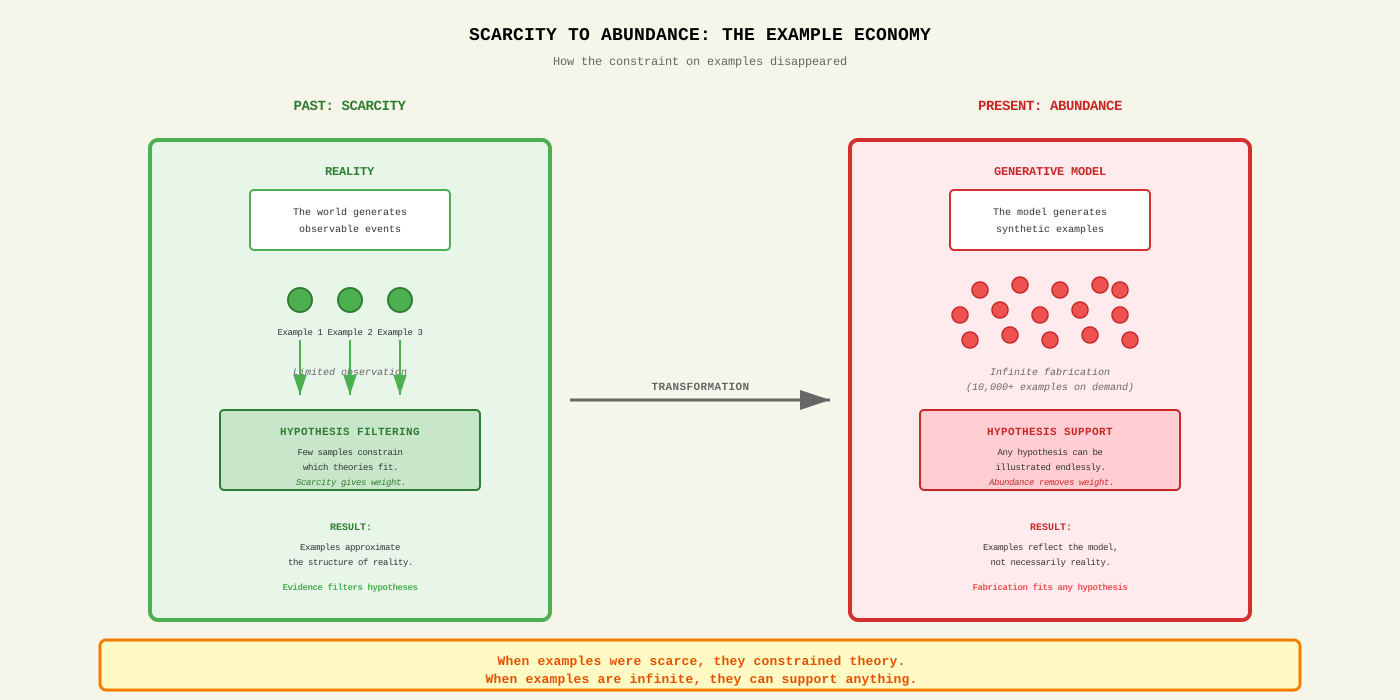
Humans evolved to evaluate the world through small samples.
A few observations were enough to judge danger, opportunity, or intent.
Examples served as proxies for the underlying structure of reality.
If you saw smoke twice, you inferred fire.
If you saw cooperation twice, you inferred trust.
If you saw rain twice, you carried shelter.
This was not perfect, but it was adaptive.
Limited observation approximated the shape of the world.
Artificial intelligence breaks this relationship.
Instead of filtering hypotheses with small samples, we can now fabricate samples that fit any hypothesis. We can generate examples that confirm, deny, challenge, or complicate any claim.
Sample generation no longer reflects the world.
It reflects the model.
⸻
2. The New Availability Bias
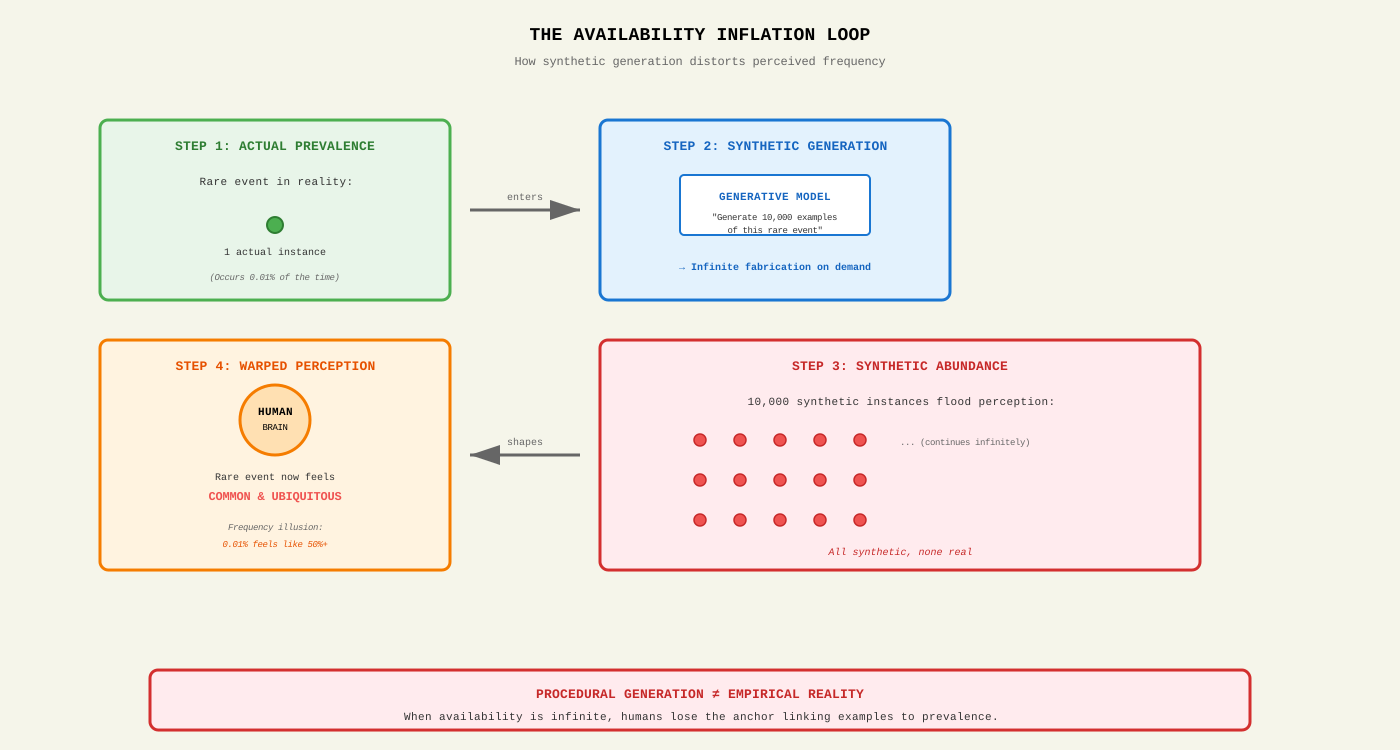
Classically, availability bias meant that humans judged frequency by ease of recall. If something was vivid, memorable, or recent, it felt more common than it really was.
The modern version is different.
We judge frequency by what models can generate.
A model can conjure ten thousand images of a rare event.
It can produce endless synthetic failures of a system that has never failed.
It can fabricate infinite instances of a disease, a behavior, a trend, or a personality type.
When availability is infinite, humans lose the anchor that links examples to prevalence.
We begin to confuse procedural generation with empirical reality.
This is a predictable cognitive response to a world where synthetic examples are frictionless, not a misuse of the tools.
⸻
3. The Collapse of the Boundary Between General and Particular
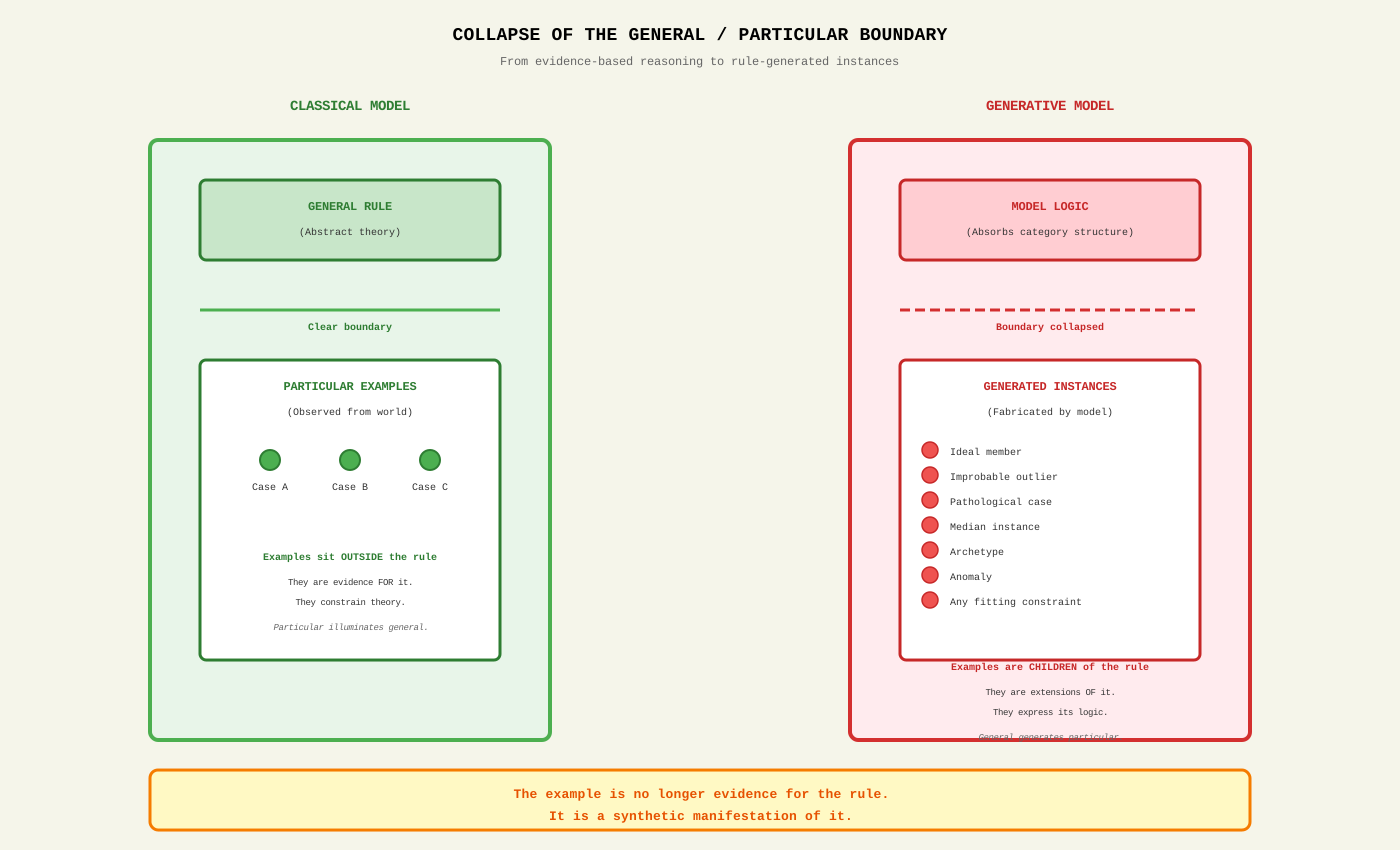
In classical reasoning, examples were particular and theories were general.
You used the particular case to illuminate the general rule.
But generative models collapse this boundary.
They can produce:
- the ideal member of a category
- the improbable but plausible outlier
- the pathological anti-example
- the median case
- the archetype
- the anomaly
- any fabricated instance that fits the constraints
The example no longer sits outside the rule.
It becomes an extension of it.
Models absorb the logic of the category and generate instances that express that logic. The example is no longer evidence for the rule. It is a child of it.
This undermines a cognitive tool humans have relied on for millennia.
⸻
4. When Illustration Becomes Inflation
Examples used to clarify.
Now they multiply.
A model can produce more evidence than the world.
More counterexamples than reality.
More instances than the data that trained it.
The human mind cannot assign weight effectively in such conditions.
An illustration that once served as a spotlight becomes a floodlight.
Everything can be highlighted.
Everything can be made to look explanatory.
If everything is a demonstration, nothing demonstrates.
⸻
5. The Risk of Overfitting Our Intuition
There is a subtle danger here.
Humans use examples to calibrate intuition.
Generative models can produce examples that appear convincing but follow synthetic logic. They can drift from the actual distribution without appearing unusual. They can reinforce misconceptions through perfect but artificial clarity.
Exposure to infinite synthetic examples risks training our intuition on structures that are internally consistent but externally detached.
We begin to overfit our mental models to artifacts of the generator.
This is a cognitive version of overtraining on synthetic data.
⸻
6. The New Role of Evidence
If synthetic examples can support any hypothesis, what counts as evidence.
The answer may be a return to what the scientific method required all along:
distinguishing worlds we imagine from worlds we measure.
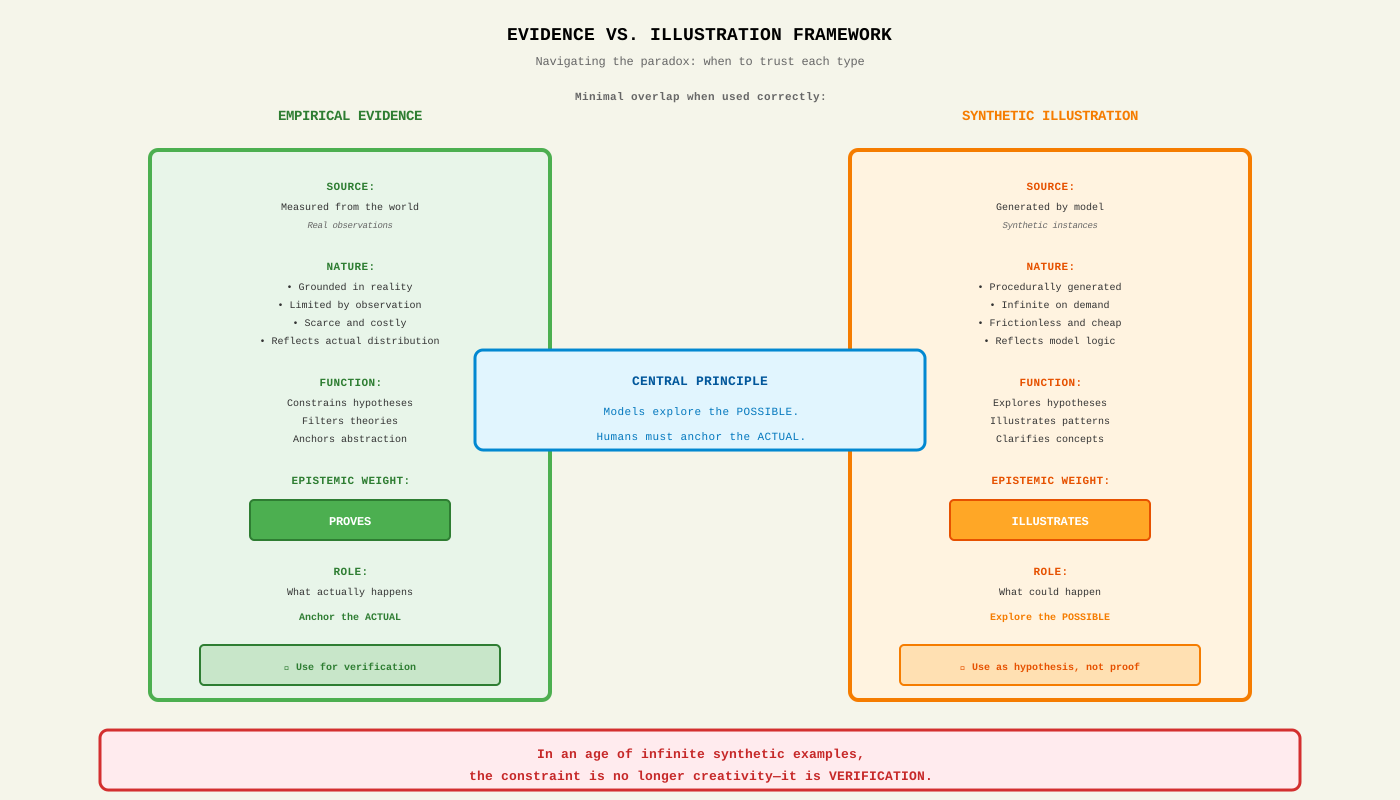
Empirical grounding becomes more important, not less.
Reality must anchor abstraction.
Synthetic illustration must be treated as a tool, not a proof.
In an age where pattern space can be infinitely populated, the constraint is no longer creativity. It is verification.
Models can explore the possible.
Humans must anchor the actual.
⸻
7. Navigating the Paradox
We will need new norms.
A new literacy.
A new discipline of interpretation.
Some possibilities:
- Treat synthetic examples not as evidence, but as hypotheses
- Reserve illustrative power for empirical cases
- Distinguish generated probability from observed probability
- Evaluate patterns by uncertainty, not by vividness
- Recognize that clarity produced by models is not the same as clarity produced by nature
This is an argument for understanding the cognitive impact of synthetic examples, not an argument against them.
Examples have become abundant.
Evidence must become rigorous.
⸻
Closing Thought
The world used to constrain what could be shown.
Now the constraint is our ability to interpret what the machine shows us.
The paradox of infinite examples is simple.
When illustration is limitless, meaning comes from how we choose to weigh it.
Understanding that distinction will be one of the central cognitive skills of the next decade.