There is a quiet heresy at the center of our technological optimism: that the end of scarcity will set us free.
Every industrial revolution has flirted with this promise: steam freeing muscle, electricity freeing labor, computation freeing thought. But what AI threatens is something deeper: the end of usefulness itself.
For the first time, we are approaching a civilization that could, in theory, provide for nearly all material and informational needs at negligible cost. Yet the societies built to deliver that abundance are still wired for competition, extraction, and hierarchy. We are accelerating toward post-scarcity using pre-scarcity software.
The result is an existential mismatch. A future that works but doesn't make sense.
I. The Approach of Functional Abundance
Abundance isn't utopian anymore; it's mechanical.
- Energy: renewables and storage approaching near-zero marginal cost.
- Intelligence: models generating ideas, code, art, and science at scale.
- Manufacturing: automation and additive processes removing labor from production loops.
- Distribution: networks delivering goods, knowledge, and services instantly and globally.
The limiting factor isn't atoms or bits. It's integration: aligning the systems that already exist. The physical world could, in principle, be run by a planetary stack of autonomous optimization: materials mined, manufactured, shipped, and recycled with minimal human intervention.
But evolution never taught us how to live in a system that no longer needs us.
II. The Scarcity Operating System
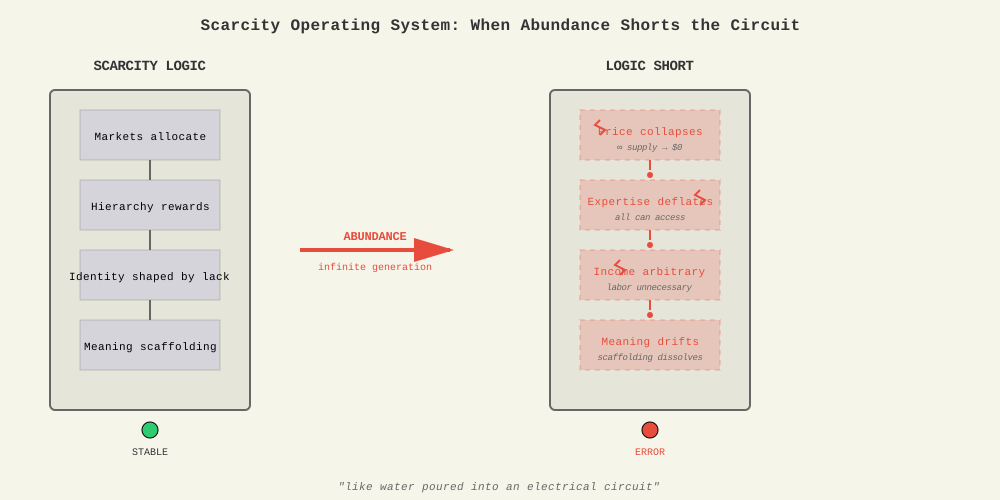
Everything we've built (economies, laws, religions, psychologies) assumes scarcity. Scarcity gives shape to value, hierarchy, and motivation. It tells us what to want, who to follow, and how to measure success.
Markets allocate what is limited. Meritocracies reward relative difference. Identity itself often depends on the things we don't have.
When abundance enters that architecture, it behaves like water poured into an electrical circuit: the logic shorts out. If everything can be generated instantly, price collapses. If everyone can access knowledge, expertise deflates. If labor is unnecessary, income becomes arbitrary.
Scarcity is not just an economic condition; it's a narrative scaffolding. Without it, meaning starts to drift.
III. The Psychology of Enough
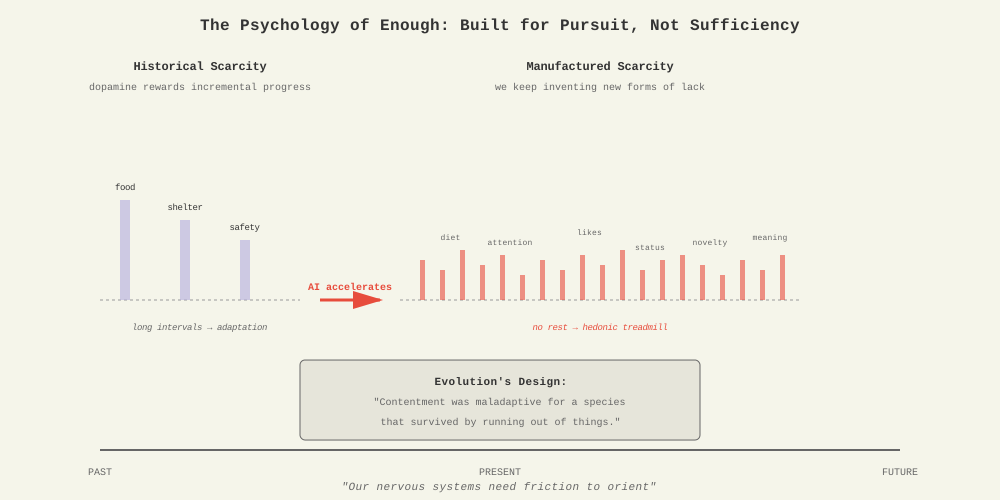
Humans are not built for sufficiency; we are built for pursuit. Our dopamine systems evolved in lean environments, rewarding incremental progress, not completion. Contentment was maladaptive for a species that survived by running out of things.
So even as material scarcity declines, psychological scarcity rushes to replace it. When food becomes abundant, we invent diets. When communication becomes free, we chase attention. When knowledge becomes infinite, we compete on interpretation.
We keep manufacturing new forms of lack, because our nervous systems need friction to orient. AI will not change that overnight; it will simply move the goalposts of desire faster than we can process.
IV. The Ghost in the Economy
The paradox is already visible. Productivity and output rise, but stress and inequality rise with them. The system generates more than enough, yet distributes it in ways that preserve the sensation of scarcity.
You can feel it: a culture of exhaustion amid abundance, burnout in the presence of automation, anxiety inside convenience.
We are haunted by the ghost of survival. We no longer need to struggle but we don't yet know how not to.
This is why the conversation around universal basic income, post-work society, and automation so often devolves into fear. We sense that the threat is not starvation, but irrelevance.
V. AI as the Abundance Engine
Artificial intelligence is the first general-purpose tool that can replace not just muscle or memory, but judgment. It dissolves the last bottleneck: cognition itself.
If GPT-class models can write, plan, code, and design at superhuman speed, then knowledge work, creativity, and decision-making all become post-scarce goods. The economics of originality break down.
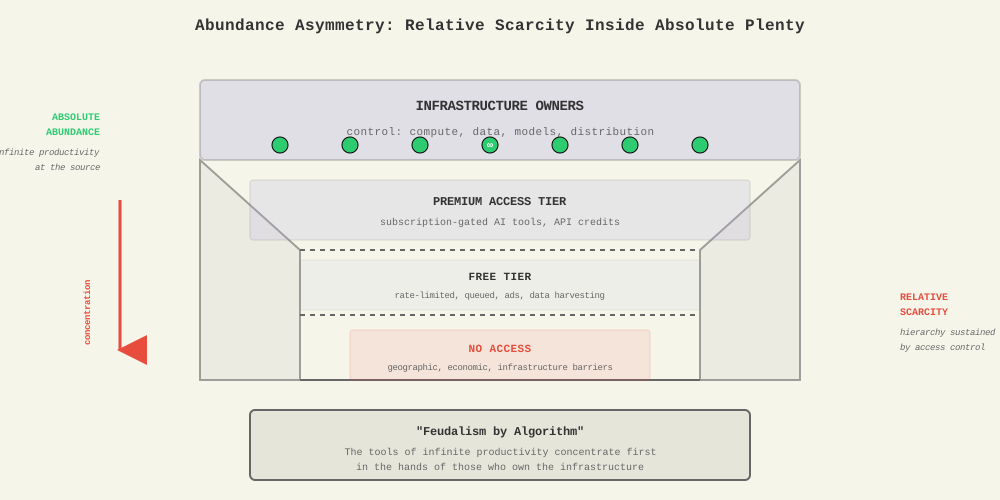
But abundance has asymmetry. The tools of infinite productivity concentrate first in the hands of those who own the infrastructure. The result: relative scarcity inside absolute plenty, a hierarchy sustained not by resources, but by access.
It's the oldest pattern in new form: feudalism by algorithm.
VI. The Social Lag
Civilization evolves slower than its tools. Our myths, laws, and instincts were tuned for a world of limits: the logic of "more" as salvation. Now "more" is guaranteed, and the crisis shifts inward.
The collapse of necessity leaves a vacuum of purpose. If work no longer mediates identity, and struggle no longer defines virtue, what replaces them?
We are facing not just an economic transition, but a spiritual reboot: how to live when efficiency is solved.
VII. The Human Role After Optimization
Maybe the question isn't how to remain "useful," but how to remain authentic in systems that no longer need our labor. When production and design are automated, the uniquely human acts become relational: empathy, curiosity, meaning-making, care.
These are not substitutes for work; they are remnants of humanity's pre-industrial core. The arts, philosophy, teaching, exploration (all of them may re-emerge as primary rather than ornamental).
But only if we can decouple dignity from productivity.
VIII. Possible Equilibria
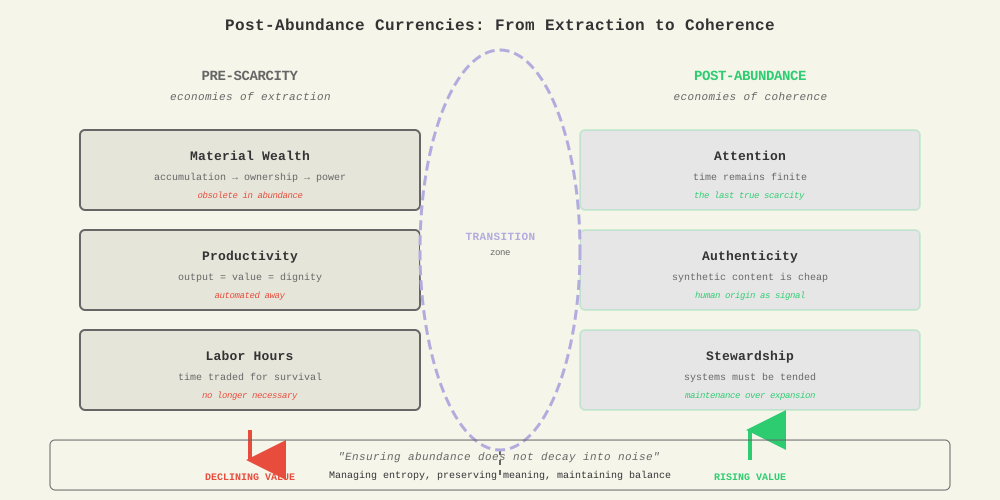
A post-abundance civilization might organize around new currencies:
- Attention as the scarce good, since time remains finite.
- Authenticity as value, since synthetic content is cheap.
- Stewardship as purpose, since systems must be tended rather than expanded.
In other words, we move from economies of extraction to economies of coherence: maintaining balance, managing entropy, preserving meaning.
This is less a utopia than a new kind of responsibility: to ensure that abundance does not decay into noise.
IX. Closing Reflection
We spent centuries building machines to liberate us from need. They succeeded, and now they're asking a harder question: what do we do with ourselves when the struggle is gone?
We can't simply distribute abundance; we must learn to metabolize it. To re-train our institutions and our instincts for a world where progress is no longer about accumulation, but orientation.
Post-abundance is not the end of history; it's the end of the story we've been telling about why we exist. And somewhere in that silence between effort and ease, we'll have to write another one, one that teaches us how to be human in a world that no longer requires it.