There's an old saying: you can't steer by the wake. Yet most of human decision-making (personal, political, institutional) is exactly that: reactive, precedent-based, and drenched in hindsight. We evaluate actions by their visible outcomes and codify the past into "rules" we mistake for laws.
Bayesian consequentialism begins with a quieter assumption: the world is probabilistic, not deterministic, and our actions should reflect that. It merges two powerful ideas (Bayesian reasoning: updating beliefs with evidence, and consequentialism: judging actions by outcomes) into a framework that's less about perfect morality and more about adaptive rationality under uncertainty.
It is, in essence, ethics with a confidence interval.
Consequentialism says: judge actions by their consequences.
Bayesianism says: update beliefs as new data arrives.
Combine them and you get something like:
"The right action is the one that, given your current beliefs and priors, maximizes expected good outcomes—and you must continuously update those beliefs as reality pushes back."
It's an ethics of iteration rather than dogma. Instead of moral rules carved in stone, you carry a posterior distribution over possible goods and harms, and you keep adjusting it.
Example:
A policymaker launches a climate initiative. It fails to meet targets. Under Bayesian consequentialism, this isn't "wrong" in the moral sense; it's new evidence. The right response isn't guilt or pride; it's an update to the prior about what interventions work, followed by a new action.
In other words, to be Bayesian consequentialist is to treat the world as an ongoing experiment, not a courtroom.
The World We Live In
In 2025, we are surrounded by systems that behave like Bayesians: algorithms updating beliefs millions of times per second. Yet the humans who design, regulate, and are governed by those systems often remain determinists: craving certainty, punishing mistakes, and valorizing conviction over calibration.
Social media rewards confidence, not posterior updates.
Politics rewards consistency, not revision.
Institutions reward compliance, not Bayesian humility.
That's the irony: our machines are probabilistic learners, while our societies remain moral absolutists.
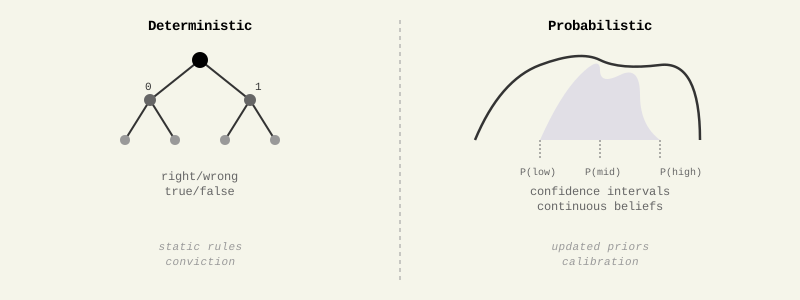
Bayesian consequentialism is what it would look like if human ethics caught up to our software.
Why It Matters Now
We're entering an era where the consequences of actions unfold across scales we can barely track—climate, AI alignment, bioengineering, economic feedback loops. We can't rely on static moral heuristics built for slower, smaller worlds.
Bayesian consequentialism offers a way to act meaningfully without pretending to know too much.
It doesn't say "do whatever seems good now" (that's naive consequentialism).
It says:
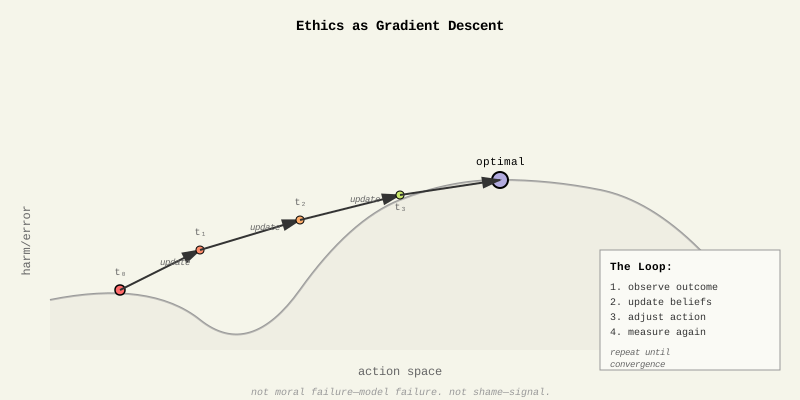
- Make your best probabilistic model of how actions lead to outcomes.
- Act in proportion to your confidence.
- Measure results.
- Update.
This is as close as moral philosophy gets to gradient descent.
The Challenges
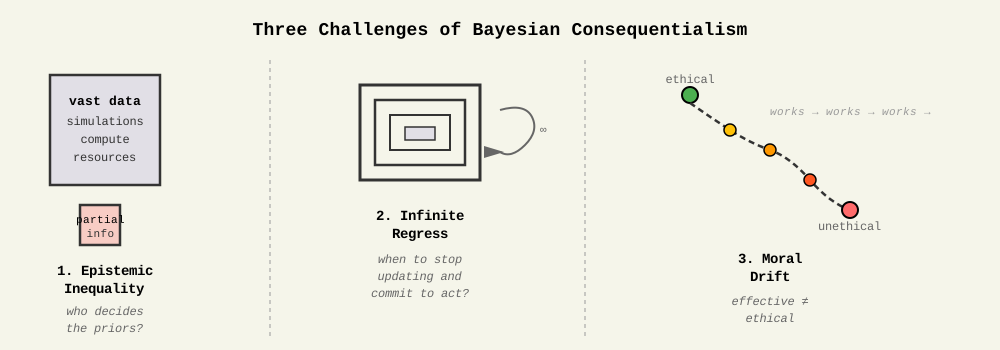
1. Epistemic inequality:
Who gets to decide the priors? The wealthy and powerful can act on vast data and simulation, while the rest operate on folklore and partial information. Bayesian consequentialism doesn't solve that—it amplifies the importance of epistemic justice.
2. Infinite regress of updates:
If every action updates every belief, how do we ever commit to act? The Bayesian consequentialist must sometimes act on bounded rationality—acknowledging that the world won't wait for infinite convergence.
3. Moral drift:
Updating beliefs based on outcomes can lead to creeping justification: if something works, we rationalize it as good. The discipline lies in maintaining a clear utility horizon; effective isn't always ethical.
The Human Application
At a personal level, Bayesian consequentialism feels like replacing guilt with gradient.
Instead of moral failure, you have model failure. Instead of shame, you have signal.
You become more experimental in your ethics:
- Test small actions.
- Gather feedback.
- Scale what seems to work.
- Drop what doesn't.
You don't demand certainty to act—you demand curiosity to adjust.
It's the moral analog of science.
A World Built on Priors
Zoom out: our entire civilization is Bayesian already.
Markets are Bayesian. Science is Bayesian. Machine learning is Bayesian by another name.
We're constantly updating — prices, predictions, reputations, beliefs.
Bayesian consequentialism simply applies that structure to ethics itself:
an ongoing loop of observe → update → act → observe again.
The ethical future, if we're lucky, won't be a world of saints or ideologues.
It'll be a world of careful updaters: people who admit what they don't know, who act despite uncertainty, and who keep adjusting course as reality teaches.
Closing Thought
If classical consequentialism was born in the Enlightenment (when the world believed in certainty), Bayesian consequentialism is the philosophy of the Information Age. It accepts that the map will always lag the territory.
And maybe that's okay.
Because in a universe where knowledge is always partial and consequences always tangled, the most moral thing we can do is to keep updating our sense of good with as much honesty, humility, and data as we can.
In other words: righteousness is static; wisdom is Bayesian.