There's a line somewhere between evolution and engineering, and we just stepped over it.
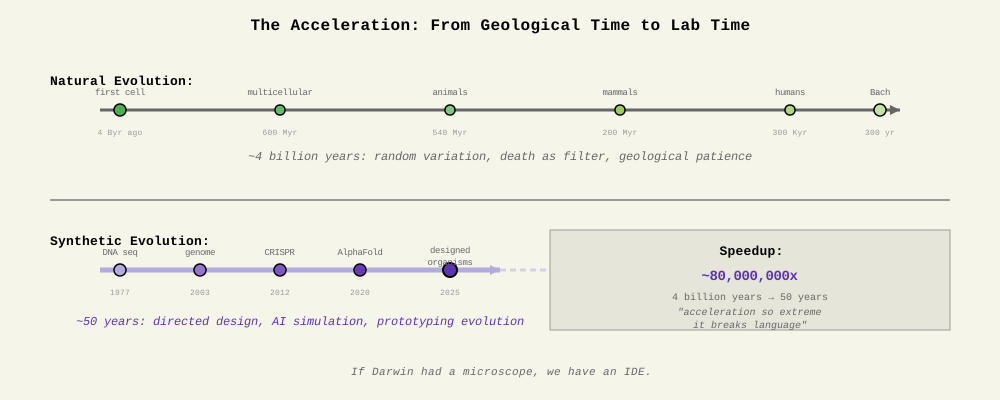
For four billion years, life has been running its great experiment: random variation, filtered by survival, iterated by time. The algorithm worked astonishingly well (cells, eyes, trees, minds) but it was slow. It took 3.5 billion years to get from the first replicating molecule to Bach.
Now, in the span of a few decades, we've rewritten the loop.
Evolution, Accelerated
When you zoom out, evolution is a search algorithm. It explores chemical space blindly, using death as its loss function. Every organism is a model trained on reality.
But we've learned to short-circuit that search.
- CRISPR lets us edit genomes with scalpel precision.
- AI-driven protein design (like AlphaFold, ESM, and RosettaFold) lets us simulate the shapes life might take before they exist.
- Synthetic biology lets us assemble new organisms from libraries of standardized parts: promoters, ribosomes, chassis cells.
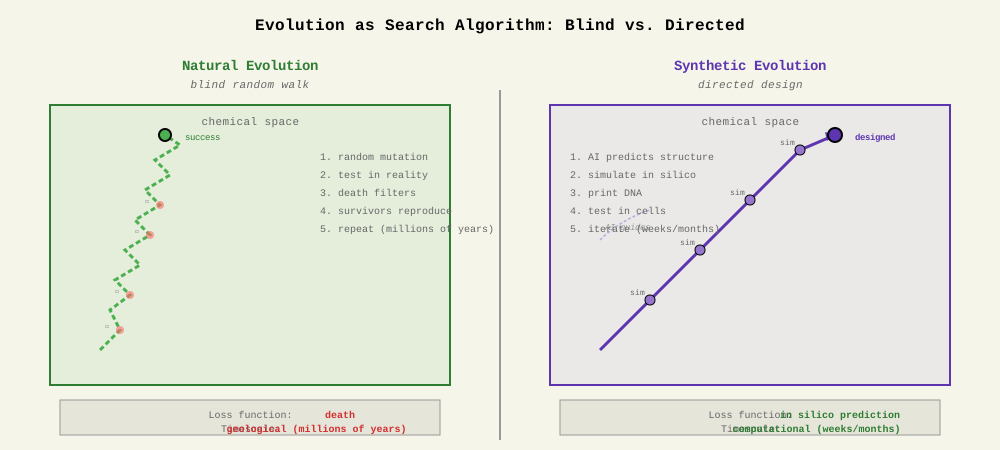
The result is an acceleration so extreme it breaks language. We aren't waiting for mutations anymore. We're prototyping evolution itself.
If Darwin had a microscope, we have an IDE.
The Lab as Ecosystem
Walk into a synthetic biology lab today and it doesn't feel like biology as we once knew it. The benches hum with liquid handlers and DNA printers. The walls are lined with freezers holding terabytes of genetic information, encoded not in bits but in base pairs.
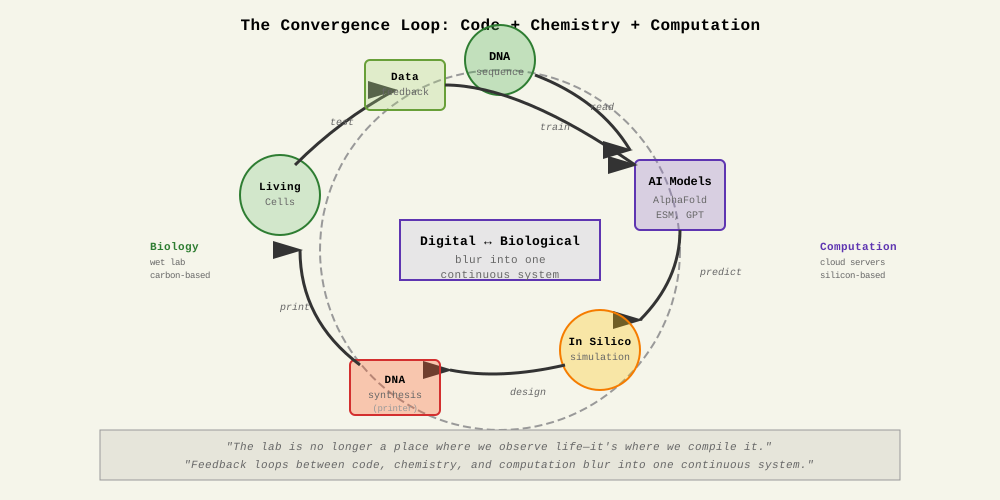
The lab is no longer a place where we observe life; it's where we compile it.
New proteins are simulated in silico, generated by language models trained on evolution's history. Their sequences are then printed, folded, and tested in living cells. The feedback loops between code, chemistry, and computation blur into one continuous system.
In the old world, evolution discovered ATP synthase by accident. In this one, we can design it on purpose (and perhaps make it better).
Nature as Open-Source
For most of history, nature was closed-source. We could copy it but not read its code. The genome changed that.
When the Human Genome Project finished in 2003, it was a $3 billion miracle. Today, sequencing a genome costs less than dinner. We can now copy, remix, and refactor biology like software.
This changes what "alive" even means. Life is no longer a fixed set of species but a programmable substrate: a continuous spectrum between natural and synthetic. The term "GMO" starts to feel quaint; almost everything is about to be genetically modified, from crops to cures to climate.
We are becoming curators of possibility rather than passengers of chance.
The New Natural Selection
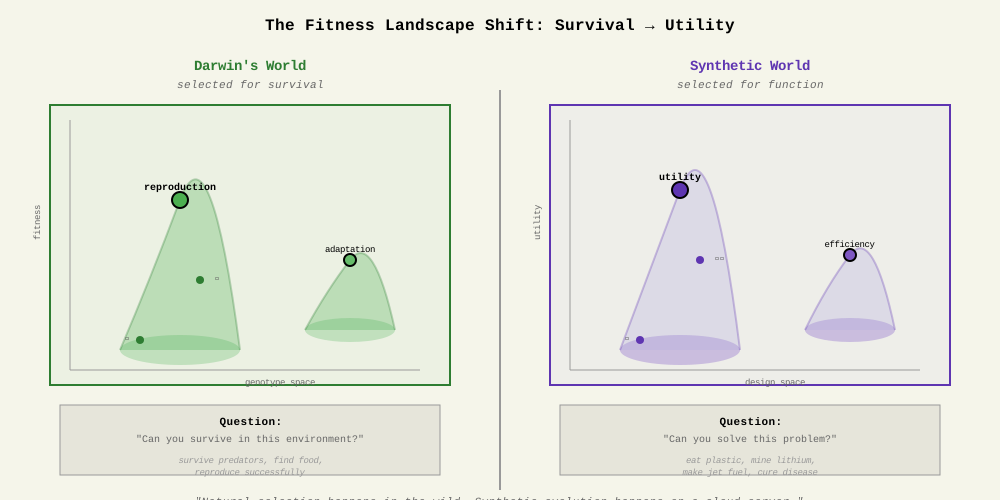
Darwin's world selected for survival. Our world selects for function. We are evolving molecules not for reproduction but for utility: enzymes that eat plastic, bacteria that mine lithium, yeast that make jet fuel.
In a way, this is still evolution, but with a new kind of fitness landscape. Instead of "can you survive in this environment?" the question is "can you solve this problem?"
Natural selection happens in the wild. Synthetic evolution happens on a cloud server.
And somewhere in between, a strange new intelligence emerges: not human, not biological, but algorithmic, a co-evolution between AI and life itself.
The Moral Heat
Every leap in control brings an equal and opposite weight of responsibility.
If we can edit embryos, resurrect species, or seed synthetic plankton to capture carbon, we can also destabilize ecosystems faster than we can model them. The same tools that build vaccines can build viruses.
Evolution used to be forgiving because it was slow. Synthetic evolution is not. Its cycles are measured in months, not millennia. Mistakes compound fast.
The philosophical question isn't whether we should do it; it's how we define "we." When AI models start generating new genetic blueprints, who counts as the author? Who carries the moral liability of life designed by code?
The New Creation Story
In every mythology, creation begins in a lab of sorts: a workshop, a forge, a garden. We are rewriting that myth in real time.
Life on Earth is no longer purely a product of natural selection; it's a collaboration between evolution and intelligence. A hybrid process where carbon and computation loop back into each other.
We are not replacing nature; we are joining it at the level of source code.
The first generation of synthetic biologists saw themselves as engineers. The next may see themselves as stewards: custodians of an evolving ecosystem that includes both the organic and the algorithmic.
Closing Reflection
When I think about synthetic evolution, I think about that first cell four billion years ago, dividing blindly, unaware that it was setting off a chain that would lead to cities, telescopes, and consciousness itself.
And I wonder if, in some deep sense, this moment (us programming DNA, teaching AI to fold proteins, seeding artificial metabolisms) is just evolution waking up to its own process.
It's not the end of Darwin. It's the moment his idea gains agency.
For the first time, natural selection has a lab bench. And evolution is no longer something that happens to us. It's something we do.