Silicon has carried us for half a century. It has been the substrate of every major digital revolution, the material through which computation became cheap, dense, predictable, and global. But silicon has limits baked into its physics: rigid wafers, brittle die, high temperature processing, costly cleanrooms, and geometries that struggle to stretch across large, flexible surfaces.
The physical world is bigger and stranger than silicon's comfort zone. Floors expand and contract. Walls flex. Textiles twist. Packaging bends. Infrastructure sweats in humidity. If you want computation and sensing to permeate these surfaces, the material palette needs to change.
Organic electronics are that change, arriving slowly and then suddenly.
This is an essay about conductive polymers, printed diodes, flexible transistors, and why their trajectory matters for the next generation of large format sensing.
⸻
1. Why Organic Electronics Matter
Traditional electronics excel at intensity, not extensiveness. They give you brilliant logic in small places. They do not want to cover stadium floors, hospital corridors, or architectural membranes that span a hundred meters.
Organic electronics flip the tradeoff:
- They favor scale over precision.
- Coverage over clock speed.
- Spatial reach over raw switching frequency.
Conductive polymers, printable inks, and organic thin-film transistors can be deposited on plastics, foams, papers, even textiles. They can be produced roll-to-roll, cured at low temperature, and integrated into materials that live in the real world instead of sitting sheltered inside enclosures.
This represents a complementary frontier to silicon, extending rather than replacing it. One for computation that blends into matter, not computation that sits on top of it.
Large format sensing depends on that frontier.
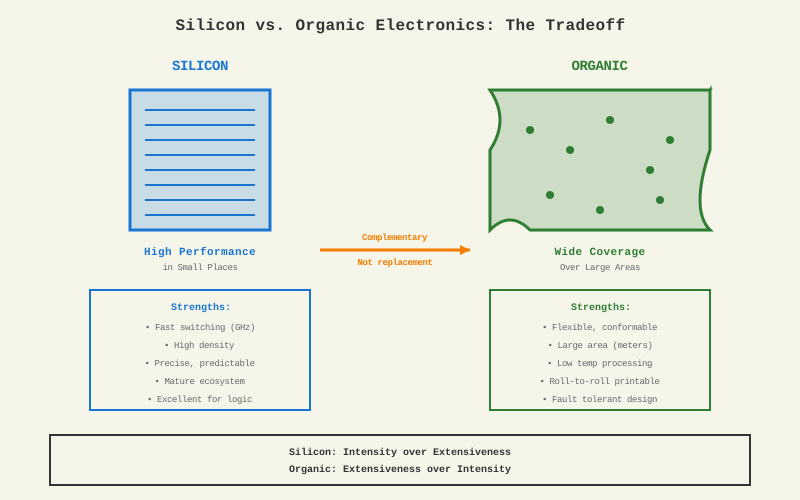
Figure 1: Silicon excels at intensity (high performance in small places), while organic electronics favor extensiveness (wide coverage over large areas). These are complementary approaches, not replacements.
⸻
2. Conductive Polymers: The First Step Toward Soft Circuits
Conductive polymers do something awkward and powerful: they act like metals while behaving like plastics. Their conductivity is lower than copper, but their flexibility, printability, and chemical tunability open design spaces that rigid metals cannot reach.
They allow:
- Pressure and strain sensors that conform to curved or compressible surfaces.
- Printed interconnects that survive repeated bending and soft deformation.
- Electrode arrays with geometries impossible in rigid boards.
Their quirks are equally important:
- Conductivity depends on humidity and temperature.
- Mechanical fatigue is gradual rather than explosive.
- Time-dependent drift becomes a feature to work with.
You start designing sensors that acknowledge softness and drift, rather than fighting to hide it. When the surface itself becomes part of the circuit, the boundary between material science and electrical engineering dissolves.
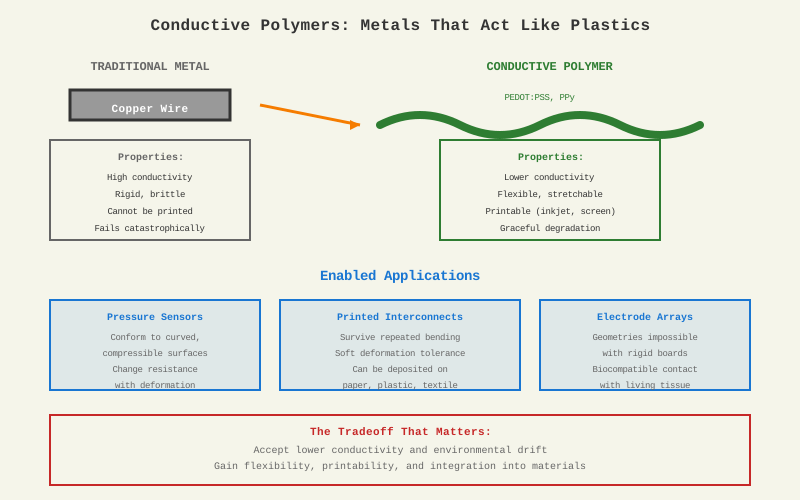
Figure 2: Conductive polymers trade high conductivity for flexibility, printability, and graceful degradation. This tradeoff enables pressure sensors, printed interconnects, and electrode arrays impossible with traditional metals.
⸻
3. Printed Diodes and the Rise of Passive Logic
Organic diodes and rectifiers are the quiet workhorses of flexible electronics. They are slow compared to silicon, but they deliver something silicon rarely can: they can be printed in large sheets with geometries as simple as a mechanical stencil.
This enables:
- Passive address matrices for large sensor grids.
- Local rectification that reduces wiring complexity.
- Noise shaping at the material level, not in a microcontroller.
Printed diodes bring computation closer to the surface. They let the sensing fabric do some of the work before any signal reaches a digital boundary. The system becomes a hybrid: part material, part circuit, part algorithm.
For large format pressure sensing, this removes a major barrier. You do not need to run thousands of wires to extract meaningful information. You can let the sheet itself encode structure.
⸻
4. Organic Transistors: Computation That Bends
Organic thin-film transistors are slower and less precise than silicon CMOS. They will not run a neural net or power a phone. But they do not need to. Their value lies in being everywhere.
They allow:
- Local signal amplification directly on flexible substrates.
- Distributed pre-processing on surfaces that bend, stretch, and age.
- Sensor arrays that maintain structure even when partially degraded.
Organic transistors support a style of computation suited for the physical world: tolerant of variation, modest in frequency, and spatially diffuse. Think of them as giving the material a little local intelligence, cell by cell.
As yields improve and mobilities climb, the idea of smart flooring, smart walls, and smart packaging becomes less science fiction and more supply chain.
⸻
5. What Organic Electronics Enable Today
The current state of organic electronics is not hypothetical. It already supports:
- Large area pressure sensing
- Conformal biomedical patches
- Flexible RFID and NFC
- Smart packaging with time-temperature indicators
- Low-cost environmental sensors
These are slow, soft, and wide technologies rather than fast, rigid, and dense ones. They make computation continuous in space, not just concentrated on chips.
For large format sensing, this is crucial. The sensor becomes a surface rather than a discrete object.
⸻
6. Why Their Long-Term Trajectory Matters
Organic electronics advance in a pattern similar to early photovoltaics or early machine learning: slow progress for years, then surprising acceleration once fabrication, materials chemistry, and modeling converge.
The future trajectory matters for several reasons.
1. Ubiquity is a material problem, not a model problem.
To instrument buildings, vehicles, clothing, infrastructure, and packaging at scale, we need electronics that match the physical environment. Silicon cannot achieve ubiquity alone.
2. Roll-to-roll production changes the economics.
If computation and sensing can be produced like wallpaper, entire industries shift. The cost per square meter becomes the critical metric, not the cost per unit.
3. Organic electronics invite fault tolerance as a design principle.
Unlike silicon fabs, where yield must be near perfect, large format organic electronics assume partial failure. Surfaces degrade. Zones drift. Layers delaminate. The system succeeds by being distributed and forgiving.
4. New interactions between material science and AI emerge.
Environmental drift becomes training data. Mechanical fatigue becomes a signal, not just a problem. Surfaces that age intelligently become possible.
5. The world becomes computable at human scale.
Instead of devices that sit in pockets, we get environments that sense and respond. This shifts agency from screens to surfaces.
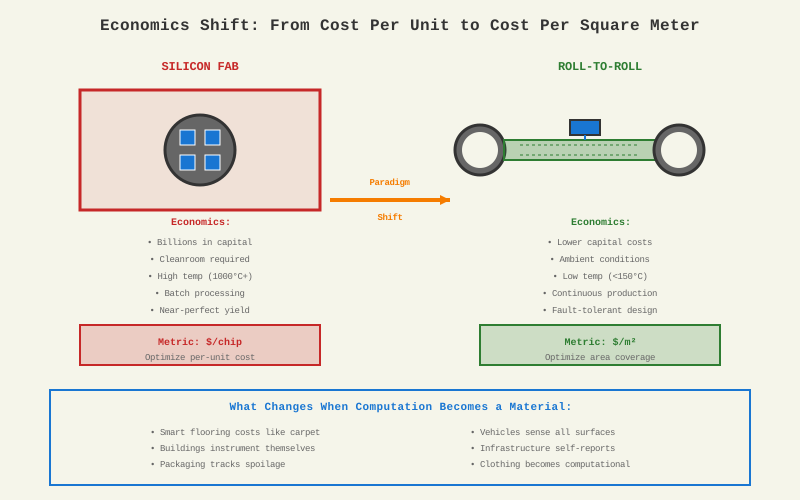
Figure 3: Roll-to-roll production changes the fundamental economics from cost per chip to cost per square meter. When computation can be produced like wallpaper, entire industries shift toward instrumented surfaces.
⸻
7. Lessons from Building Real Large-Format Surfaces
Working with large-format printed sensing is a tutorial in humility. The world bends, swells, warps, creeps, and sweats. No simulation prepares you for the slow violence of daily life on materials.
Organic electronics meet this world on its own terms.
They accept:
- deformation
- imperfection
- drift
- spatial non-uniformity
And they offer architectures that integrate redundancy, probabilistic reconstruction, and distributed inference as first-class design patterns.
The technology's trajectory is slow only in the way biological evolution looks slow. Each breakthrough compounds.
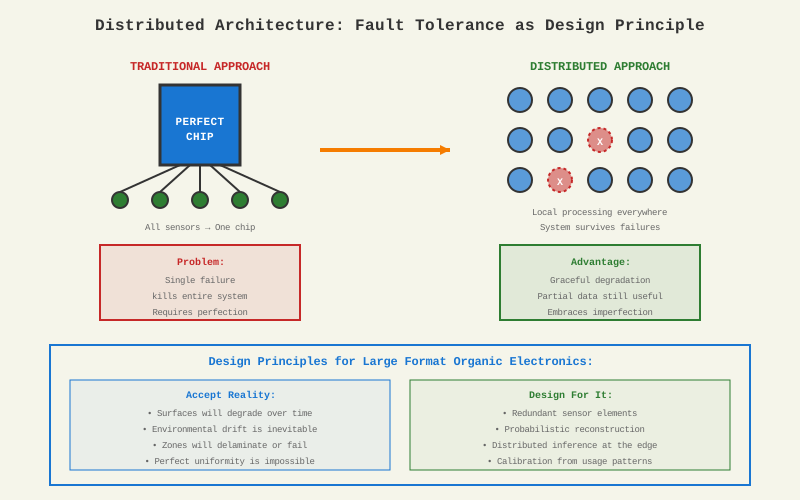
Figure 4: Unlike traditional electronics requiring near-perfect components, organic electronics embrace distributed architectures with graceful degradation. The system succeeds by accepting imperfection and designing for partial failures from the start.
⸻
8. A Future of Computation That Blends Into Matter
Silicon will continue to dominate high-performance computing, but the growth frontier shifts once we stop asking "How do we make chips faster" and start asking "How do we spread intelligence across the world".
Organic electronics sketch that future:
- surfaces that feel activity
- materials that self-report their stress
- infrastructure that maps its own use
- packaging that tracks its own spoilage
- buildings that read their own behavior
The next revolution in sensing will arrive as a smarter surface, distributed across materials rather than concentrated in faster chips.
⸻
Closing Thought
The slow march beyond silicon expands the computational landscape into new territories.
Where silicon mastered density, organic electronics are beginning to master distribution. Where silicon makes machines powerful, organic materials give matter itself the ability to register, respond, and remember.
Large format sensing depends on this shift. Intelligent surfaces depend on it. A more instrumented, adaptive built world depends on it.
The future of computation will unfold across the surfaces we stand on, extending far beyond individual chips.