Digital signal processing is built on a comforting idea: if you sample a signal fast enough relative to its highest frequency, you can reconstruct it without distortion. The Nyquist criterion gives you a clean boundary. Sample above it and the world behaves. Sample below it and aliasing appears.
In audio, this means sampling at least twice the highest frequency you want to preserve. For music that tops out around 20 kHz, you sample at 44.1 kHz (CD quality) and the waveform can be perfectly reconstructed. For digital images, it means your pixel grid needs to be fine enough to capture the smallest details without creating moiré patterns or jagged edges. The math is clean. The boundaries are knowable. Engineers design around them.
Buildings ignore this boundary.
Human behavior in physical space manifests as a superposition of slow flows, abrupt impulses, long-tail events, rare interactions, and overlapping spatial frequencies, far exceeding any band-limited model. When you try to sample this with large-format sensing, the question stops being "what is the highest frequency in the signal" and becomes "what counts as a frequency in the first place."
This is the spatial Nyquist problem: once you move from electronics to architecture, the notion of a "sampling rate" becomes multi-scale, contextual, and deeply tied to the geometry of the world.
⸻
1. What Counts as a Frequency in Human Movement
In a classical signal, frequency corresponds to oscillation. In a building, movement patterns have many oscillatory components, but they are not tied to a single dimension.
A person walking generates:
- a step frequency
- a gait asymmetry frequency
- micro-adjustments from balance control
- higher frequency contact noise from materials, shoes, or assistive devices
Now add multiple people. Their movements interfere, overlap, synchronize, and diverge. The physical environment adds its own "modulations" through slopes, thresholds, carpets, tiles, and structural resonance.
A single circulatory zone becomes a harmonic landscape where:
- traffic density has a low-frequency drift
- turns and avoidance behaviors inject mid-range transients
- subtle gait instabilities or early fall signatures live in high-frequency jitter
You cannot pick one frequency to sample for. You pick which structure of reality you are willing to preserve.
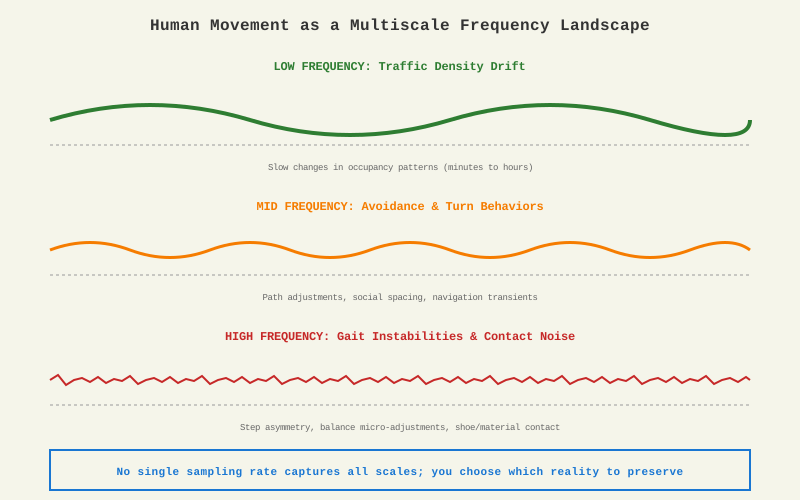
Figure 1: Human movement has multiple overlapping frequency components, from slow traffic density drifts to fast gait instabilities. No single sampling rate captures all scales simultaneously.
⸻
2. Spatial Resolution as a Choice About What Matters
Floor sensors enforce a spatial grid. Maybe four inches. Maybe six. Maybe coarser.
Each choice defines what you can resolve:
- step placement vs general presence
- gait asymmetry vs average load
- micro-slips vs gross trajectories
Go coarser, and two distinct people walking side by side fold into one blob. Go finer, and you enter a regime where measurement noise starts to resemble signal. Both extremes distort reality, just in different ways.
This inverts the classical Nyquist frame, where resolution is a bounded engineering parameter. In spatial sensing, resolution is a value decision: what details of human behavior are worth preserving, and what distortions are tolerable.
For example, in fall detection, you care about high-frequency irregularities. In energy optimization, you care about slow occupancy drifts. In retail flow analysis, you care about medium-range path structure. No single resolution fits all.
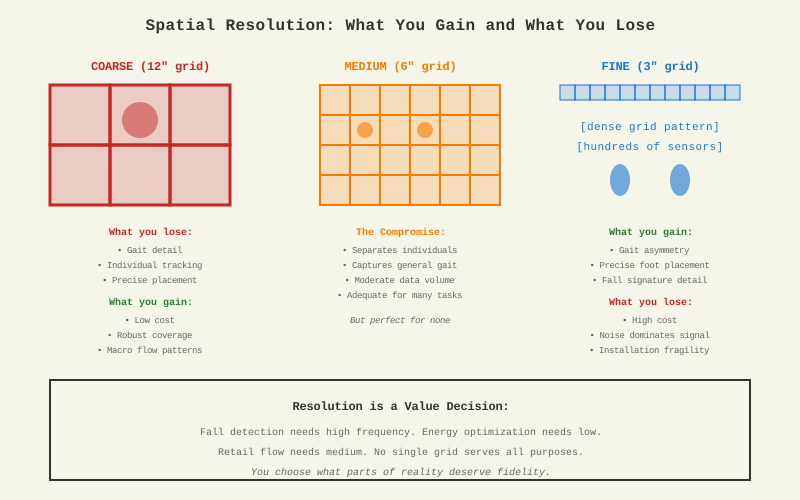
Figure 2: Resolution is a value decision. Coarse grids miss gait detail but provide robust coverage. Fine grids capture fall signatures but drown in noise. No single grid serves all purposes; you choose what parts of reality deserve fidelity.
⸻
3. Aliasing in Architecture
Aliasing in DSP means high frequencies masquerading as lower ones because sampling was too slow.
In buildings, aliasing takes stranger forms.
Some examples:
- A poorly placed column creates a path deviation that looks like behavioral preference.
- A change in floor finish produces a ghost signal that resembles gait hesitation.
- Two interpersonal interactions overlap in time and footprint, causing their patterns to fold into one ambiguous trace.
- A cleaning cycle creates a rhythmic load signature that looks like a mobility anomaly.
Aliasing becomes contextual. Geometry, materials, objects, and even schedules interfere with the behavioral signal in ways DSP never designed for.
You can oversample in space and still alias in meaning.
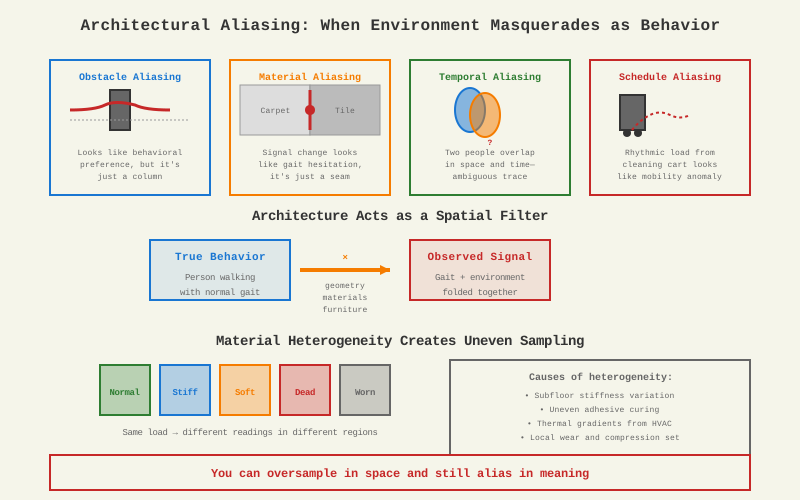
Figure 3: In buildings, aliasing becomes contextual. Columns create path deviations that look like behavioral preference. Floor finish changes produce signals that resemble gait hesitation. Material heterogeneity creates uneven sampling where the same load yields different readings in different regions.
⸻
4. Dead Zones and Material Inhomogeneities
Classical sensors assume consistency: the transfer function is uniform, and deviations are noise.
Large-area sensors violate that assumption immediately.
Flooring has:
- variation in subfloor stiffness
- differences in installation pressure
- edges that are stiffer or looser
- adhesives that cure unevenly
- thermal gradients from HVAC ducting
- local wear patterns and compression set
A four-inch tile placed above a cold slab behaves differently from one above a warm plenum. The same applied load yields different readings in different regions. That means your spatial sampling grid is not uniform. It is an uneven lattice of microdomains.
Dead zones represent regions where physics departs from calibration assumptions, extending beyond simple sensor failure. A designer may never notice them; a scientist discovers them only after puzzling over asymmetric patterns that refuse to fit a clean model.
The spatial Nyquist problem here is not just about spacing. It is about how heterogeneous the world becomes between samples.
⸻
5. The Challenge of Multiscale Behavior
Human behavior shows structure at multiple spatial scales:
- macro flows across atriums, corridors, terminals
- meso-scale interactions within clusters, queues, and waiting areas
- micro-scale adjustments in gait, posture, and foot placement
A single grid cannot fully serve all of these.
If you optimize for macro, you lose gait.
If you optimize for gait, you oversample macro and pay the cost in data volume, noise, and fragility.
If you try to compromise, you end up with a grid that is adequate for many tasks but perfect for none.
Multiscale sensing becomes essential to avoid compressing away important structure. This is why truly large-scale sensing strategies mix:
- dense areas for high acuity
- coarse areas for broad patterns
- algorithmic upsampling
- spatial redundancies
- behavioral priors collected over time
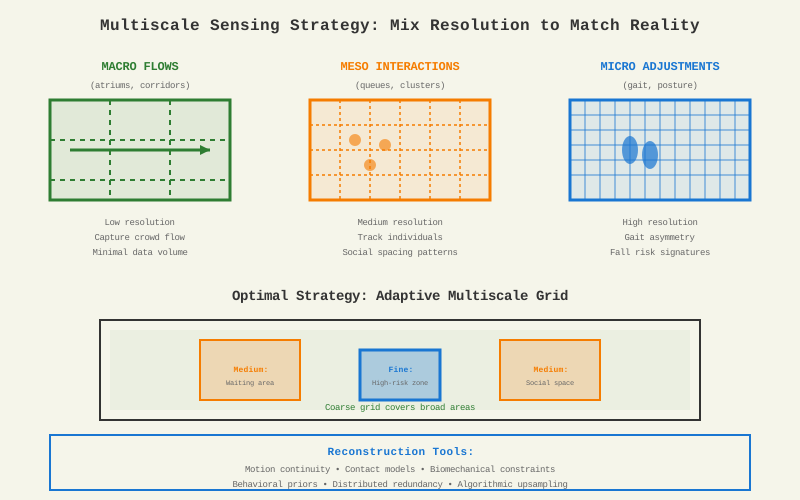
Figure 4: No single grid resolution captures all scales. Optimal strategies use adaptive multiscale grids: coarse coverage for broad areas, medium resolution for social zones, fine resolution for high-risk areas. Reconstruction relies on motion continuity, biomechanical constraints, and behavioral priors.
⸻
6. How Architecture Warps the Sampling Grid
Physical geometry interacts with sensing in subtle ways. Corners create bottlenecks. Stairs create mode shifts in gait. Long corridors push people into narrow distributions. Open spaces create interference patterns of flow.
Sensors do not see raw behavior. They see behavior filtered through architecture.
This means your "sampling function" is not a grid alone. It is the product of grid and layout. Narrow passages create compressed sampling domains. Open areas dilute density. Furniture acts as local filters. Small changes in layout alter the effective spatial frequency of movement.
A DSP engineer can write equations for sampling on a lattice. An architect can change the entire nature of that lattice with a chair.
⸻
7. Recovering Truth When Sampling Is Imperfect
Because perfect sampling is impossible in architecture, the only viable path is reconstruction with priors.
A few tools help:
- motion continuity
- contact patch models
- biomechanical constraints
- person-specific subpatterns like stride length
- environmental models of how people move in certain spaces
- distributed redundancy across tiles
High-quality reconstruction often comes from the interplay between sensor data and behavioral models. The sensor grid captures glimpses. The behavioral model stitches them into trajectories.
This is why intelligent surfaces rely as much on human factors and gait science as they do on electronics. Sensing is half measurement, half inference.
⸻
8. Why the Spatial Nyquist Problem Matters Now
As cities, hospitals, airports, retail chains, and senior living facilities adopt large-format sensors, the spatial Nyquist problem stops being an academic curiosity.
It becomes a limit on:
- fall detection fidelity
- safety analysis
- energy optimization
- crowd management
- mobility research
- architectural evaluation
- accessibility improvement
If your spatial resolution is too coarse, you miss the weak signals that predict harm. If it is too fine, you drown in noise and environmental distortion. If you ignore architectural context, you alias human behavior into misleading patterns.
Understanding the spatial Nyquist boundary is understanding which truths survive the sampling process.
⸻
Closing Thought
Digital systems thrive on clean domains. Human movement inside buildings is anything but clean. It has multiple frequencies, overlapping trajectories, physical distortions, architectural filters, and long-tail outliers that matter as much as the average case.
Sampling such a world demands deciding what parts of reality deserve fidelity, far beyond hitting any magic threshold.
The spatial Nyquist problem reminds us that intelligent environments begin as sampling problems. The world is always richer than the grid that measures it, and every choice of resolution is a declaration about what we care about, what we are willing to lose, and how deeply we want to understand the behavior of the people who move through space.