Countries have always built power in whatever substrate they could control. In the nineteenth century it was steel mills and rail. In the twentieth it was oil, uranium, and bandwidth. In the twenty first, computational power is increasingly the scarce resource that determines industrial capacity, scientific pace, national security posture, and geopolitical leverage.
The question has shifted from whether energy matters to what form of energy matters. AI workloads consume extraordinary amounts of electricity, but raw generation is not the only chokepoint. Temporal mismatch between generation and load, spatial mismatch between production and demand, and reliance on centralized grids all create strategic bottlenecks. Training a frontier model requires continuous access to high quality energy with extremely low variance. Running model inference across a nation at scale requires local availability, low latency, and resilience against disruption.
This opens a provocative question that sits outside the usual policy debates.
What if the surfaces we already build at national scale could become part of the computational energy ecosystem?
These would function as a distributed network of micro energy collectors, reducers, and buffers embedded into the everyday fabric of built environments, distinct from solar panels or battery replacements. Surfaces that capture, transform, and redistribute forms of mechanical, thermal, and vibrational energy that are too small to route into the grid, yet large enough in aggregate to matter once you multiply them by billions of square feet.
This describes surface reactors: surfaces that transform dissipated mechanical, thermal, and vibrational energy into useful work for the computational infrastructure.
This essay explores that idea in three parts:
- The physics and math behind distributed micro energy.
- Why surface reactors align with national technical defense.
- How sensored flooring and soft printed electronics allow this to happen in places we already occupy.
⸻
1. The Physics of Distributed Energy Capture
The built world is full of micro energies that are too small to route into central infrastructure but too abundant to ignore. Footfall pressure, gait cycles, mechanical strain, thermal gradients near slabs, air pressure fluctuations, and vibration from HVAC equipment all represent energy that buildings dissipate.
Individually these energies are trivial. Collectively they form a surface level energy field that has never been harvested because the technology did not exist to do so.
Printed electronics changes that. So does the ability to manufacture sensing surfaces cheaply and at large scale.
Start with a simple mechanical case: human footfall.
A typical adult footfall applies between 300 and 500 newtons of peak force. The center of pressure travels across the foot over roughly 400 to 600 milliseconds. The mechanical energy per step is approximately
where
- F is force (300 to 500 N)
- d is vertical displacement during heel strike and toe off (1 to 2 cm)
Using a midrange estimate:
A typical person takes on the order of 4,000 to 7,000 steps per day indoors. Choose 5,000 steps as a midrange estimate:
In a large mixed use complex with 20,000 occupants:
Spread across a year:
That is not power plant scale. It becomes interesting when you park the energy where it is generated and use it locally for compute.
Now consider thermal mass.
A one square foot section of interior concrete slab with a daily temperature swing of only 4 °C can store
Take
- m ≈ 22 kg for a 4 inch thick square foot of concrete
- c ≈ 880 J/kg·°C
- ΔT ≈ 4 °C
Over a year that is about 28 MJ per square foot.
Scaled to 1 million square feet of floor area:
Even if only a small fraction of that were practically harvestable through thermoelectric films or related technologies, you land in the tens of thousands of kilowatt hours per year per million square feet.
Again, trivial as a grid contributor. Nontrivial as a local buffer attached directly to sensing and compute.
The key shift is conceptual. Surface reactors are about turning dissipated micro energies into useful local work, mainly in service of perception, inference, and control.
They shift energy from being invisible background to being part of the computational substrate.
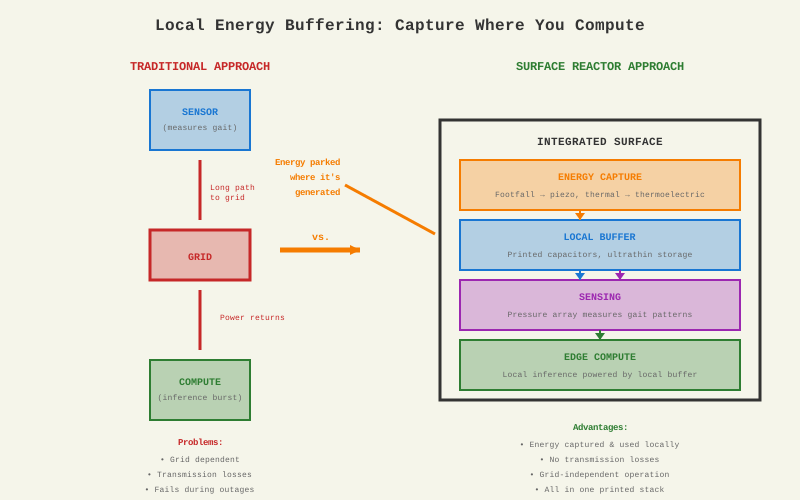
Figure 1: Traditional approach requires sensors to draw power from the grid, creating dependency and transmission losses. Surface reactors integrate energy capture, local buffering, sensing, and edge compute in one printed stack. Energy is parked where it's generated and used for local inference, enabling grid-independent operation.
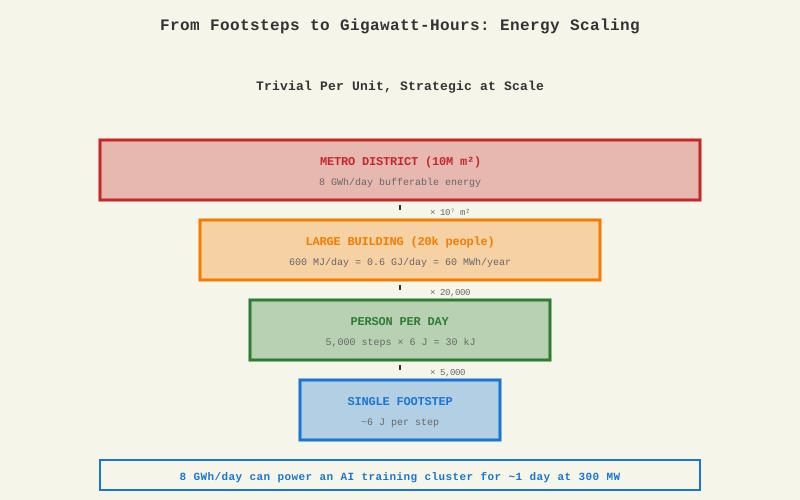
Figure 2: Energy scales from trivial per footstep (6 J) to strategic at district scale (8 GWh/day). A single person's daily footfall energy is negligible, but 20,000 people in a building generate 60 MWh/year, and 10 million square meters of instrumented surfaces produce 8 GWh/day, enough to power a 300 MW AI cluster for a day. (District-scale figure uses composite energy approach from Section 4: PV harvest + HVAC savings + mechanical harvesting = 0.8 kWh/day/m².)
⸻
2. Why This Has Strategic Implications
Frontier models consume energy at three layers:
- Training: concentrated, extremely high power loads.
- Inference at scale: widely distributed, lower power but high volume.
- Local autonomy: small models running on devices, sensors, and embedded hardware.
Only the first layer must remain heavily centralized. The second and third layers benefit from distributed energy buffers located where inference occurs.
Surface reactors slot into the latter two layers.
They provide:
- microbuffers that hide inference bursts
- redundancy against grid disruptions
- energy smoothing at the square meter scale
- local autonomy for embedded, always on perception
This matters for national defense and sovereignty because compute is now a strategic asset. Nations that can guarantee low latency, high availability inference across their critical infrastructure gain advantages in:
- logistics
- defense situational awareness
- resilient manufacturing
- energy optimization
- emergency response
- public health surveillance
- secure local autonomy for robotics and sensors
A distributed computational fabric powered partly by surface reactors makes a country harder to disrupt, easier to coordinate, and capable of running critical workloads even under grid stress.
The useful mental model resembles micro caching in networks rather than micro generation displacing power plants. Small units at the edge reshape system behavior disproportionate to their absolute size.
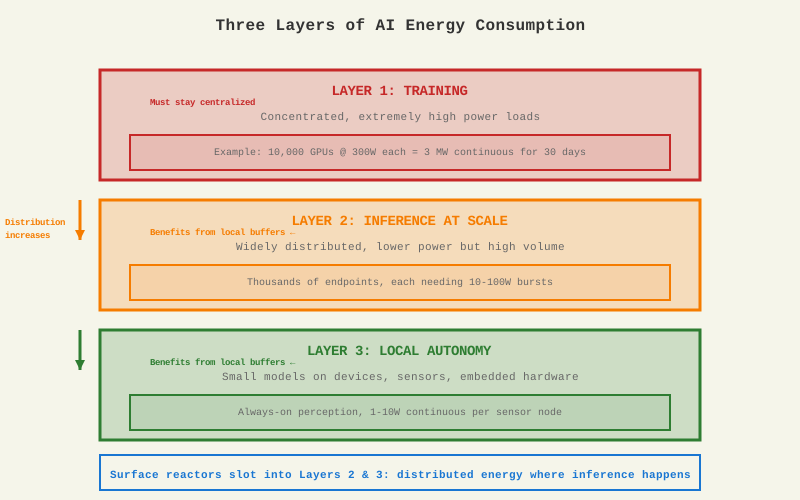
Figure 3: AI energy consumption has three distinct layers. Training (Layer 1) must stay centralized with extreme power loads. Inference at scale (Layer 2) and local autonomy (Layer 3) benefit from distributed energy buffers, exactly where surface reactors provide the most value.
⸻
3. Why Surfaces
Floors, walls, rooftops, and structural members have distinctive advantages:
- They already exist in enormous quantities.
- They are replaced or resurfaced on predictable cycles.
- They have stable mechanical coupling to human and environmental activity.
- They present large areas for printed electronics.
- They can host stacked layers of sensing, energy capture, and microstorage.
- They are difficult to sabotage at scale because of their distribution.
This is where sensored flooring and large area printed electronics intersect.
The same printed conductive networks used for high resolution gait sensing can support electroactive polymers, piezoelectric arrays, ultrathin film capacitors, and thermoelectric layers. The same edge gateways that process movement can buffer micro energy. The same redundancy techniques used for spatial fault tolerance can support energy routing networks.
Surfaces become the shared substrate for measurement, control, and small scale energy work.
⸻
4. District Scale Math: From Local Watts to Strategic Buffers
To see why this is more than a curiosity, look at a slightly broader energy balance that combines direct harvesting and avoided waste.
Imagine an "instrumented and energy active" square meter that participates in three ways:
- Direct electrical harvest via something like rooftop photovoltaic coating.
- Control informed HVAC savings via better sensing and occupancy feedback.
- Small scale mechanical harvesting in high traffic areas.
Conservative numbers are enough.
4.1 Direct harvest
For rooftop or sun facing surfaces, a reasonable average is around 20 W/m² over a full day for PV class materials:
Over 24 hours this gives:
Call that about 0.5 kWh/day per square meter.
4.2 Avoided waste via intelligent control
For HVAC, serious occupancy informed control often yields on the order of 10 to 30 percent savings. Suppose a commercial building uses 40 kWh/m² per month for HVAC. A 20 percent improvement is:
That is about:
This is energy you no longer spend because surfaces and sensors let you avoid conditioning empty space or badly controlled loads.
4.3 Mechanical micro harvesting
For direct kinetic harvesting in heavily trafficked zones, long term realistic averages are modest: on the order of 1 to 5 W/m² during active hours. Over a full day this is a small increment, better thought of as noisy contribution for local buffers rather than base load.
Taken together, a plausible daily figure per energy active square meter is on the order of:
Half from direct harvest, roughly a third from avoided waste, and a small tail from mechanical harvesting.
Now scale up.
Consider a metro region that instruments and energy activates 10 million square meters of rooftops, floors, and walls across public facilities, bases, campuses, logistics hubs, and transportation infrastructure.
The daily bufferable or re-timeable energy is then:
That is 8 GWh per day of energy that can be harvested, shifted, or freed through better control, attached directly to the surfaces where sensing and edge compute live.
Even if only a modest fraction of that is steered toward critical compute windows, the numbers begin to matter.
4.4 Relating this to AI and defense compute
Take a concrete AI training run:
Suppose 10,000 GPUs running at 300 W each for 30 days.
Over 30 days:
Compare this to the 8 million kWh per day of potential surface buffer in the district scale example.
One AI training run of this magnitude consumes about a quarter of a single day of the district's surface buffer. In practice you would not wire things this literally, but the scale comparison is instructive.
Rather than directly powering massive training workloads, a nation, or even a region, that cultivates millions of square meters of energy active surfaces can carve out gigawatt hour scale flexibility that makes critical compute less vulnerable to grid stress and more affordable to dispatch at strategic times.
The surface layer becomes a shallow but very wide reservoir that can support:
- peak shaving for AI clusters
- preferential support for defense and intelligence inference loads
- emergency operation of critical sensing and decision systems during disruption
The numbers are small at the square meter scale. They are significant when multiplied across a city.
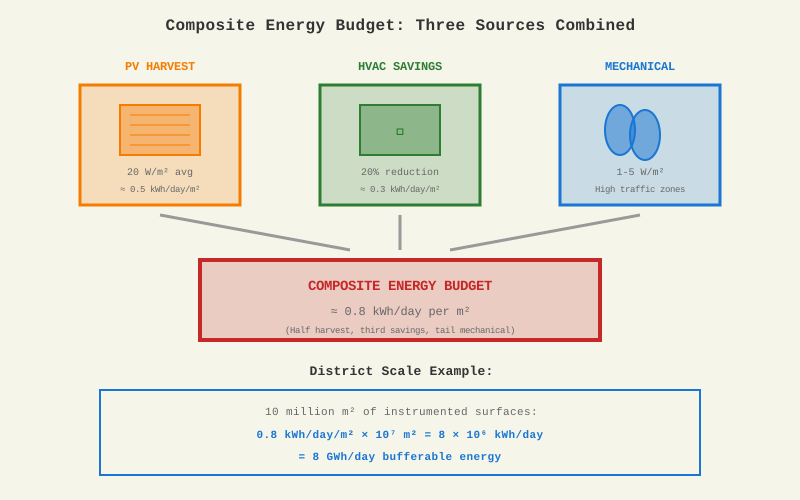
Figure 4: An energy-active square meter combines three sources: PV harvest (~0.5 kWh/day), HVAC savings from intelligent control (~0.3 kWh/day), and mechanical harvesting (small tail). Together this yields ~0.8 kWh/day/m². Scale to 10 million m² and you reach 8 GWh/day of bufferable energy.
⸻
5. Why Printed Electronics Matter
Printed electronics and organic materials make this kind of distributed surface participation economically plausible.
They offer:
- low cost per square meter
- mechanical compliance with real surfaces
- laminates that integrate with existing flooring and roofing supply chains
- large area coverage with minimal added thickness
- embedded sensing plus micro energy capture in the same stack
- failure tolerance through redundant printed geometries
Chemistry is the quiet driver.
- PEDOT:PSS and silver nanoparticle inks provide flexible conductors.
- Printed piezoelectric polymers capture mechanical impulses from steps and vibrations.
- Carbon nanotube inks support strain sensing and controlled dissipation.
- Printed ultrathin capacitors buffer microbursts of captured energy.
- Inkjet printed Schottky diodes and other rectifying structures convert irregular impulses into usable charge.
Small decisions about viscosity, sintering temperature, adhesion promoters, and substrate treatments ripple upward into system behavior. An ink that cracks slightly differently under thermal cycling can change long term yield. A curing profile that shifts resistance drift by a few percent can change how much energy you can reliably store at the edge.
Surface reactors are chemistry scaled to geography. They work at all only if the underlying printed structures can survive humidity, temperature cycling, substrate creep, and mechanical fatigue.
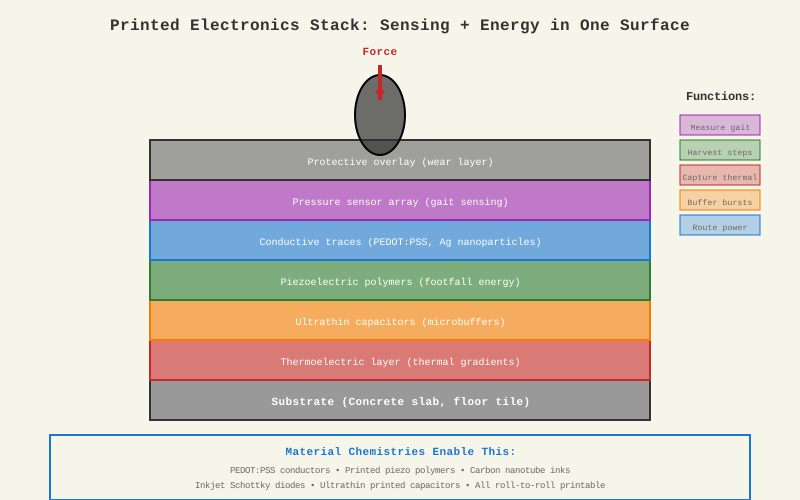
Figure 5: A multi-layer printed stack integrates sensing and energy capture. From bottom to top: substrate, thermoelectric layer, ultrathin capacitors, piezoelectric polymers, conductive traces, pressure sensors, and protective overlay. Material chemistries like PEDOT:PSS, silver nanoparticle inks, and printed Schottky diodes enable this integration.
⸻
6. What This Means for the Next Decade
The goal centers on adding a new tier to the computational energy ecosystem, complementing rather than replacing traditional generation or large scale storage.
A country that embeds surface reactors into its built environment gains:
- local energy smoothing for inference and control
- distributed compute autonomy in critical facilities
- resilience during outages or targeted disruption
- a computational mesh that grows with every renovation cycle
- leverage in a world where compute scarcity is strategic scarcity
At national scale, even small per meter gains compound.
If one percent of a country's existing flooring stock consists of energy active, sensored surfaces capable of fractions of a watt per square meter, the available local power for inference climbs into the hundreds of megawatts. Not for heavy industry, but for the nervous system of infrastructure.
The result manifests as a quiet enhancement of national technical sovereignty, built into the surfaces people already walk on, rather than as traditional power plant revolution.
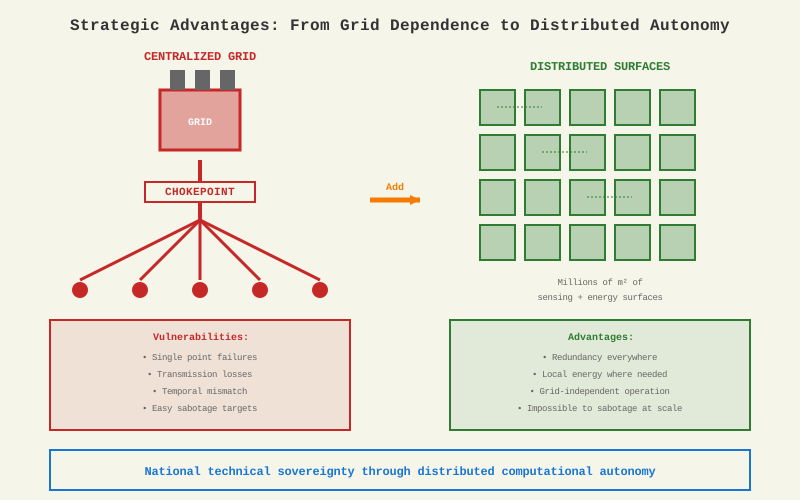
Figure 6: Centralized grids create single points of failure and easy sabotage targets. Distributed surface reactors provide redundancy everywhere, local energy where needed, grid-independent operation during disruptions, and resilience that's impossible to sabotage at scale, enabling national technical sovereignty through computational autonomy.
⸻
Closing Thought
The built world absorbs mechanical pressure, thermal gradients, vibration, and movement every second of every day. This energy dissipates as waste, bypassing the grid entirely.
Distributed sensing shows that surfaces can measure. Distributed harvesting suggests that surfaces can support. Distributed inference points toward surfaces that can think.
Surface reactors are a sketch of that future. They describe a world where the energy that once vanished into heat and noise instead supports a layer of persistent, local intelligence.
The next epoch of national technical defense may belong to the countries that realize their most underused energy resource is not buried in the ground, but spread across the surfaces they already own.