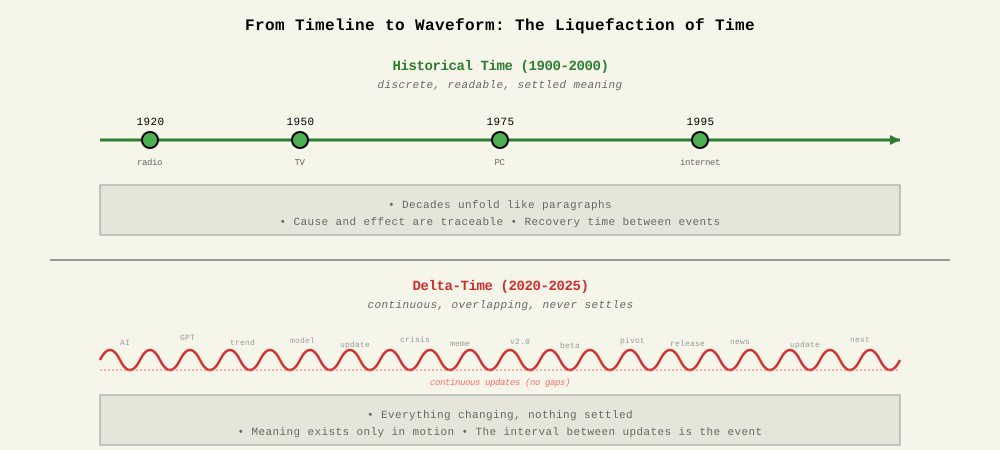
There's a strange vertigo to modern life: a feeling that time itself has liquefied. Trends flash, markets swing, technologies age out before they even reach ubiquity. The world is no longer a timeline; it's a waveform.
We used to live in history, looking back at cause and effect, watching decades unfold like paragraphs. Now we live in delta-time, the infinitesimal interval between updates, where everything is changing but nothing has quite settled into meaning yet.
It's not just that things move faster. It's that speed has become the environment itself.
The Shrinking Half-Life of Everything
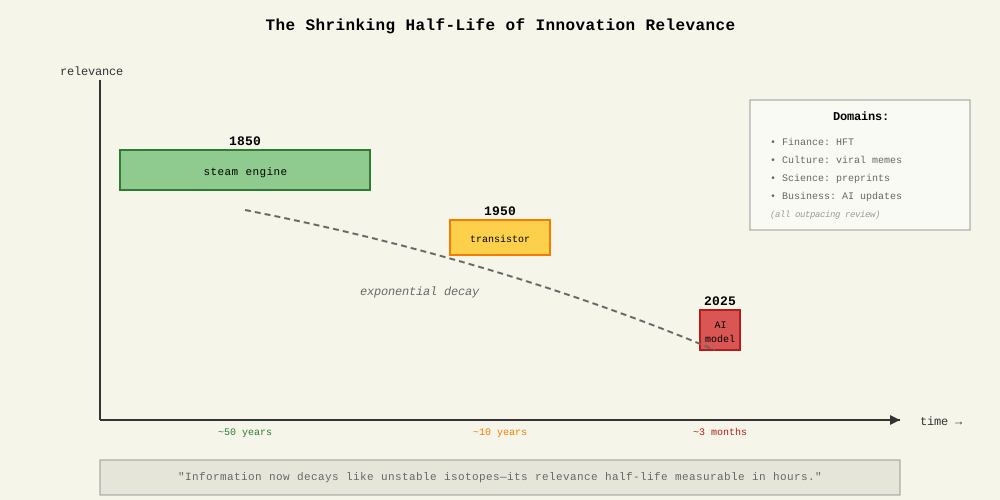
There was a time when innovation cycled with human generations. A breakthrough in 1850 might echo until 1900. A breakthrough in 1950 might define a decade. A breakthrough in 2025 defines a quarter.
Information now decays like unstable isotopes: its relevance half-life measurable in hours. News, memes, research papers, even friendships fade at exponential rates.
In finance, this looks like high-frequency trading. In culture, it's virality without memory. In science, it's preprints faster than peer review. In business, it's AI models outrunning regulation.
Temporal compression isn't just acceleration; it's the collapse of recovery time. We don't get to metabolize before the next event arrives.
Physics of Acceleration
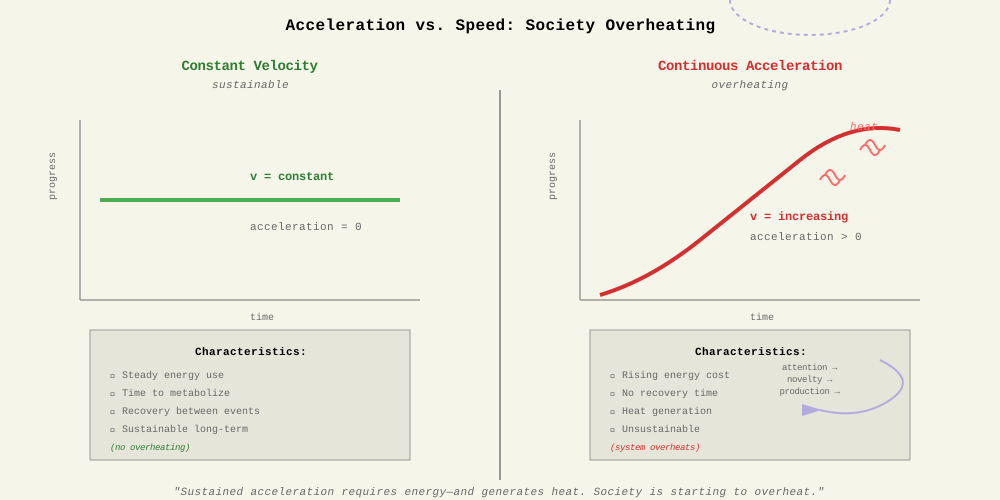
Acceleration is not speed; it's change of speed over time. In physics, sustained acceleration requires energy and generates heat.
Society is starting to overheat.
Every system, from media to money to science, is now driven by positive feedback loops. Attention chases novelty; novelty drives production; production feeds attention. The derivative of progress has become the product.
We measure ourselves not by where we are, but by how fast we're changing.
When velocity becomes identity, deceleration feels like death.
The Permanent Near-Future
Every conversation now happens half a step ahead of the present tense. Products ship in beta and stay there. Cities plan for technologies that haven't stabilized. Careers are shaped by tools that don't exist yet.
We live in a kind of permanent anticipation, always adjusting for the next release, the next model, the next wave. It's exhilarating and exhausting.
In psychology, this shows up as temporal anxiety: the inability to feel "caught up." Every inbox and feed is a window into futures that are constantly arriving but never fully here.
It's not the future that overwhelms us; it's the rate at which it updates.
The Speed of Money, The Speed of Thought
Finance used to be about risk. Now it's about latency. When markets move at the speed of light, advantage comes from milliseconds. The global economy runs on fiber optic timing: who can see the future 0.002 seconds before everyone else.
Information systems follow the same logic. The best-performing algorithms are not necessarily the smartest, but the fastest to adjust. The world has become a real-time control loop, where adaptation itself is the main asset.
In this sense, time has become capital. And for most people, we are increasingly poor.
Memory Erosion
Compression leaves artifacts. In audio, it's distortion. In time, it's amnesia.
When everything accelerates, memory becomes drag. Reflection feels inefficient. We optimize for throughput, not understanding.
Cultural memory (books, rituals, institutions) once acted as time reservoirs, slowing civilization down just enough to learn from itself. Now, those reservoirs are draining. The past is searchable but not felt.
We don't remember; we retrieve. We don't plan; we pivot. We live in a continuous now, updated hourly.
Biological Mismatch
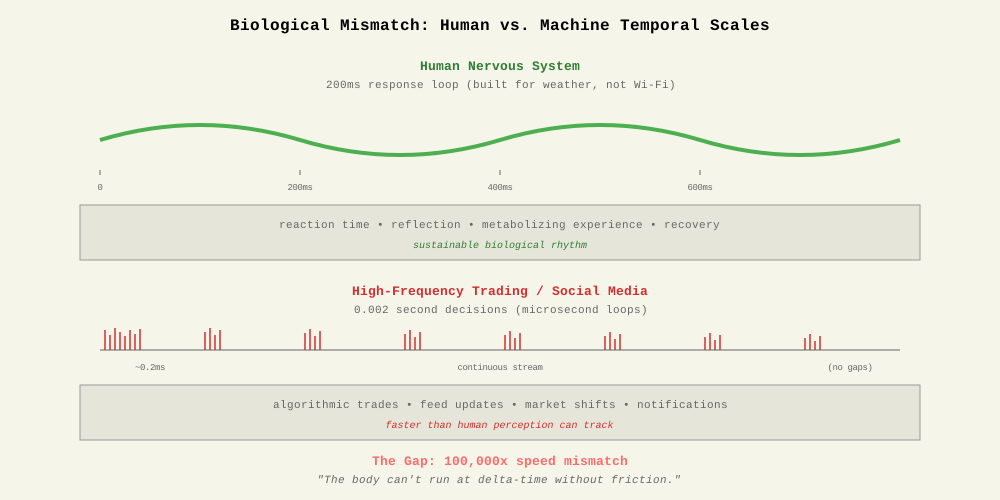
The human nervous system runs on a 200-millisecond loop. Evolution built us for weather, not Wi-Fi.
Our hormones still treat uncertainty as threat, speed as pursuit, overload as danger. The result is a body permanently tilted forward: dopamine chasing prediction errors, cortisol cleaning up the mess.
We talk about burnout as a personal failure, but it's really a physics problem: the energy cost of continuous acceleration.
The body can't run at delta-time without friction.
Attempts at Equilibrium
Some are trying to build counter-technologies:
- Slow media movements that privilege curation over immediacy.
- Local manufacturing and long-termism in design.
- Regenerative calendars in workplaces, syncing to human rather than machine rhythms.
Even AI alignment research, in a strange way, is a reaction to temporal compression: a desire to slow down the rate of emergent intelligence long enough to stay inside the loop.
We are learning, awkwardly, that not every derivative needs to be optimized.
Living in Delta-Time
When you operate in delta-time, meaning comes not from permanence but from stability amid motion: like surfing a wave rather than standing on ground.
Maybe wisdom in this era isn't about slowing time down, but about developing temporal literacy:
- Knowing when to speed up and when to idle.
- Knowing which streams to sample and which to ignore.
- Learning to see time not as a line, but as a fluid you can breathe through.
In delta-time, the skill isn't prediction. It's presence.
Closing Reflection
Humanity spent millennia fighting scarcity of information. Now we fight its velocity.
We've built a civilization that moves faster than our capacity to interpret it, and yet we can't stop accelerating, because acceleration has become our only proof of progress.
Maybe the next enlightenment won't come from new discoveries, but from new pacing: a collective decision to reintroduce friction where it matters.
Until then, we remain suspended in this strange interval between moments, living not in history, but in its derivative—the thin slice of delta-time where the future keeps refreshing before it ever arrives.