Human behavior feels intuitive from the inside. You walk through a lobby, you choose a path, you avoid someone's rolling cart, you speed up because you are late, you slow down because you recognize a face. Each action feels small and obvious.
But to a scientific observer, every one of those moments sits inside a state space so large that it is difficult even to describe. What looks simple is combinatorial. What looks predictable is a branching tree of possibilities. What looks like a pattern is often just a coincidence that happened twice.
Behavior explodes into micro-decisions unfolding in parallel.
The challenge for anyone building models of human movement, cognition, or interaction is that this space grows faster than our tools can track when we move from single individuals to real environments.
⸻
1. Behavior as a Graph
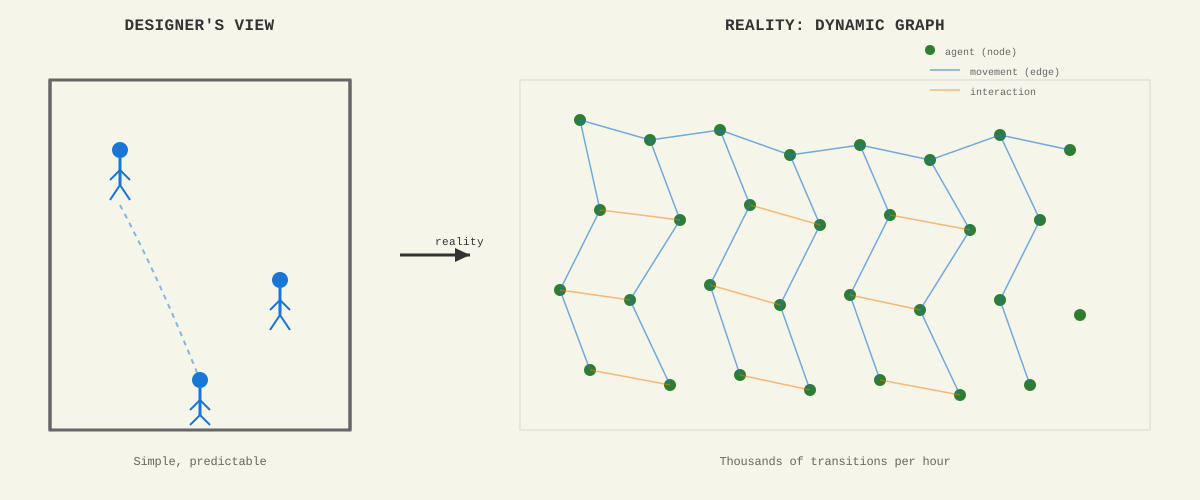
One way to understand this is to treat behavior as a graph.
Every human in a space can be considered a node.
Every movement, glance, shift of attention, or micro-adjustment is an edge.
Every interaction between people is a joint transition in a shared graph.
The structure evolves continuously. People enter and exit. Their goals shift. Their attention toggles between internal and external cues. Their perception of the space changes depending on lighting, sound, fatigue, or urgency.
What looks like a single hallway becomes a dynamic, multi-agent graph with thousands of transitions per hour. In a large building, the graph is more like a living organism than a static structure.
This is where the combinatorics begin.
Every added agent expands the number of possible interactions.
Every added objective multiplies the number of trajectories.
Every environmental factor compounds the branching.
There is no "typical" path. There is only the distribution.
A sensor system like Scanalytics observes only a subset of this graph, but even that subset reveals how quickly complexity grows. A few hundred square feet of instrumented flooring can generate millions of movement patterns no designer could guess in advance.
⸻
2. Markov Blankets and What People Can Even See
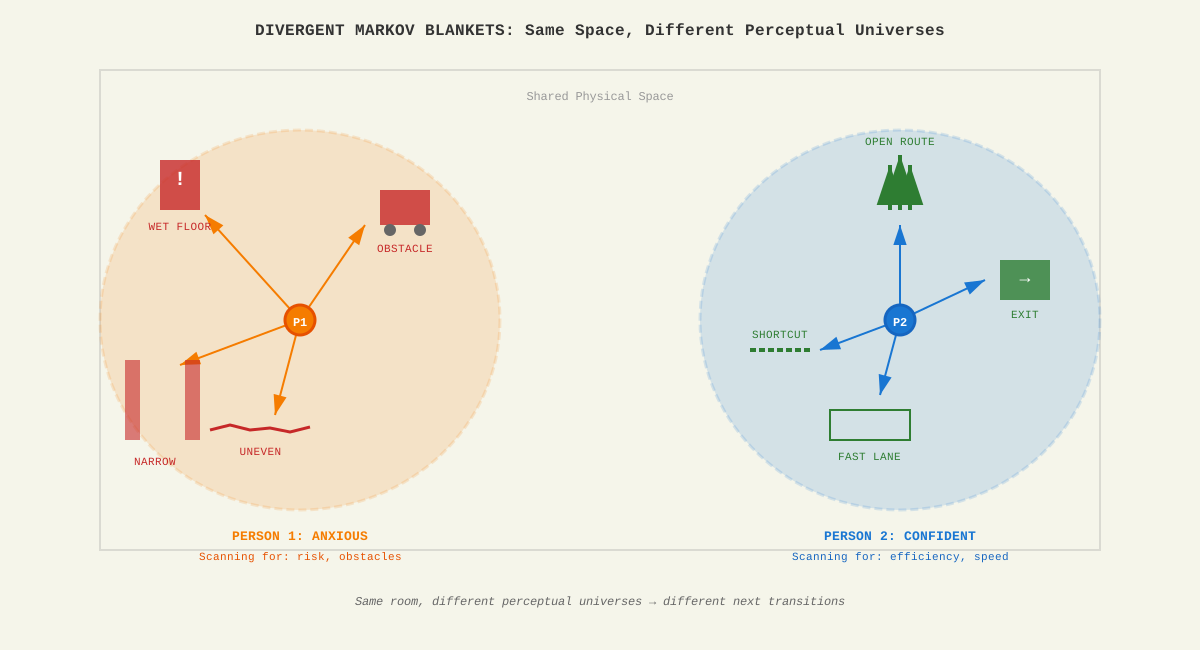
Another useful lens is the Markov blanket. The idea is simple: each individual can only respond to the information inside their sensory boundary. Everything else is outside their inference horizon.
Two people in the same room inhabit different perceptual universes.
One hears a sound the other missed.
One is distracted, the other focused.
One sees the open route, the other sees the obstacle.
One is anxious and scanning for risk.
One is confident and scanning for efficiency.
Their internal models differ, so their next transitions differ. Even identical sensory inputs do not generate identical behaviors.
When you widen the frame to a full environment, these subjective blankets produce complex cascades. One person slows, another reroutes, someone decides to overtake, someone pauses to read a sign, someone moves erratically because of pain, someone hesitates because of glare. These cascades ripple through the space, recombining at each step.
The combinatorics are not just spatial.
They are perceptual.
They are emotional.
They are intent-driven.
To model human behavior, you must accept that each agent brings its own miniature universe into the shared one.
⸻
3. State Explosion: The Real Source of Complexity
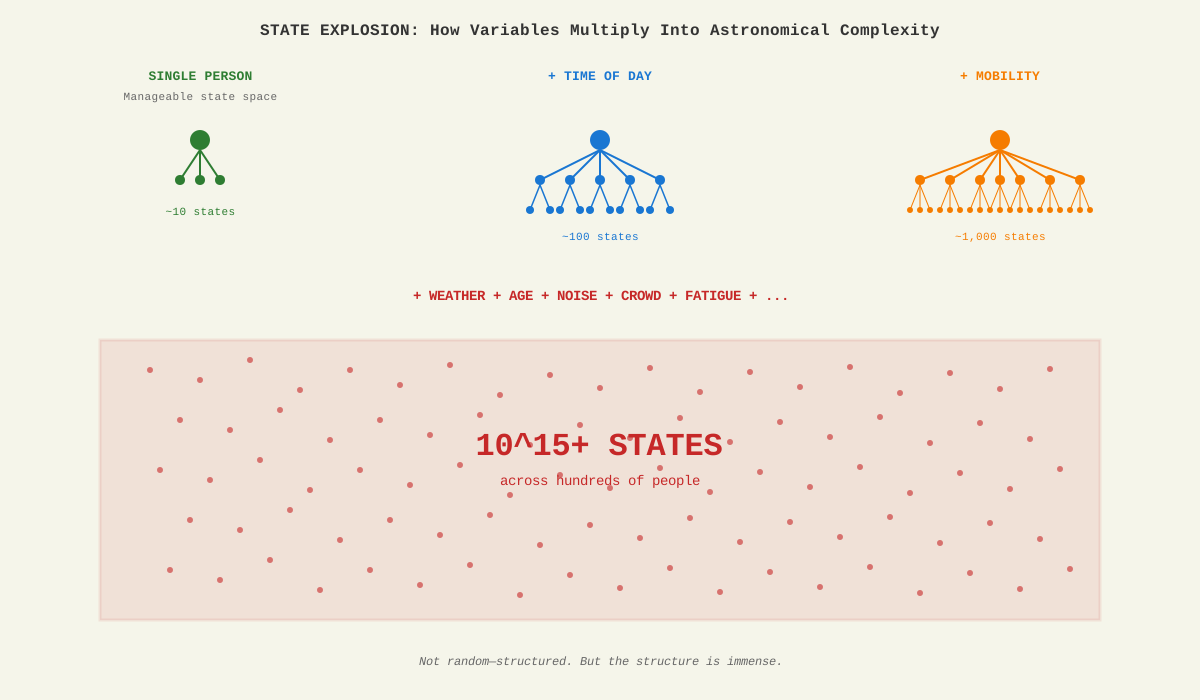
Add even a few variables and the state space becomes astronomical:
- time of day
- purpose of visit
- mobility differences
- age
- weather
- noise
- crowd density
- familiarity with the building
- emotional state
- social obligations
- fatigue
Now multiply these across hundreds or thousands of individuals occupying the same environment.
This is state explosion in the strict combinatorial sense. The number of possible behavioral trajectories grows faster than our ability to enumerate them. Human behavior is structured—but the structure is immense.
Architects see this when designs meet reality.
What was intended as a clear path becomes a collision zone.
What was meant as a quiet alcove becomes a shortcut.
What was laid out as a gathering space becomes unused.
Small assumptions lead to large mismatches.
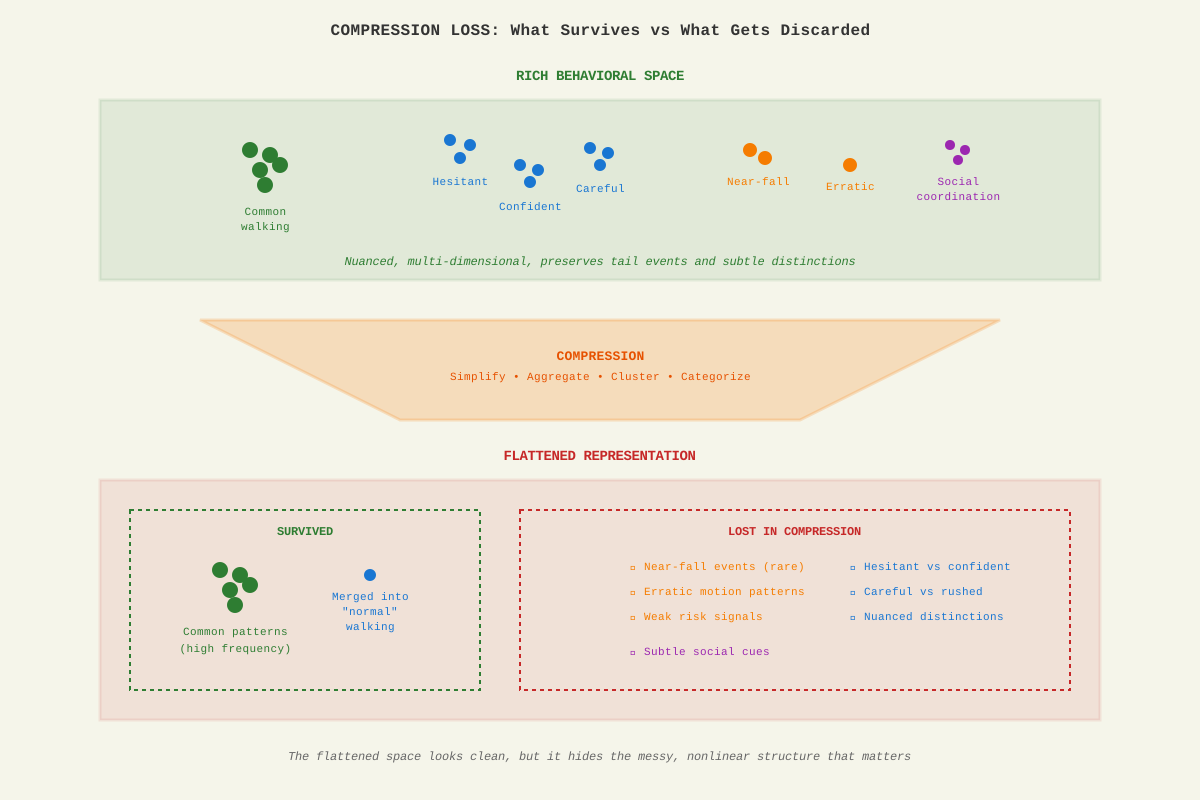
Even machine learning struggles with this. Models compress behavior into embeddings, clusters, or categories. They must, because no system can compute directly over the full space. But compression hides nuance. It erases tails. It flattens rare but important patterns.
This is the danger: the illusion of simplicity in a domain that is fundamentally combinatorial.
⸻
4. Why Compression Creates Illusions
Every behavioral model chooses what to keep and what to discard.
Simplify trajectories.
Aggregate flows.
Cluster movement types.
Define categories of risk.
Represent users as personas.
Pool time into slices.
Pool space into zones.
Each step discards structure.
Each step reduces dimensionality.
Each step maps many possible realities into one labeled bucket.
The problem emerges when compression creates the illusion of understanding.
The flattened space looks clean, but it hides the messy, nonlinear structure of human behavior. When rare but consequential patterns collapse into more common ones, mistakes accumulate.
A design might work for ninety percent of users but quietly fail the ten percent who never get modeled. A risk pattern might hide in the long tail because the representation space was optimized for frequency rather than consequence. A social cue might disappear because embeddings merge subtle distinctions.
Systems that compress behavior too aggressively lose the texture that makes behavior intelligible.
⸻
5. Can We Model Behavior Without Losing Its Soul
We already model behavior. The question is whether we can do it without erasing the very nuance that matters.
Some ways forward:
1. Multi resolution modeling
Keep multiple levels of abstraction. High level flows for planning. Fine grained micro-patterns for safety, accessibility, and response.
2. Preserve tails
Rare events carry disproportionate importance. Slip events, erratic motion, unexpected slowdowns, micro-clusters. These must have modeling capacity allocated to them.
3. Cross modal grounding
Combine movement with context: weather, lighting, room function, time. Behavior only makes sense relative to environment.
4. Real environments as living laboratories
This is where a platform like Scanalytics plays a role. The ability to observe millions of trajectories across diverse environments allows patterns to surface that no designer or theorist could anticipate. The value lies in rich empirical grounding, not perfect prediction.
5. Human in the loop interpretation
Models can highlight structure, but humans interpret why it matters.
We may never fully conquer the combinatorics, and that is acceptable. The goal is fidelity, not completeness.
⸻
Closing Thought
Human environments generate an enormous behavioral state space because people carry complex internal worlds with them. When these worlds collide inside architected space, the result is a combinatorial structure that requires care to understand.
Compression is necessary. But careful compression preserves the richness that makes behavior meaningful.
The future of modeling human environments will depend on striking this balance. Enough structure to generalize. Enough nuance to stay faithful to the living patterns of human life.
The space is vast.
Our models are partial.
The challenge is to keep them honest.