3:47 AM, Tuesday
Mrs. Chen gets up to use the bathroom. The floor in her senior living apartment knows.
Not because of cameras or wearables. She refused to wear the fall-detection pendant months ago. But because pressure sensors woven into the flooring itself capture something more fundamental: how she moves through space.
Tonight, her gait is different. Her left foot is landing 40 milliseconds slower than usual. Her stride length has shortened by 3 centimeters over the past six weeks. The floor has logged 847 bathroom trips over 18 months and knows her nocturnal patterns better than any human observer could.
A quiet alert goes to the care team. Not urgent, just a pattern worth watching. Three weeks later, during her routine checkup, they discover early-stage arthritis. Treatment begins before a fall ever happens.
Now zoom out.
That same data, anonymized and aggregated across thousands of residents and millions of footsteps, becomes something else entirely: training data for embodied AI that no foundation model company can scrape from the internet or synthesize from text.
It's the difference between an AI that has read about how elderly people fall, and an AI that has observed 10,000 falls beginning: the micro-changes in gait, the hesitation patterns, the temporal signatures of decline. One AI can write about fall prevention. The other can predict falls before they happen and design interventions that actually work.
This is the data that Anthropic, OpenAI, and Google cannot get anywhere else. And they would pay handsomely for exclusive access to it.
But Mrs. Chen's story is just one building type.
That same floor in a Nike training facility is learning how elite athletes generate power and identify injury risk. In an office building, it's revealing collaboration patterns and optimizing space for productivity. In a hospital rehabilitation center, it's tracking recovery progress with millimeter precision. In a retail store, it's understanding customer flow and decision-making.
The floor doesn't care what building it's in; it just measures how humans move through space. And when you combine senior living data (aging patterns) with sports facility data (peak performance) with office data (collaboration) with hospital data (recovery) with retail data (decision flow), you don't get isolated insights.
You get a universal foundation model for spatial intelligence.
⸻
Every AI story is a data story.
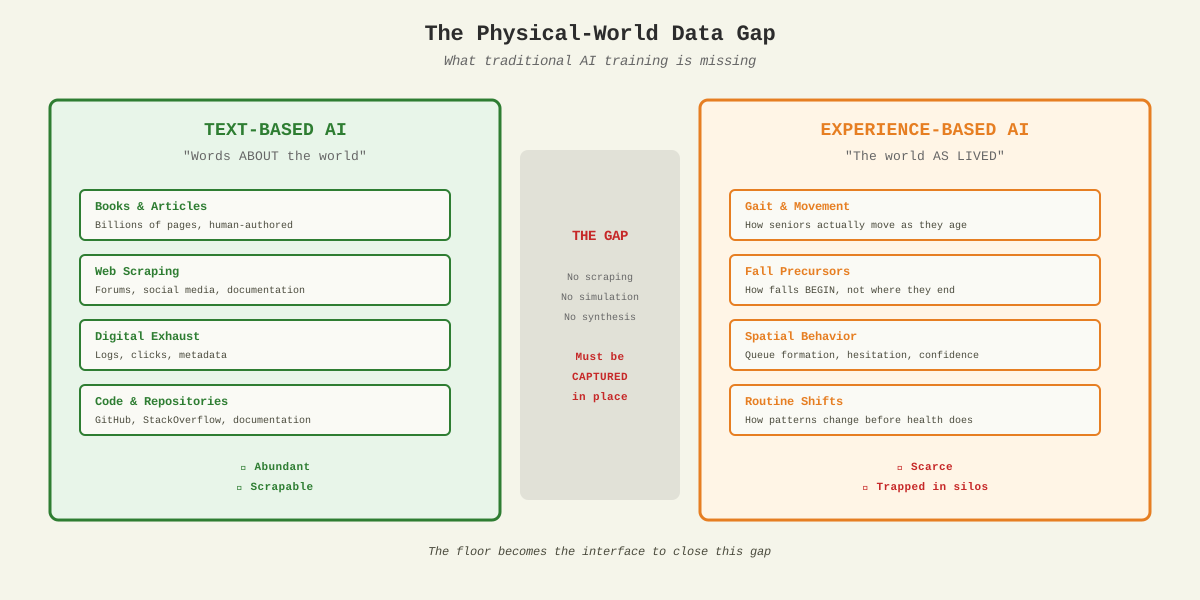
Large models don't just need more compute; they need more reality: rich, structured, non-obvious data about how the physical world actually behaves. Not the world as described in text, but the world as lived: how people move, hesitate, queue, fall, recover, gather, and avoid.
Right now, that kind of data is almost impossible to get at scale. It's fragmented across buildings, trapped in proprietary systems, or never captured at all. We have a universe of "built-world behavior" that's effectively a dark matter for AI.
Scanalytics' bet is simple and radical:
The floor is the missing interface between physical experience and foundational models.
Because flooring is the only surface that routinely touches the entire building stock, refreshed every 5-10 years, it can quietly become the largest, regularly updated corpus of physical-world behavioral data on Earth.
And if you can turn that into a business model, you don't just sell sensors. You marry two worlds that rarely share a room: building materials and frontier AI companies.
What follows is the economic and strategic opportunity unlocked when the built environment becomes legible: not through cameras or wearables, but through the surfaces we already inhabit.
⸻
I. The physical-world data gap
We have reached the limit of what text, images, and scraped digital exhaust can teach AI.
The next wave of intelligence (health, safety, robotics, elder care, urban design) will require spatiotemporal experience, not documents:
- How people navigate unfamiliar environments (airports, hospitals, campuses)
- How gait changes signal health decline across populations
- How layout influences behavior: confidence, confusion, crowding, avoidance
- How foot traffic patterns reveal operational inefficiencies in retail, logistics, manufacturing
- How building occupancy shifts throughout the day, week, and season
This data cannot be obtained through scraping or simulation. It must be captured in place, continuously, unobtrusively, and with privacy preserved.
The question is: what surface can do that, at global scale?
⸻
II. Why the floor is the most compelling lens
Walls, ceilings, cameras, and IoT devices are fragile. They break, move, get turned off, blocked, or updated. Tenants churn. Hardware becomes obsolete.
Flooring is different.
- It covers nearly 100% of usable space.
- It's replaced on predictable cycles (5-10 years).
- It's capital expenditure, not a gadget.
- Everyone interacts with it every day, regardless of age, device literacy, or behavior.
By integrating large-format, high-resolution sensors directly into flooring products, the floor becomes a long-duration, building-scale observatory: a place where gait, intention, risk, attention, routine, and anomaly leave measurable signatures.
Senior living offers a vivid example of what becomes possible at scale. Imagine:
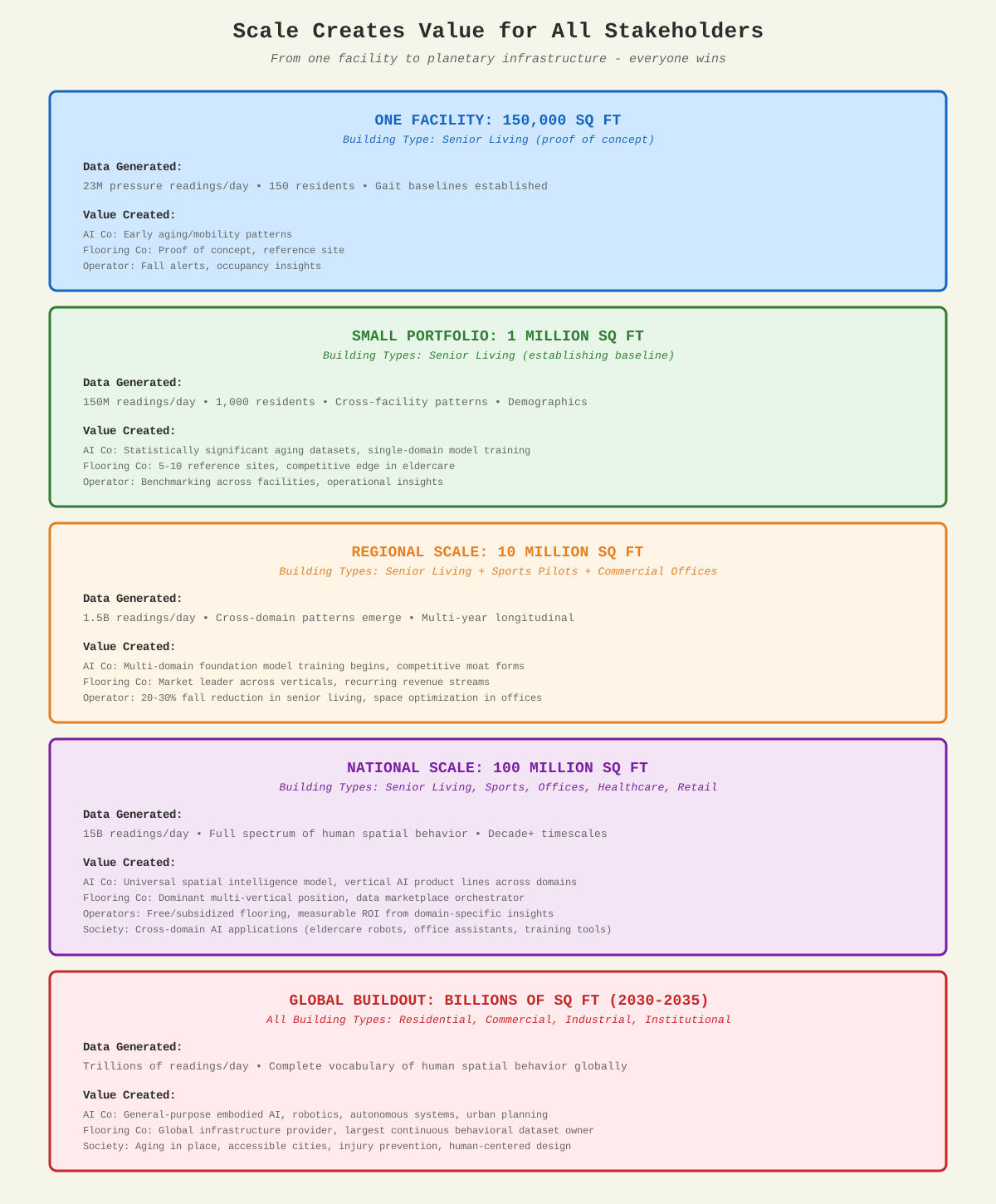
- 10 million square feet instrumented (equivalent to 65+ senior living facilities)
- Sampling 5 times per second, 24/7
- Across 10,000+ residents
- Over multiple years, generating 1.5 billion pressure readings daily
That's not analytics. That's a foundational dataset for embodied intelligence: larger in temporal resolution than any wearable study, richer in spatial context than any camera system, and longer-running than any controlled experiment.
⸻
III. From materials to meaning: the data corpus beneath our feet
Raw contact data is only the beginning. What Scanalytics actually generates is a semantic layer:
- space utilization and traffic patterns (offices, retail, logistics)
- hesitation at navigation points (wayfinding, signage effectiveness)
- flow bottlenecks and queue formation (airports, hospitals, events)
- health signals through gait and mobility (senior living, insurance, wellness)
- dwell time by zone (retail conversion, amenity usage)
- routine baseline and anomaly detection (security, operations, health)
- population rhythm across time and season (facility management, energy, staffing)
This is the physical analogue of what the largest AI labs crave: high-value, domain-specific, real-world data that cannot be imitated or scraped.
It's the difference between reading about humans in text and studying human movement at population scale.
But what about privacy?
This is always the first question, and it's the right one to ask. Here's how privacy works in this model:
No cameras. No faces. No personal identification.
Pressure sensors detect footsteps and gait patterns, not individuals. The system doesn't know who Mrs. Chen is; it knows that "a resident in apartment 3B has exhibited gait pattern changes consistent with mobility decline." Data is anonymized at the sensor level, before it ever leaves the building.
Population-level insights, not individual surveillance.
AI companies don't need to know that "John Smith fell at 3:42 AM." They need to know that "across 10,000 fall events, 87% were preceded by specific gait changes over 4-6 weeks." The value is in the aggregate patterns, not personal tracking.
Think traffic sensors, not facial recognition. Traffic sensors count cars and measure flow without reading license plates. Floor sensors measure movement and detect patterns without identifying people. The data is inherently privacy-preserving because the sensor modality itself cannot capture personally identifiable information.
⸻
IV. Scanalytics' role: the protocol and the bridge
Before we dive into the economics, it's important to understand what Scanalytics actually does.
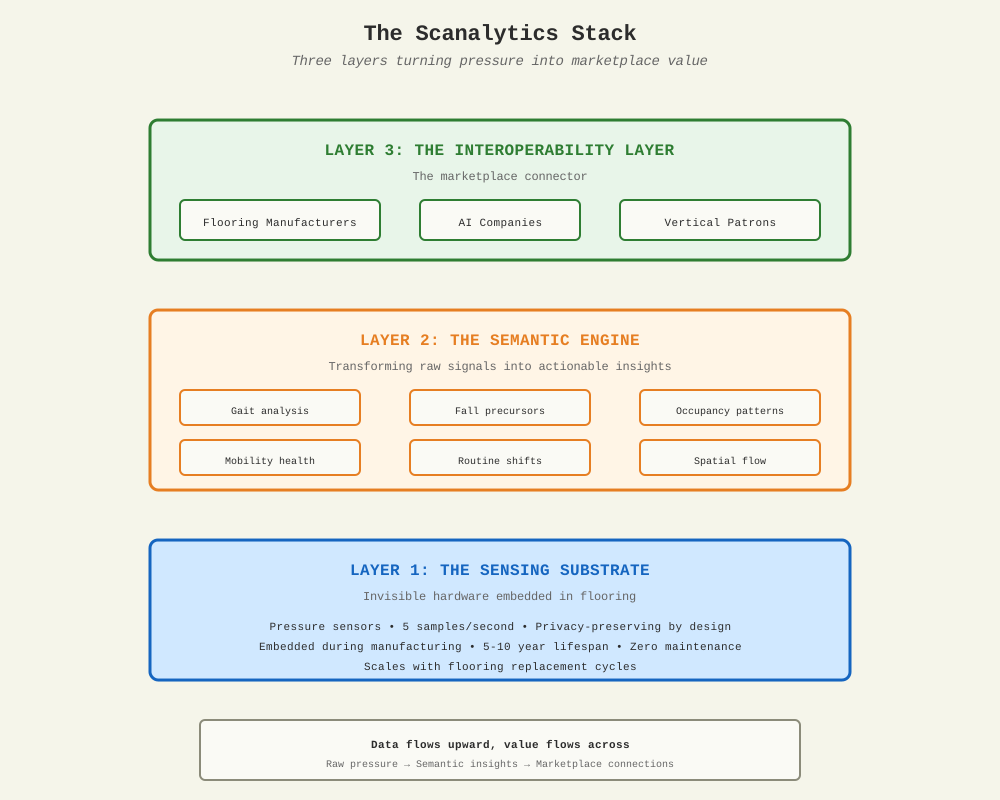
Scanalytics functions as a protocol layer that turns raw pressure data into structured, privacy-preserving, domain-ready insights.
We provide three critical layers:
- The sensing substrate: A low-friction, invisible hardware layer that scales with flooring replacement cycles. Sensors are embedded directly into flooring products during manufacturing.
- The semantic engine: Transforming raw pressure signals into actionable insights (gait analysis, fall precursors, occupancy patterns, mobility health trends).
- The interoperability layer: Bridging flooring manufacturers with AI model companies and vertical patrons, making the marketplace work.
We orchestrate the marketplace. We make the economics work. We make the data legible.
Why Multiple Building Types Matter
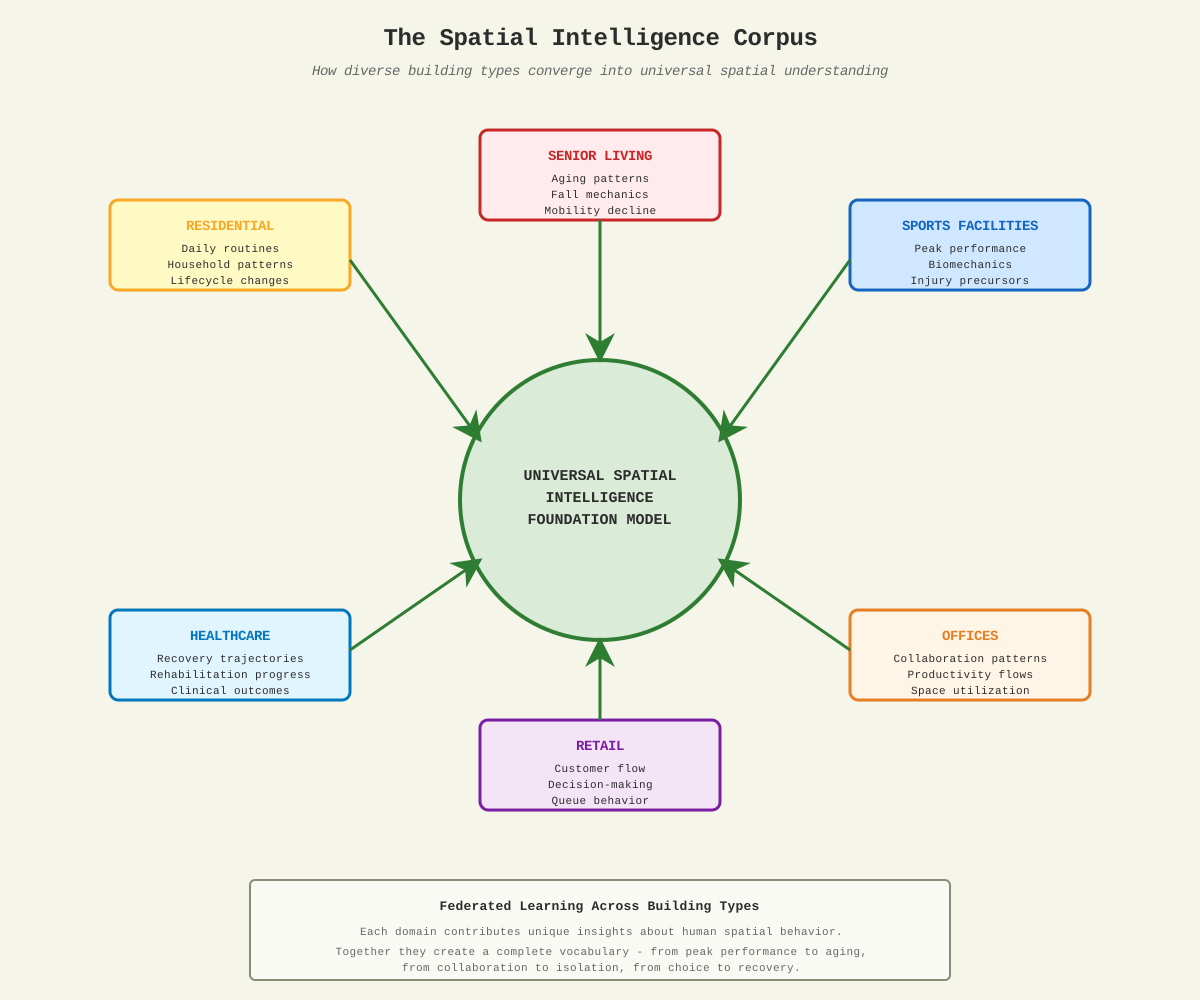
Training on senior living data reveals how aging affects movement. Training on sports facilities reveals peak performance biomechanics. Training on offices reveals collaboration patterns. Each domain unlocks insights that simply don't exist in the others, and the combination creates something no single vertical can achieve.
Each building type teaches the AI something unique:
Senior Living: How mobility degrades with age, fall mechanics, hesitation patterns, cognitive load through gait
Sports Facilities: Peak human performance, biomechanics, injury precursors, training adaptation
Offices: Collaboration patterns, productivity flows, space utilization, social dynamics
Retail: Decision-making under choice, queue behavior, browsing patterns, spatial attention
Hospitals: Recovery trajectories, rehabilitation progress, assisted mobility, clinical outcomes
Residential: Daily routines, household patterns, lifecycle changes, long-term behavioral shifts
The magic is in the synthesis. An AI that understands how 80-year-olds move AND how Olympic athletes move has learned the full spectrum of human spatial capability. An AI that knows both collaboration (offices) and isolation (senior living) understands social context. An AI trained on recovery (hospitals) and peak performance (sports) can map the entire health continuum.
This is why flooring manufacturers who instrument multiple building types become exponentially more valuable. They're not selling data from one vertical; they're selling the Rosetta Stone of human spatial behavior.
⸻
V. The economic inversion: flooring as an AI-financed asset
Here's the core inversion of the business model:
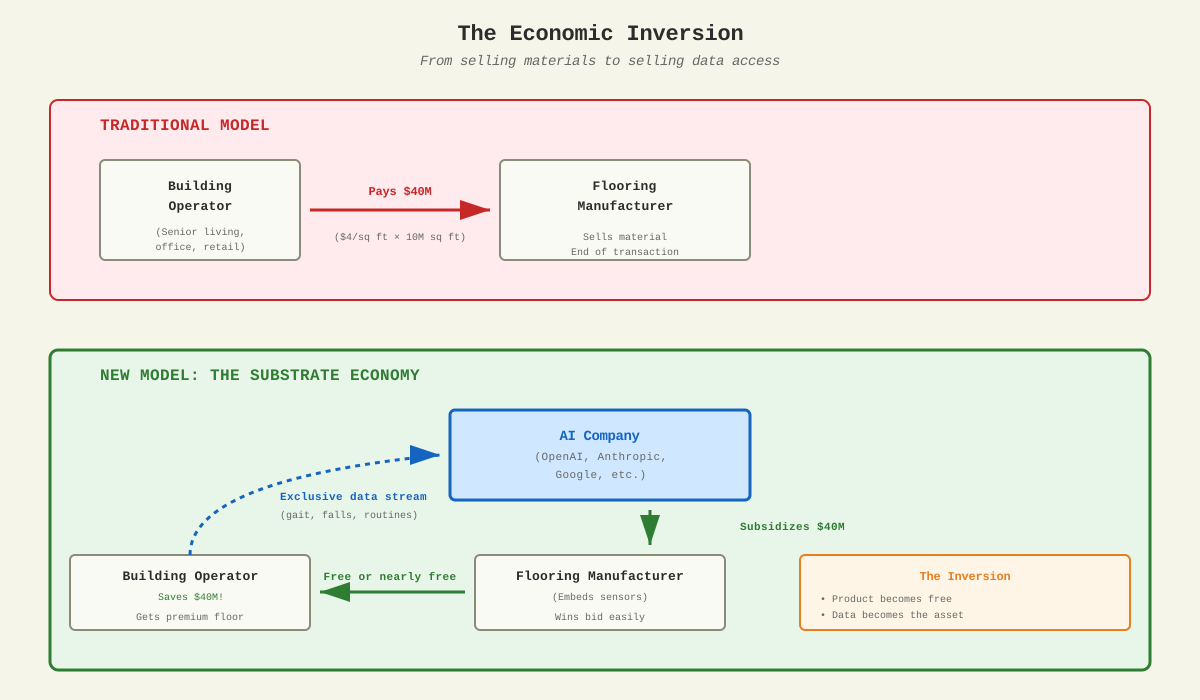
Flooring manufacturers don't sell material. They sell access to exclusive, real-world data streams.
In the traditional model, a manufacturer sells flooring at, say, $4 per square foot. A 10M sq. ft. project is a $40M contract.
In the new model:
- Step 1: Embed the sensors. A flooring manufacturer embeds Scanalytics sensors into their product line.
- Step 2: Win the bid. They win bids for large installations (say, 10 million sq. ft. of senior living).
- Step 3: AI company subsidizes. Instead of the operator paying for that flooring, a foundational AI company steps in and subsidizes it - partially or fully.
- Step 4: Secure exclusive data. In return, that model provider receives exclusive or preferential access to the anonymized data produced by those floors.
Suddenly, the flooring company has an unbeatable value proposition:
"Your flooring is free, or nearly free."
And the model company secures a rare asset:
A proprietary, compounding corpus of physical-world experience.
Even full subsidies are trivial at frontier scales. GPT-4 reportedly cost over $100M to train. Subsidizing 10M sq. ft. of sensorized flooring ($40M) is less than half of one training run, yet it secures years of exclusive, irreplaceable training data that compounds in value with every footstep.
⸻
VI. When AI companies become the banks of infrastructure
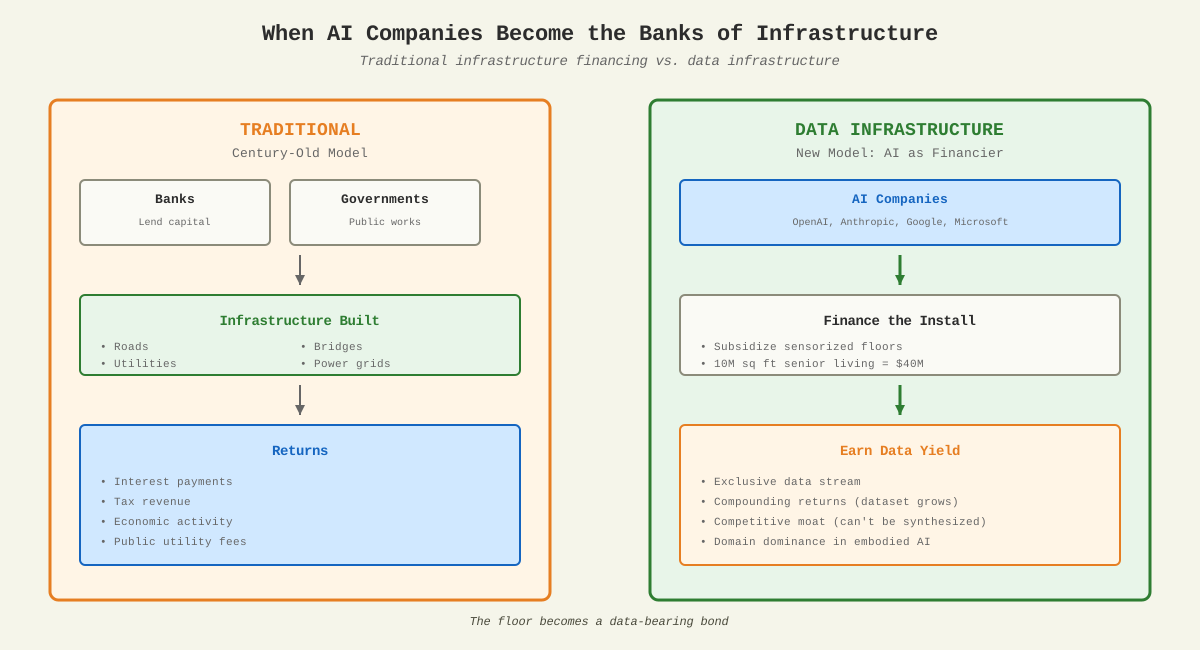
For over a century, infrastructure has been financed by banks, governments, and utilities.
But data infrastructure is different. It's financed by whoever needs the data the most.
In this model, AI companies act as banks:
- They finance the install.
- They earn the yield (data).
- They hold the asset (exclusivity).
- They benefit from compounding returns (as the dataset grows).
- They gain a competitive moat that cannot be synthetically reproduced.
The floor becomes a data-bearing bond, and model companies become institutional lenders of intelligence.
⸻
VII. Multipliers: the compounding loop
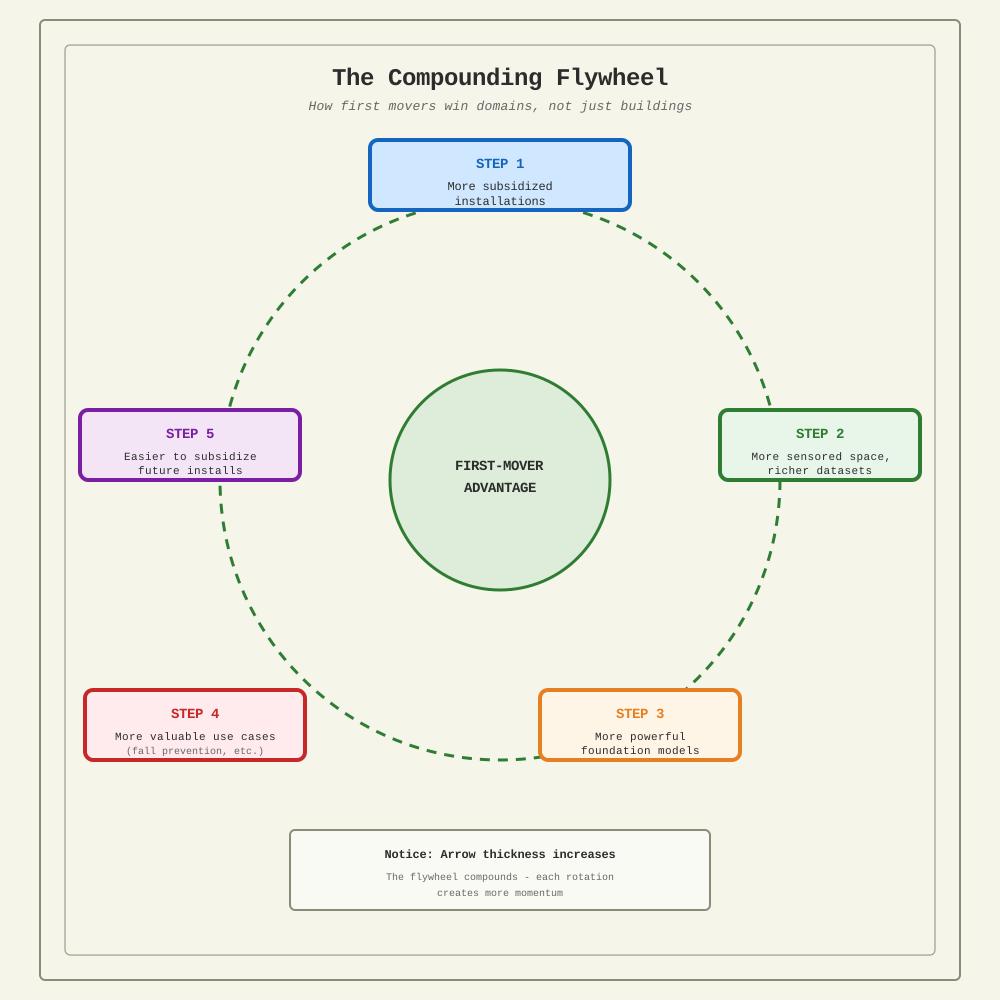
This architecture creates a self-reinforcing flywheel:
- More subsidized installations means more sensored space.
- More sensored space means richer, more diverse datasets.
- Better data means more powerful, domain-dominant foundation models.
- Better models means more valuable use cases (fall prevention, layout optimization, agentic safety).
- More valuable use cases means easier to subsidize future installs.
The first mover doesn't win a building. They win a domain.
⸻
VIII. Beyond AI labs: vertical data patrons
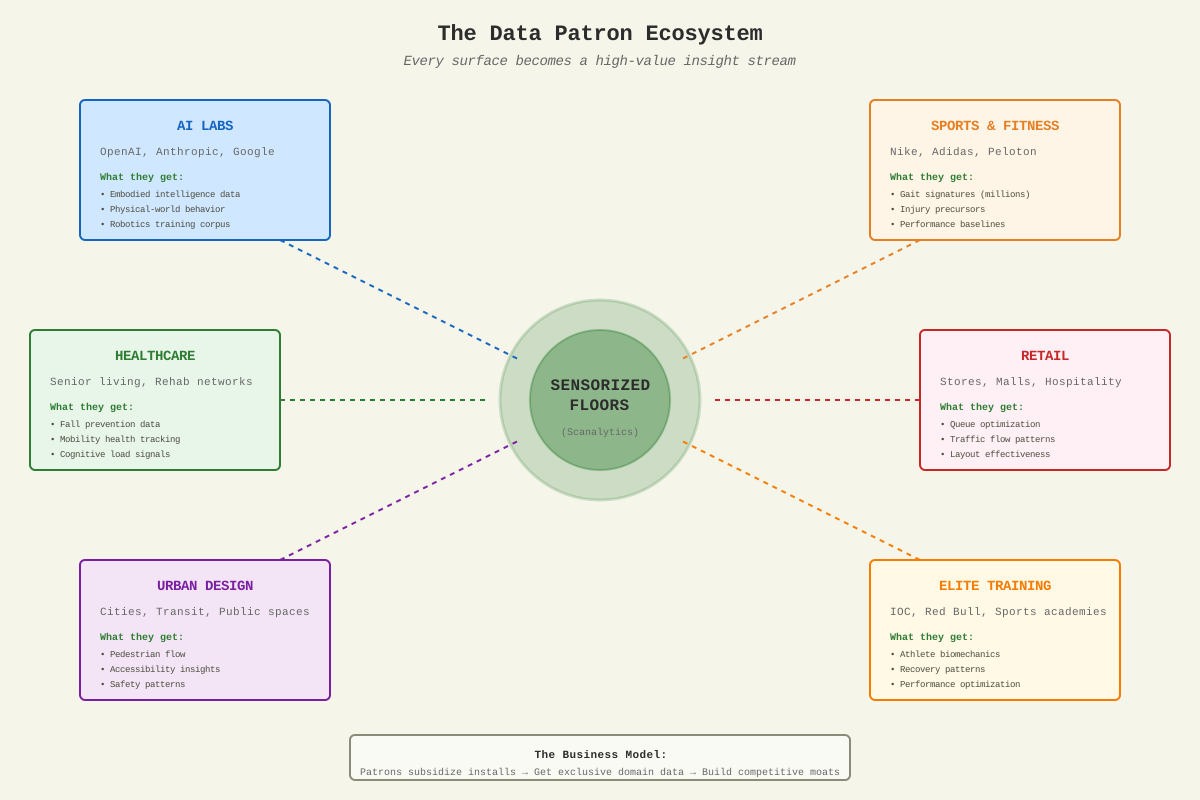
The model generalizes far beyond foundation-model companies. Any company whose future depends on understanding human movement, performance, or interaction with space becomes a potential data patron.
Nike as an example
When Eliud Kipchoge trained for his sub-2-hour marathon attempt, Nike invested millions in specialized biomechanics facilities, motion capture systems, and sports science research. They controlled every variable (the track surface, the pacing, the footwear) to extract insights worth billions in product development.
Now imagine Nike underwriting the sensorization of:
- Every NCAA Division I track and training facility (350+ locations)
- 10,000 high school tracks across the US
- Popular running paths in 500 major cities
- Elite training centers for Olympic athletes
Nike's annual marketing budget is $3.6 billion. Instrumenting these surfaces might cost $200-300M over 5 years, less than 2% of their marketing spend.
In exchange, Nike receives:
- Gait signatures across 50 million runners, not 50 elite athletes
- Injury precursor patterns from millions of training sessions, not controlled studies
- Real-world acceleration and deceleration data across every age group and skill level
- Surface-response signatures showing exactly how different shoes perform on different terrains
- Performance baselines segmented by geography, climate, altitude, age, and footwear
This isn't marketing data; it's the raw material for designing the next generation of footwear, building personalized coaching algorithms, creating predictive injury prevention tools, and developing entirely new product categories.
Nike doesn't buy flooring; Nike buys a planetary-scale biomechanics lab that runs 24/7 and captures every meaningful runner on Earth.
Healthcare networks: Kaiser Permanente
Kaiser Permanente operates 39 hospitals and 700+ medical offices serving 12.7 million members. They spend billions annually on fall-related injuries, rehabilitation services, and long-term care.
Imagine Kaiser instrumenting:
- All rehabilitation centers and physical therapy facilities
- Senior living partnerships and assisted living referral networks
- Hospital corridors and patient rooms in high-fall-risk units
- Outpatient clinics serving elderly and mobility-impaired patients
In exchange, Kaiser receives:
- Recovery trajectory data across thousands of patients, which interventions actually work
- Early warning systems for fall risk before incidents occur
- Mobility decline patterns that predict hospitalization months in advance
- Real-world effectiveness data for different rehabilitation protocols
- Population health insights that reduce emergency room visits and readmissions
The ROI is direct: every prevented fall saves $30,000-50,000 in medical costs. Every avoided hospitalization improves patient outcomes and reduces system strain. Kaiser doesn't buy flooring; Kaiser buys a continuous clinical trial across their entire patient population.
Commercial real estate: WeWork and flexible office operators
WeWork and similar operators manage millions of square feet of workspace globally. Their business model depends on understanding how people actually use space: not assumptions, but reality.
Instrument their portfolio and they receive:
- Real-time space utilization patterns (which areas are overbuilt, which are constrained)
- Collaboration hotspots and dead zones (where teams naturally gather vs. avoid)
- Peak usage times and flow patterns (optimizing cleaning, amenities, and layout)
- Workspace preferences by industry, team size, and work style
- Productivity correlations with layout, density, and circulation patterns
This transforms office design from guesswork into science. Layout optimization increases lease rates. Space efficiency reduces operating costs. Data-driven design becomes a competitive advantage in winning corporate clients.
Retail: understanding the customer journey in physical space
Major retail chains spend fortunes on store layout, merchandising, and customer experience, all based on limited observational data and surveys.
Sensorized flooring reveals:
- Queue tolerance thresholds (exactly when customers abandon checkout lines)
- Browsing patterns and dwell time (which displays actually capture attention)
- Traffic flow bottlenecks (where crowding reduces sales)
- Decision points (where customers hesitate before purchasing)
- Store layout effectiveness (path optimization for maximum engagement)
A 5% improvement in checkout efficiency or product placement can translate to millions in recovered revenue across a national chain.
The same logic applies to Peloton, Adidas, Under Armour, the IOC, Red Bull, university athletic programs, and rehabilitation networks. Each vertical adds a dimension that enriches the universal model.
Every surface becomes a potential high-value insight stream.
⸻
The cross-domain advantage: the path to universal spatial intelligence
Here is where the economics and the AI science converge into something compelling: while single-domain models create immediate value, multi-domain models unlock the entire spatial intelligence market.
An AI trained on senior living data masters aging patterns and fall prediction. An AI trained on sports facilities masters peak performance and injury precursors. Train on both, and emergent insights appear: how the body adapts across the entire human lifespan, patterns that couldn't be discovered in either domain alone.
An AI trained on sports facilities learns peak performance biomechanics and injury precursors. Add senior living data, and suddenly you can map the entire trajectory of human movement capability, from Olympic athletes to assisted living residents, revealing how mobility changes, adapts, and degrades across contexts and time.
An AI trained on offices learns collaboration patterns and space utilization. Add healthcare facility data, and you discover how social density affects movement: insights that transform both workplace design and clinical rehabilitation protocols. The patterns inform each other in unexpected ways.
But an AI trained on senior living AND sports AND offices AND healthcare AND retail AND residential?
That AI understands the full spectrum of human spatial behavior:
- From peak athletic performance to end-of-life mobility decline
- From high-density collaboration to isolated routines
- From choice under abundance (retail) to constraint under recovery (hospitals)
- From competitive environments (sports) to supportive environments (eldercare)
- From professional spaces (offices) to intimate spaces (homes)
This creates a foundation model for spatial intelligence: a universal understanding of how humans move, interact, decide, recover, perform, age, and navigate the built world.
And this creates an insurmountable competitive moat.
Multi-domain instrumentation creates something unprecedented: a universal foundation model for spatial intelligence. Instead of building separate AI models for eldercare, athletic performance, workplace optimization, and retail analytics, you build one model that understands the full vocabulary of human spatial behavior. This is market creation, not market capture.
The economic logic is brutal: first mover in multi-domain wins the entire spatial intelligence market.
Not first mover in senior living. Not first mover in sports. First mover in cross-domain data federation.
This is why the 2025-2030 window matters. Whoever assembles multi-vertical exclusivity during this period doesn't just win market share; they win the substrate itself.
⸻
IX. Flooring manufacturers as intelligence distributors
In this model, flooring manufacturers become:
- the physical distribution arm of embodied AI
- the installation partner for population-scale sensing
- the gatekeepers of tens of millions of square feet of behavioral telemetry
- the beneficiaries of enormous bid advantages
Their product is no longer judged solely by color, price, or durability. It's judged by intelligence yield per square foot.
This transforms the economics of an entire industry.
⸻
X. The philosophical shift: from attention to experience
Much of the past 20 years of tech economics revolved around attention: who clicked, viewed, scrolled.
This new layer focuses on experience rather than attention, especially in domains that deeply matter: health, mobility, safety, dignity, confidence, performance.
It is the difference between observing someone's face and understanding how they move through the world.
This shift is not extractive. It produces insights at the population level, not the individual level. It uplifts entire environments by making them safer, more inclusive, more ergonomic, more humane.
And unlike the attention economy, where building operators pay for surveillance that benefits tech companies, this model inverts the economics: building operators get paid (through subsidized flooring) to deploy sensing that makes their environments demonstrably better.
Flooring as the invisible API to the built world
Sensorized flooring becomes an unspoken interface: an API woven into architecture itself.
It is:
- perpetual
- universal
- passive
- unbiased
- multi-decade
- privacy-preserving
- context-rich
It is the only surface that can legitimately scale to a planet-wide biosignal dataset for human movement.
And through this, flooring becomes the gateway not just to smarter buildings, but to embodied AI.
⸻
X. Closing: the quiet surface that underwrites intelligence
It's easy to overlook the floor. That's the point.
Because it hides in plain sight, it can scale without the frictions that doom other sensing modalities. And because it measures the most fundamental human signal - how we move through space - it will generate data that no text corpus or synthetic dataset ever will.
In a decade, we may look back and realize that some of the most important breakthroughs in AI, safety, eldercare, sports science, robotics, and urban design weren't trained on internet text, but on the invisible record laid down, step by step, across sensorized floors.
The businesses that control those surfaces will not merely sell flooring. They will lease the raw material of embodied intelligence, becoming partners in the most consequential data infrastructure buildout since the creation of the internet itself.
The floor becomes a data commons.
And the quiet foundation of every building becomes the foundation of the next generation of AI.