The Feeling of Something Slipping
There's a quiet anxiety humming beneath modern life: the sense that we can no longer tell what's real. The videos lie. The signatures lie. The systems that were supposed to secure us (banks, blue checks, media institutions) feel porous and reversible.
Every week, another layer of reality becomes spoofable.
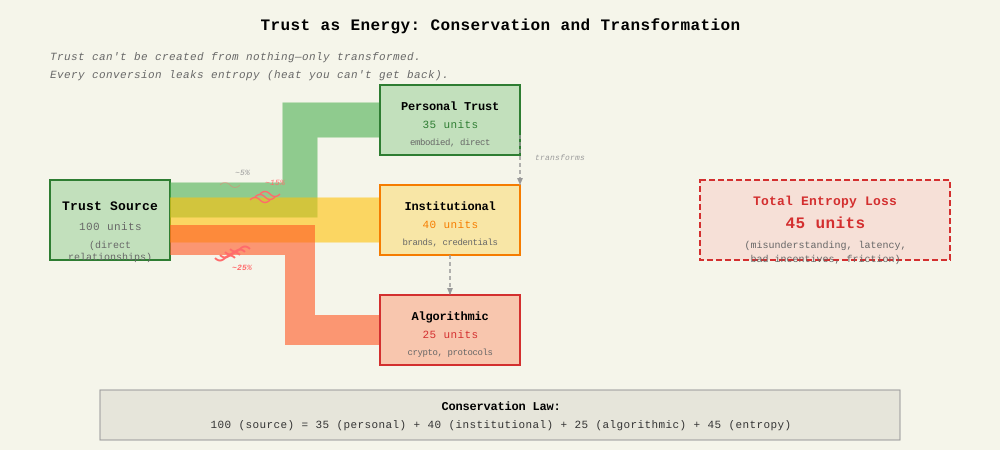
And so we reach, instinctively, for trust: that invisible currency that lubricates everything from markets to marriages. But lately, trust behaves more like energy than emotion: it can't be created from nothing, only transferred, transformed, or lost as heat.
That's what this essay is about: the thermodynamics of trust.
The Physics Metaphor That Won't Leave Me Alone
In thermodynamics, energy doesn't disappear. It flows between forms: kinetic, potential, thermal. But some always leaks as entropy: heat you can't get back.
Trust feels the same.
- You can't invent it out of thin air.
- You can't destroy it outright.
- You can only convert it between people, systems, and symbols.
- And every conversion leaks a little entropy: misunderstanding, latency, bad incentives.
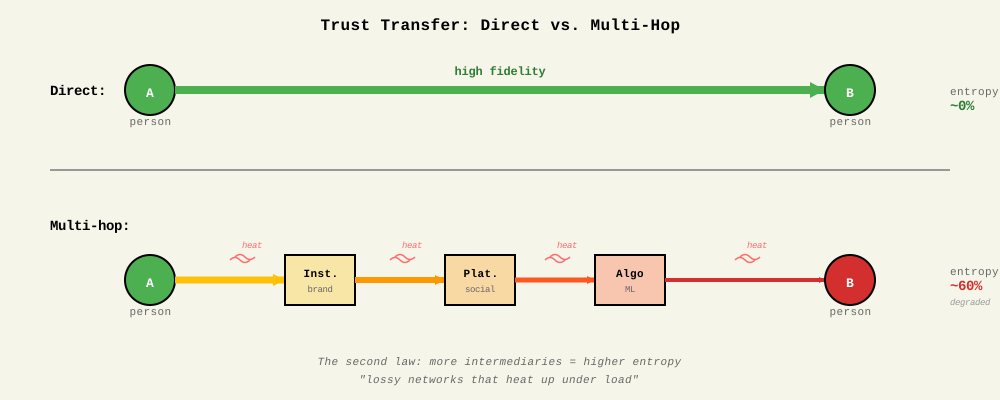
The second law applies: the more intermediaries in a trust chain, the higher the entropy. The message degrades; the proof decays.
That's why direct relationships are efficient engines of trust, while bureaucracies, platforms, and social networks are lossy networks that heat up under load.
The Industrialization of Authenticity
For centuries, trust was local and slow. You trusted the baker because you knew her face, not her cryptographic hash.
Then industrial civilization required scaling it. We invented brands, institutions, and credentials: trust proxies that let us transact with strangers. That worked, mostly, until the internet made strangers infinite.
Now, in the age of deepfakes and generative media, those proxies are melting. The face can lie. The credential can be forged. The institution can be automated.
So we reach for a new physics: cryptographic trust.
Blockchains, decentralized identifiers (DIDs), and verifiable credentials are not about money; they're about conservation of authenticity. They promise that trust can be preserved across space, that we can move from "I know you" to "the network knows this is true."
It's an engineering response to moral decay.
Entropy Grows in Systems Without Friction
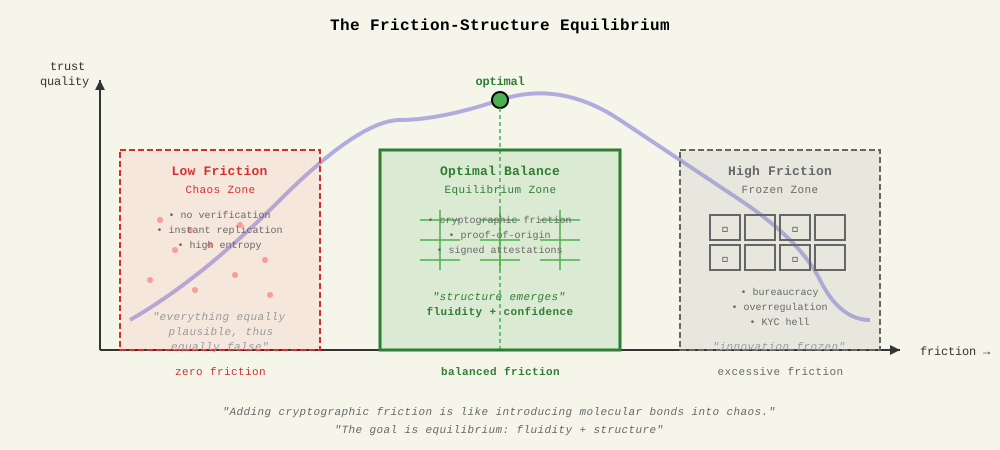
The internet has always been a low-friction environment: content replicates instantly and freely. But in physics, systems without friction also can't hold temperature; they can't store energy.
Likewise, in a fully open internet, trust dissipates faster than it can form. Everything looks equally plausible, and thus equally false.
Adding cryptographic friction (proof-of-origin, timestamps, signed attestations) is like introducing molecular bonds into chaos. It lets structure emerge.
Of course, too much friction (bureaucracy, overregulation, KYC hell) freezes innovation. The goal is equilibrium: a dynamic balance between fluidity (freedom to create) and structure (confidence in what's created).
Conservation Laws and Reputational Energy
Trust is conserved. When you lose it, someone else gains it.
We see this in the migration from institutions to influencers, from media to individuals, from banks to protocols. The total amount of trust in society may be constant, but it redistributes toward wherever validation feels most immediate.
In the analog era, reputation accumulated slowly, like potential energy in a rock wall. In the digital era, it flows like electricity: volatile, reversible, prone to sudden discharge.
One scandal, one screenshot, and years of stored trust evaporate as heat.
Measurement: The Missing Unit
Physics advanced when it learned to measure energy.
Trust doesn't yet have a unit. We measure it in followers, likes, credit scores, ratings, but those are noisy proxies. They don't capture the thermodynamic reality that trust depends on context and transfer efficiency: who vouched for you, and how costly it was for them to do so.
In future networks, I suspect we'll see the rise of a "trust layer" that formalizes this flow: reputation graphs that behave like electrical circuits, where each credential, endorsement, or identity has impedance and loss.
Your trust "voltage" at any point is a function of both your source (credibility) and your circuit (community).
That will sound dystopian to some, but every civilization measures what it depends on.
AI as an Entropy Amplifier
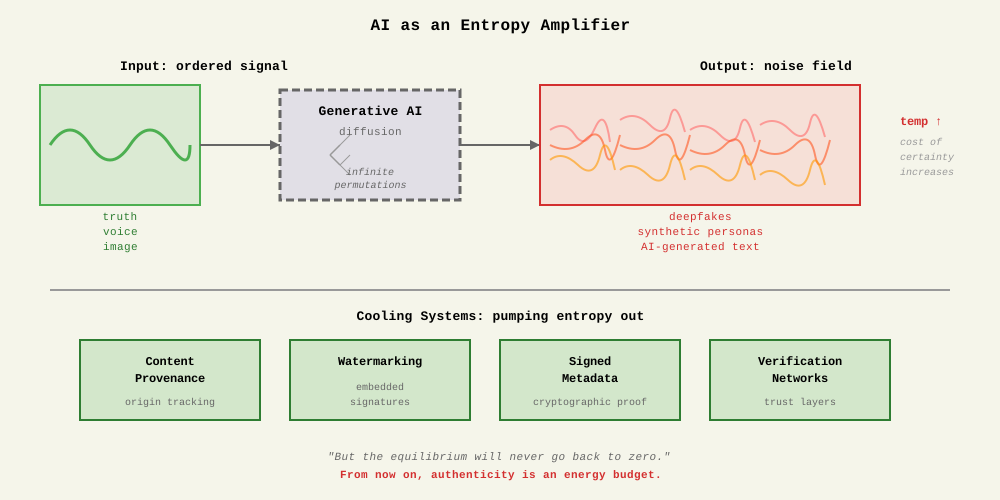
Generative AI is the perfect entropy machine. It takes ordered data (truth, voice, image) and produces infinite permutations with nearly identical energy signatures. It doesn't destroy information; it diffuses it.
Every convincing deepfake, every synthetic persona, every AI-generated text adds one more particle of noise to the social atmosphere. The temperature rises. The cost of certainty increases.
In response, we'll build new cooling systems: content provenance frameworks, watermarking, signed metadata, ways to pump entropy out of the system.
But the equilibrium will never go back to zero. From now on, authenticity is an energy budget.
The Future Economy of Proof
If information wants to be free, authentic information wants to be expensive.
The next economy may revolve around proof markets: layers of verification traded like commodities.
- Who verified this claim?
- How much entropy did it resist?
- How costly was the proof to produce?
A signed dataset might be like refined oil: processed, certified, valuable. Unsigned data? Raw crude.
This changes how we think about ownership, creativity, and even identity. Your reputation might become a kind of proof-of-work: the accumulated energy of consistent behavior over time.
Personal Reflection: The Warmth of Human Proof
For all the crypto and code, there's still something irreplaceable about embodied trust: the glance, the tone, the track record of kindness. Humans are analog validators. We cross-check intent through tiny signals of presence.
When I meet someone in person after years of online dialogue, there's always that palpable collapse of uncertainty. Like two waveforms finally phase-locking.
That's the lowest-entropy form of trust there is. And maybe our next technologies should aim not to replace it, but to conserve it across distance.
Closing Thought
Trust, like energy, obeys its own laws:
- It can't be created from nothing.
- It transforms between forms: personal, institutional, algorithmic.
- Every transformation leaks entropy.
Our task this century is to build systems that conserve it better, technologies and cultures that minimize trust-loss without freezing progress.
If the 20th century was powered by oil and electrons, the 21st will be powered by credibility: the invisible, thermodynamic medium that makes complexity possible.
And maybe the final law is this:
In the long run, entropy wins, but the story of civilization is the art of buying time through better trust engines.