For most of history, knowledge had an address.
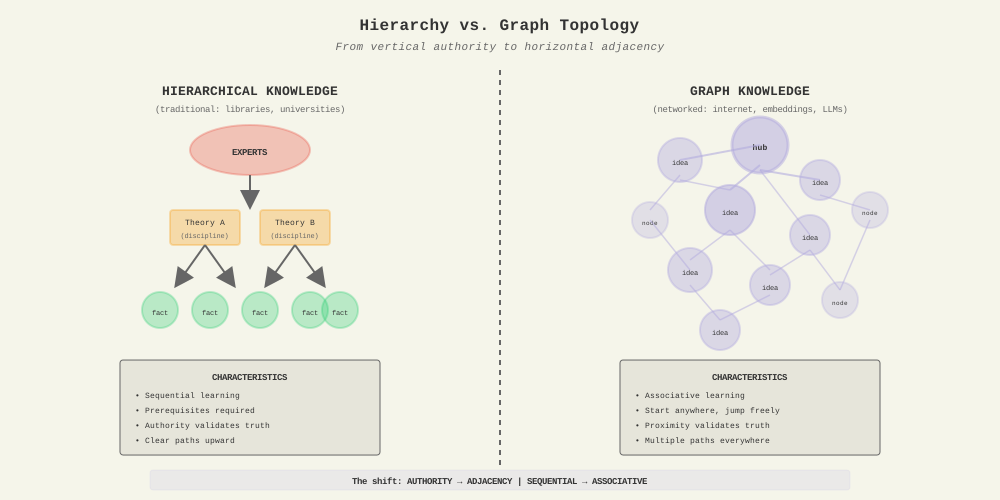
You found it in libraries, universities, guilds, and lectures: places where information was bound by sequence and authority. You climbed through prerequisites, followed citations upward, and trusted that truth was vertically organized: facts at the bottom, theories at the top, experts as the keepers of both.
That topology has quietly collapsed.
Knowledge no longer ascends; it sprawls. It flows through hyperlinks, embeddings, and model weights. It behaves less like a library and more like a neural network: associative, non-linear, recursive.
We used to inhabit pyramids of knowledge. Now we live inside its graph.
I. The Death of the Syllabus
For centuries, the syllabus was civilization's compression algorithm. It defined what mattered, in what order, and to whom. It told you which texts were canonical and which were supplementary, and it gave coherence to learning by linear progression.
The internet atomized that. Search engines, wikis, and forums dissolved sequencing. You no longer start at Chapter 1; you start at whatever query your curiosity or crisis produces.
It's liberating, until you realize that context was the invisible syllabus. Without it, learning becomes spatial, not sequential. You wander, connect, loop back, and build personal constellations of understanding. The result is both exhilarating and disorienting: meaning without map, mastery without ladder.
We are trading authority for adjacency.
II. The Shape of a Graph
A graph is a network of nodes and edges. Each idea is a node; each connection a relationship. What defines truth in this topology is not hierarchy but proximity. A concept gains weight not by its credentials, but by its connectivity: how many other ideas link to it, how coherently, and with what persistence over time.
This is how large language models learn: not by memorizing facts, but by embedding words into high-dimensional spaces where similar meanings cluster. The system doesn't "know" in the human sense. It maps semantic gravity.
In this world, truth behaves like a center of mass: the point where a million associations balance each other out. The stronger the consensus in the embedding, the more stable the gravity well, but stability is not infallibility. It only means many things point there.
When proximity replaces provenance, knowledge becomes fluid, which is both the miracle and the risk.
III. Provenance vs. Proximity
Traditional epistemology was obsessed with provenance: Who said it? Where did it come from? What are its sources?
Graph epistemology asks instead: Where else does this connect? What other patterns reinforce or destabilize it? Truth becomes a property of the network rather than the node.
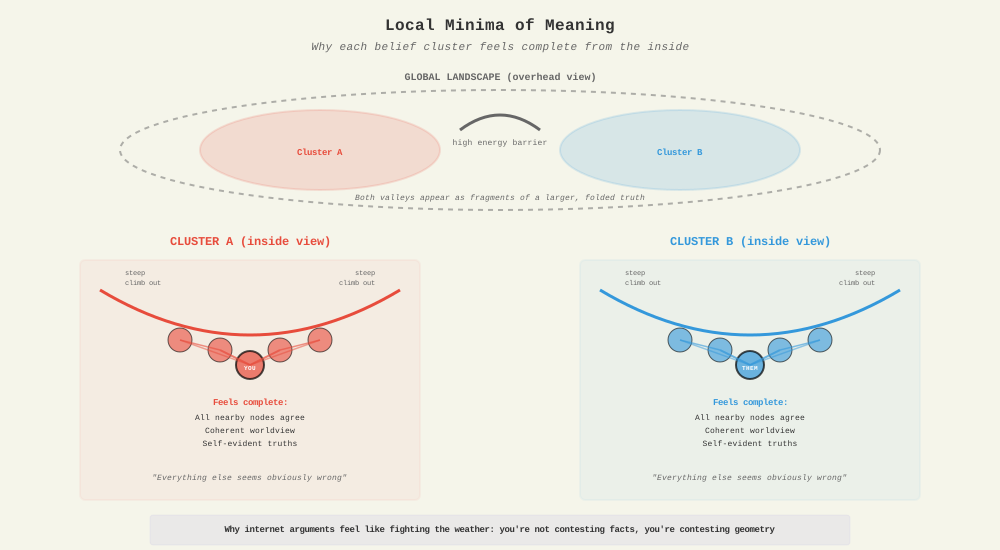
That shift explains why arguing on the internet feels like fighting the weather. You're not contesting facts; you're contesting geometry. A belief anchored in one cluster feels self-evident because everything nearby agrees. Move to another cluster, and an equally coherent world appears.
We are all inhabiting local minima of meaning. The global landscape of truth is still there, but it's folded so tightly that each neighborhood mistakes itself for the whole.
IV. The Epistemic Economy
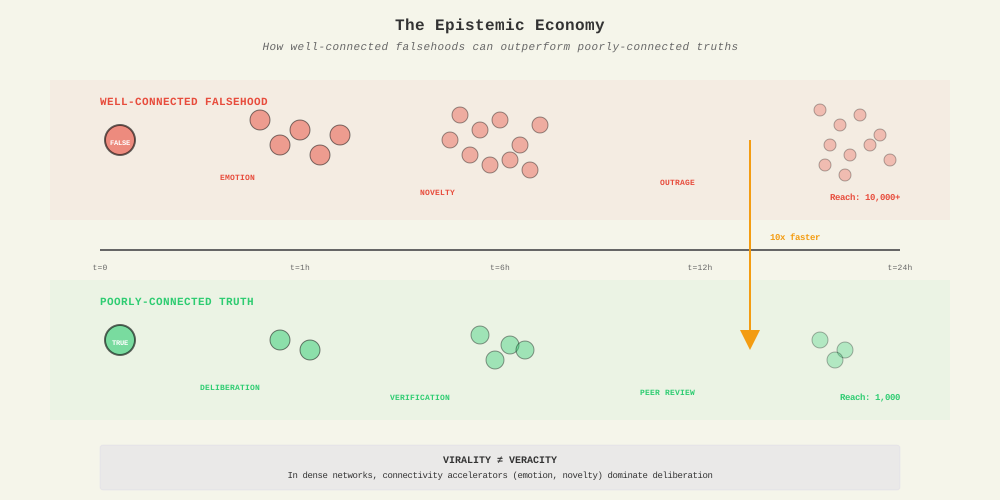
When knowledge becomes networked, attention becomes the currency that moves it. Algorithms optimize for linkage (not accuracy, not even persuasion, but propagation). A well-connected falsehood can outperform a poorly connected truth simply because it spreads faster.
This is not a failure of technology; it's the physics of graphs. In a dense network, any force that accelerates connectivity (emotion, novelty, outrage) will dominate forces that demand deliberation.
The new question isn't "Is this true?" but "How far does this travel before it burns out?" Virality has replaced verification as the measure of vitality.
And yet, the same dynamics that create chaos can create coherence, if we learn to design the topology rather than drown in it.
V. Designing for Sensemaking
There's an art to building graphs that think clearly. Wikipedia did it with editorial linking. Scientific citation networks do it with peer review. LLMs do it with embedding distance.
Each is an attempt to formalize context adjacency: making sure that the nodes most likely to illuminate each other remain close.
In the age of AI, our new intellectual infrastructure will depend on how we encode relationship ethics:
- Which ideas do we keep near each other?
- Which clusters do we prevent from collapsing into monoculture?
- How do we make the map legible without making it flat?
The future of education might look less like teaching content and more like teaching navigation: the literacy of moving through dynamic knowledge spaces without losing your epistemic gravity.
VI. The Return of the Curator
As graphs explode in scale, curators (human or machine) become crucial again. Not to impose hierarchy, but to maintain coherence. Curation is topology maintenance: pruning edges, updating weights, highlighting bridges between disjoint clusters.
In a sense, the curator is the new librarian, except the shelves move, and every visitor reshapes the architecture by walking through it.
The librarian's job now is not to guard the stacks, but to keep the graph habitable.
VII. Truth as a Dynamic Equilibrium
If knowledge used to be a tree, we could prune false branches. In a graph, falsehoods don't disappear; they lose connectivity. Truth is not eternal; it's stable enough across connections to persist through turbulence.
In this model, epistemology becomes a kind of ecology: truths compete, cooperate, decay, and re-emerge based on informational fitness. Climate change, for example, remains true not because of authority, but because every new dataset reinforces its gravitational pull. Conspiracies fade not when refuted, but when the network that sustains them collapses under entropy.
The graph forgets nothing, but it constantly reweighs what matters.
VIII. The Human Role
We are still the only nodes that can choose edges deliberately. That is the defining human act in the topology of knowledge: to connect responsibly, to link with care.
We can design tools that show us our cognitive neighborhoods, that suggest crossings between rival clusters, that measure epistemic diversity the way we once measured literacy.
Our task is not to rebuild the hierarchy. It is to learn to live in the graph without mistaking closeness for correctness, or connectivity for truth.
IX. Closing Reflection
Information used to move upward, like worship. Now it moves outward, like light. Every mind is a node, every connection a vote in the geometry of understanding.
The danger is that we mistake the glow for wisdom. The promise is that we can build a civilization that thinks in patterns, not decrees.
If we learn to read the topology, we might rediscover something older than any hierarchy: the simple, humbling fact that knowledge is never owned. It is relational: a living fabric of attention, linking one curious mind to another, across the infinite graph we now call home.