Real-world AI systems fail because they create uncertainty in places where organizations have to spend money. Raw intelligence matters less than how uncertainty converts to cost.
Every deployment has a hidden exchange rate between uncertainty and operations:
- Uncertainty becomes human review time.
- Uncertainty becomes customer churn.
- Uncertainty becomes safety margin and wasted energy.
- Uncertainty becomes compliance overhead.
- Uncertainty becomes downtime when teams freeze a rollout after a bad incident.
This is why accuracy alone rarely predicts ROI. Two models can score similarly on a benchmark and behave very differently in production economics. One produces clean, well-calibrated confidence. The other produces confident nonsense. The first one drives automation. The second one drives escalation.
The core claim of this essay is simple: uncertainty has unit economics, and you can design it.
The levers are calibration, abstention, and confidence reporting.
---
1. A cost model for uncertainty
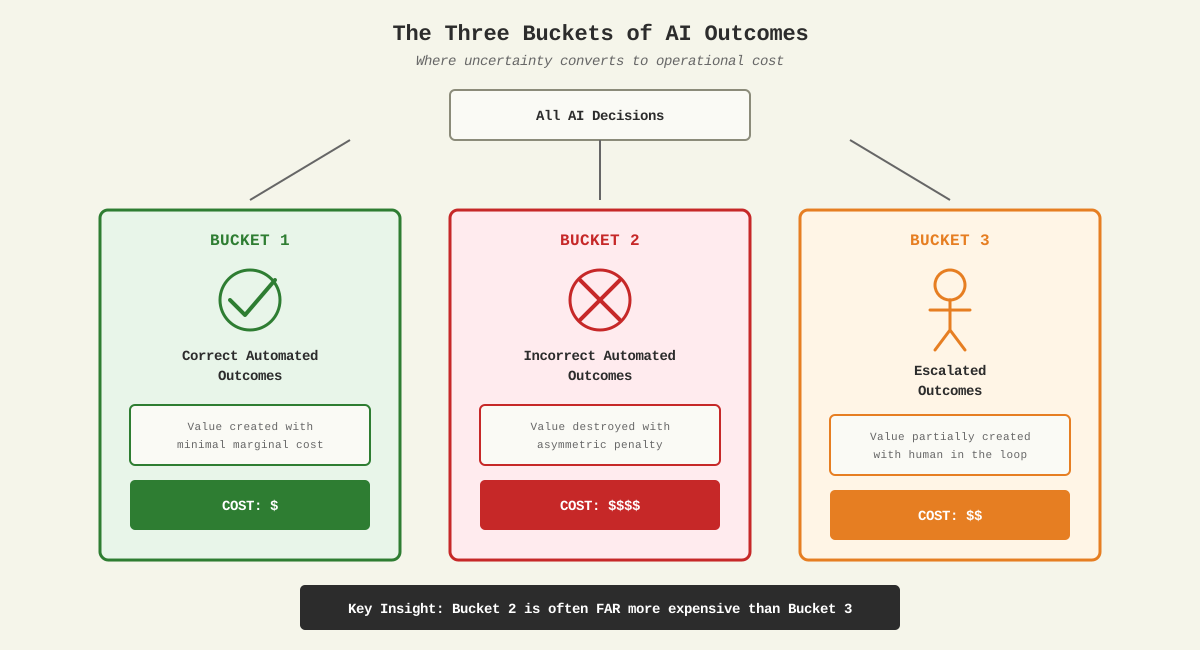
Take any applied AI workflow: classification, detection, forecasting, triage, search, anomaly detection. The organization ends up with three buckets of outcomes:
- Correct automated outcomes
Value created with minimal marginal cost. - Incorrect automated outcomes
Value destroyed, often with an asymmetric penalty. - Escalated outcomes
Value partially created, but with a human or secondary system in the loop.
The economic trick is that bucket 2 is often far more expensive than bucket 3.
A wrong fraud decision can trigger chargebacks and reputational damage. A wrong medical triage can trigger liability. A wrong facility alert can trigger costly dispatches or missed hazards. A wrong enterprise recommendation can quietly erode trust until the system gets turned off.
So the goal in many systems is to minimize total expected cost, rather than maximize automation:
\[\text{Expected Cost} = C_{fp} \cdot P(fp) + C_{fn} \cdot P(fn) + C_{esc} \cdot P(esc)\]
- \(C_{fp}\) is cost of a false positive
- \(C_{fn}\) is cost of a false negative
- \(C_{esc}\) is cost of escalation (human review, extra sensing, additional query)
- \(P(\cdot)\) are the rates under your decision policy
This equation is basic. The hard part is that most teams treat \(P(fp)\) and \(P(fn)\) as properties of the model, when in practice they are properties of the model plus its uncertainty handling.
That is where calibration and abstention become unit economics levers.
---
2. Calibration is revenue infrastructure
Calibration answers a very specific question:
When the model says "0.8," does it mean "about 80 percent" in the real world?
A calibrated model makes confidence actionable. An uncalibrated model makes confidence decorative.
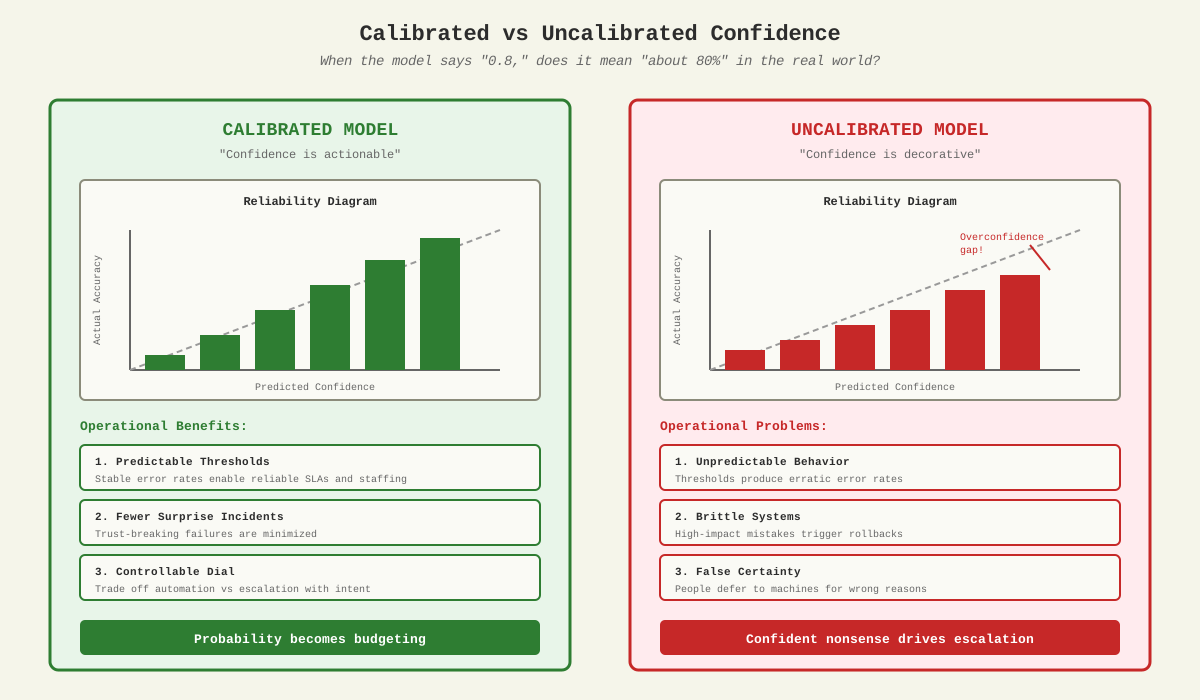
In operations, calibration does three things that change the cost curve:
A. It lets you set thresholds that behave predictably
You can choose a confidence cutoff that targets a stable error rate and a stable escalation rate. That stability matters because staffing, SLAs, and compliance depend on it.
B. It reduces surprise incidents
The most expensive failures are the ones that break trust. Overconfidence produces brittle systems that look great until one high-impact mistake triggers a rollback and a political cascade.
C. It turns uncertainty into a controllable dial
Once confidence correlates with correctness, you can trade off automation against escalation with real economic intent.
There is a simple mental model here: calibration turns probability into budgeting.
---
3. Abstention is the economics of humility
Abstention means the system is allowed to say: "I do not know," or "This case needs a different pathway."
That sounds like weakness until you look at the economics.
Abstention is the cheapest way to avoid the high-cost tail of errors.
You can think of abstention as defining an operating region where the model is trusted and a boundary where it defers. A well-designed boundary increases total system performance because it prevents expensive failures.
One useful framing is "selective prediction." Let the model act only on a subset of inputs where its confidence is high enough, and escalate the rest.
Then you measure performance at a given coverage level:
\[\text{Coverage} = P(\text{model acts})\]
\[\text{Risk} = P(\text{error} \mid \text{model acts})\]
The economic goal becomes: maximize coverage subject to a risk constraint that your business can afford.
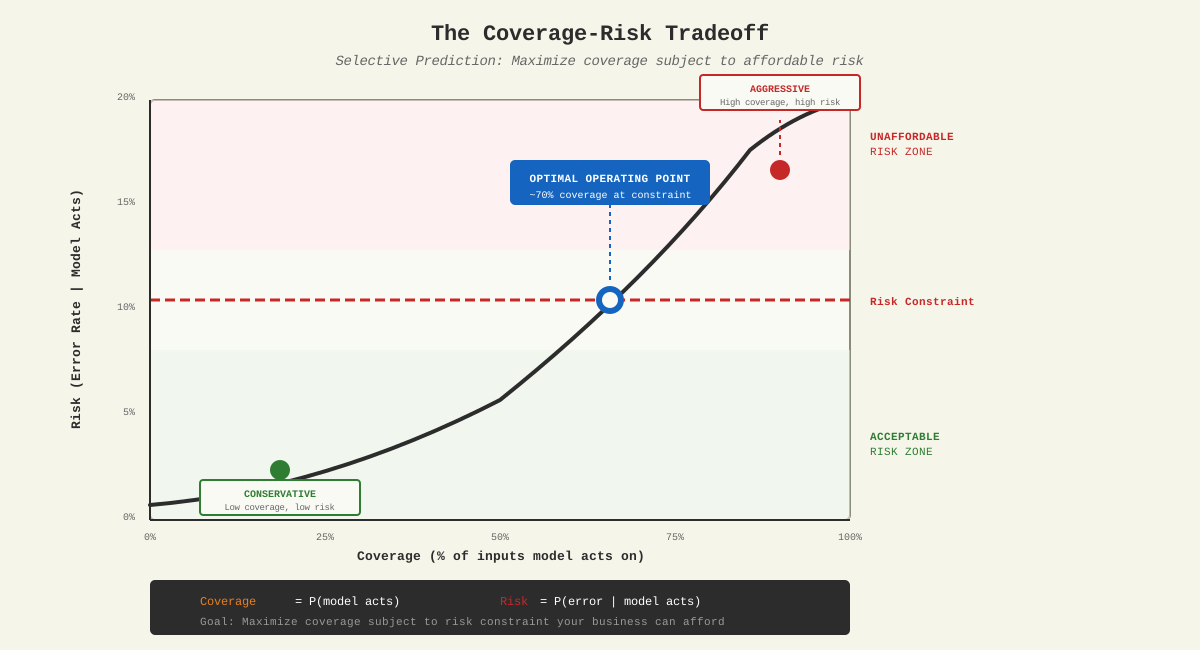
In practice, this becomes a product decision: Where do you want the system to be decisive, and where do you want it to be cautious?
High-frequency trading systems already live this way. Safety systems live this way. Clinical systems live this way. The same logic is spreading to everyday enterprise workflows.
---
4. Confidence reporting is how organizations learn
Confidence is more than a number. It is a protocol between the model and the humans around it.
A good confidence interface changes behavior:
- It tells operators when to trust automation.
- It tells reviewers where to focus attention.
- It helps product teams find regime shifts and drift.
- It helps leadership understand whether the system is scaling safely.
A bad confidence interface does the opposite. It creates a false aura of certainty and encourages people to defer to the machine for the wrong reasons.
The most useful confidence reporting is rarely a single scalar. It often includes:
- Uncertainty type: ambiguity, novelty, missing context, conflicting evidence
- Top competing hypotheses: what else the model considered plausible
- Evidence trace: which signals mattered, at least at a coarse level
- Escalation recommendation: what human or secondary check resolves the uncertainty fastest
This is where "unit economics" becomes concrete. You are designing the lowest-cost path to resolution.
---
5. The real payoff: margin expansion through software
Once calibration and abstention are reliable, the system's economics start compounding.
Two compounding mechanisms matter:
A. You can safely increase automation over time
As the system learns from escalations and drift is monitored, coverage grows while risk stays bounded. That translates directly into lower cost per decision.
B. You can add new use cases without rebuilding the entire ops layer
A calibrated confidence pipeline becomes shared infrastructure. Each new model plugs into the same escalation, auditing, and monitoring system.
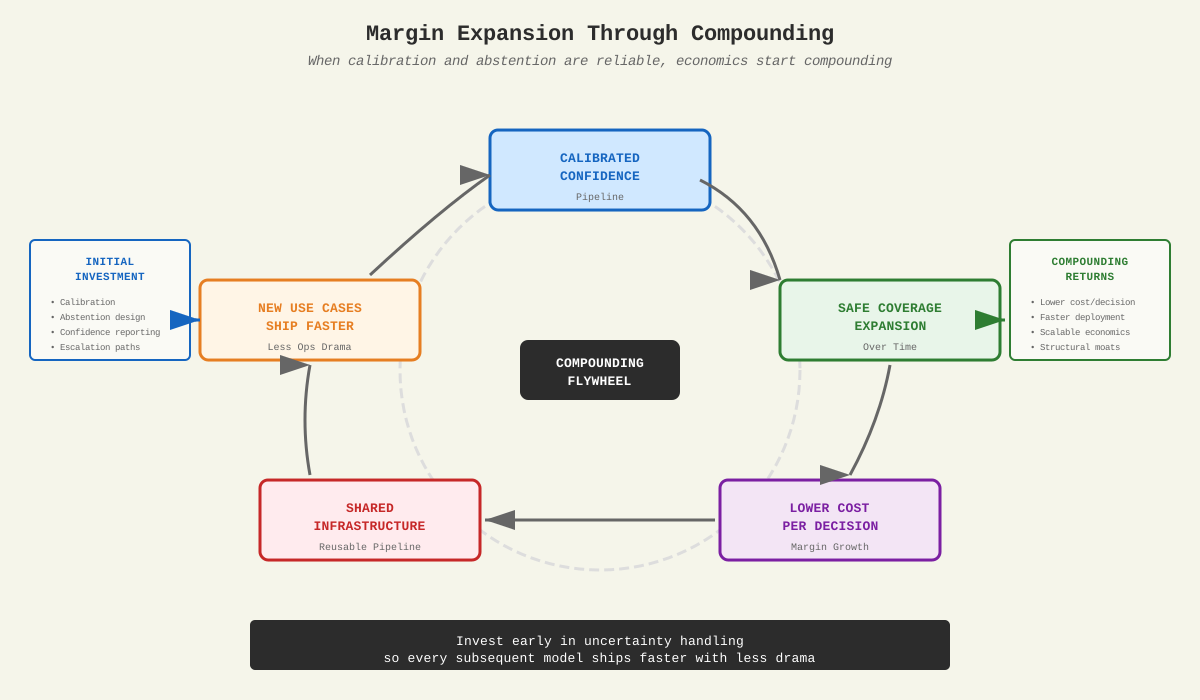
This is a quiet pattern behind many successful real-world AI products: the company invests early in uncertainty handling so every subsequent model ships faster with less operational drama.
---
6. A concrete example from physical-world AI
In physical sensing systems, uncertainty has a specific flavor. The world injects mess: humidity, wear, occlusion, drift, changing layouts, unusual events.
A system that pretends to be certain will create expensive operational artifacts: constant false alarms, missed hazards, overconfident classifications, and endless tuning.
A system that treats uncertainty as first-class can do something more scalable: it escalates in the right places.
In a sensor fabric like Scanalytics, even if the downstream application is something simple like occupancy, the system lives across many regimes. A conference hall behaves differently during teardown than during keynotes. A senior living corridor behaves differently at 2 a.m. than at noon. That regime diversity makes calibration and abstention feel less like ML hygiene and more like product survival.
The win is economic. When uncertainty is explicit, you avoid shipping brittle guarantees. You ship a system that can be operated, expanded, and trusted.
---
7. A practical design checklist
If you want uncertainty to improve unit economics, the system needs a few things that sound boring and turn out to be decisive:
- A calibration evaluation suite by segment, not only global metrics
- Decision thresholds chosen by cost curves, not by intuition
- An abstention pathway that is fast and operationally cheap
- Instrumentation that logs confidence, outcomes, and escalation results
- Monitoring that detects drift in both accuracy and calibration
- Product language that sets expectations correctly for operators and customers
This is how you keep a model from becoming a demo that never becomes a product.
---
Closing thought
In the real world, intelligence is only half the story. The other half is how the system behaves when it is unsure.
Calibration turns confidence into a contract.
Abstention prevents expensive failures.
Confidence reporting makes coordination possible.
Together they change the unit economics of AI from fragile to scalable.
The most valuable systems in the next decade will be the ones that know when to speak, when to defer, and how to make uncertainty cheap.