Modern data systems often treat human behavior as either random noise or predictable routine. Yet neither description holds up under close inspection. When you trace actions with enough temporal or spatial resolution, an interesting pattern appears: behavior is neither chaotic nor fully regular. It has structure, but the structure is irregular. It is randomness with a shape.
This is the stochastic signature of human behavior.
It shows up in heavy-tailed distributions of activity, in bursts of engagement followed by long pauses, in the way people explore their environment, and in the fine-grained oscillations of attention and choice. It is the statistical residue of perception, memory, fatigue, intention, and context all interacting at once.
To understand humans, we have to understand this structured randomness.
1. Heavy Tails Everywhere
If you log almost any behavioral variable, the distribution refuses to be Gaussian.
- Number of steps between pauses
- Time between decisions
- Frequency of returning to the same location
- Duration spent in a hallway or buffer zone
- Interactions with staff or peers in clinical or senior living spaces
Instead of clustering tightly around an average, the distribution spreads out. A few events dominate. Many are rare. The curve stretches into a long tail.
Heavy-tailed patterns mean that most of the signal sits outside the mean.
For behavioral modeling, this creates a fundamental tension. Models that assume typical behavior will miss the tail events where risk, insight, opportunity, and change actually live.
In physical spaces, this matters. A building operator may see thousands of uneventful steps but care deeply about the ten steps that came close to a fall. A retail manager may care less about average dwell time and more about the rare but decisive long visits that correlate with high-value purchases.
The stochastic signature tells us that if we only design for the average, we design for a fiction.
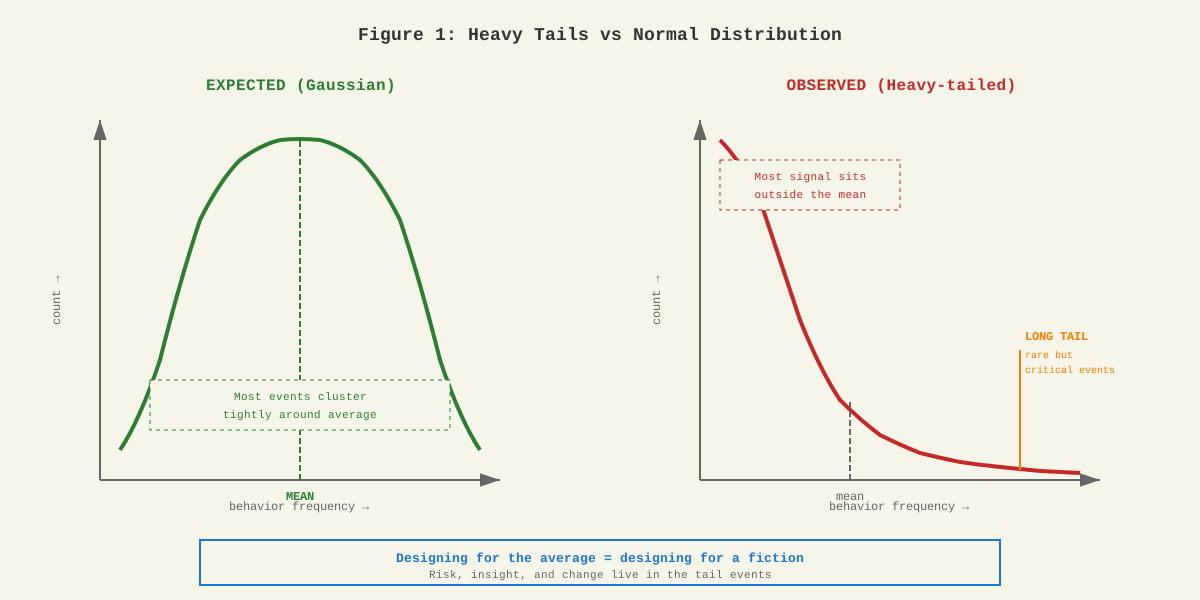
Figure 1: Heavy Tails vs Normal Distribution. Gaussian models assume events cluster around the mean, but behavioral data shows heavy-tailed distributions where most signal sits outside the average. Risk, insight, and change live in the tail events.
2. Burstiness as a Cognitive Rhythm
Human behavior unfolds in bursts. People work intensely, then drift. They walk steadily, then pause. They explore, then commit. This burstiness arises from deep cognitive and neural processes.
Systems built on predictive coding theories suggest that the brain continuously reduces uncertainty until a threshold is crossed. Once the internal model stabilizes, attention can shift abruptly. That shift produces the burst pattern: long quiet periods followed by rapid sequences of activity.
In practice, this means that human behavior clusters around cognitive transitions.
- A resident pauses before entering a stairwell.
- A shopper drifts through an aisle, then suddenly stops.
- An office worker walks the same route every day until one day they take a detour that reveals something subtle.
Burstiness reflects an internal computation finishing, not random interruption.
This helps explain why small changes in environment produce nonlinear effects. A tiny shift in lighting, congestion, or signage can trigger a burst or suppress one. And that difference, even if statistically minor, can matter for safety, usability, or comfort.
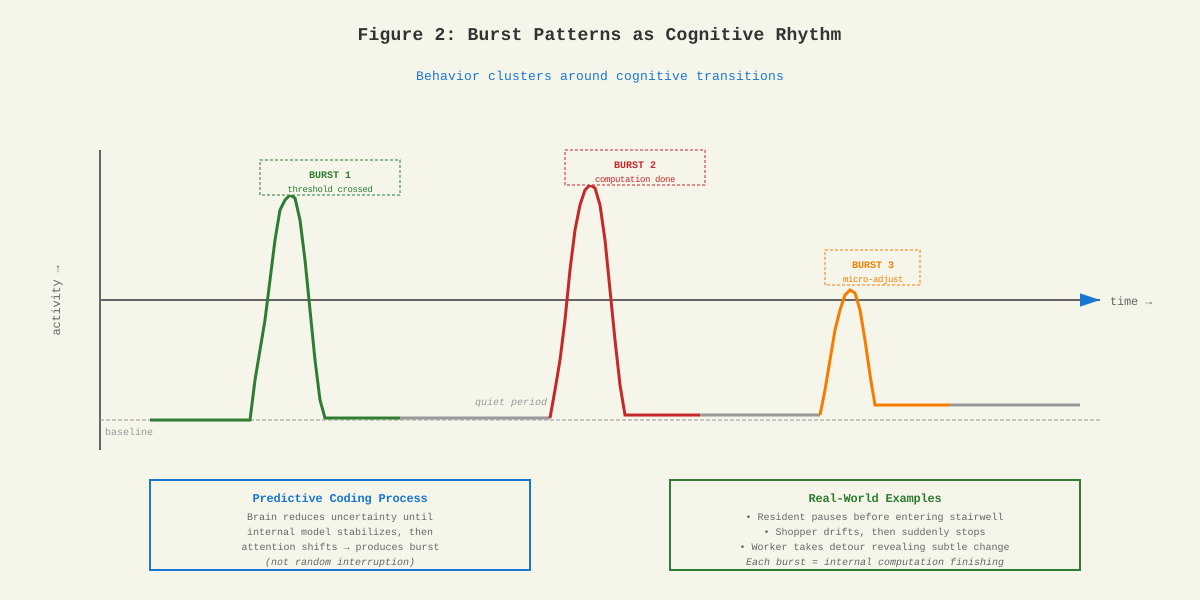
Figure 2: Burst Patterns as Cognitive Rhythm. Human behavior unfolds in bursts—long quiet periods followed by rapid activity. These patterns emerge from predictive coding processes where the brain reduces uncertainty until a threshold is crossed, then attention shifts abruptly. Burstiness is the signature of internal computation finishing.
3. Exploration and Exploitation
Humans constantly oscillate between exploring the environment and exploiting known routines. This tradeoff is foundational in reinforcement learning, but in humans it is textured by emotion, culture, fatigue, and context.
Exploration spikes when:
- the environment feels safe
- novelty is rewarding
- uncertainty is low but curiosity is high
- routines become inefficient or frustrating
Exploitation dominates when:
- time is scarce
- risk is present
- cognitive load is high
- goals are narrow
This dynamic creates branching patterns in physical spaces. Most of the time, people follow familiar routes. Occasionally, they diverge in ways that reveal intentions the space was never designed to support.
In senior living research with Scanalytics, for example, small shifts in exploration behavior sometimes preceded mobility decline. Residents stopped trying alternate routes and favored only the most familiar ones. The structure of randomness changed. That change was meaningful.
The stochastic signature is often a more sensitive indicator of human state than simple metrics like total movement or step count.
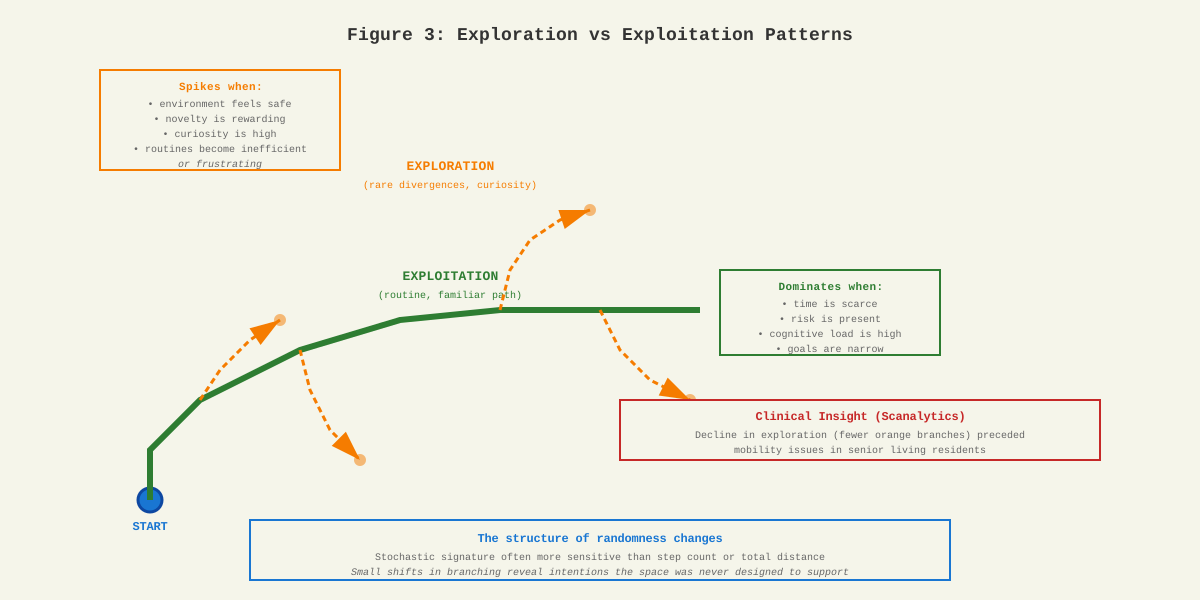
Figure 3: Exploration vs Exploitation Patterns. Humans oscillate between familiar routines (thick green paths) and rare divergences (dashed orange branches). In senior living research, decline in exploration behavior—fewer orange branches—preceded mobility issues. The structure of randomness changes, revealing intentions and states invisible to simple metrics.
4. Predictive Coding and Microstructure
Humans act based on predictions, not raw sensory data. The brain constructs expectations about the next movement, the next sightline, the next step. When prediction errors appear, behavior adjusts.
This constant micro-adjustment produces patterns like:
- small corrections in gait before a slip
- tiny delays before turning a corner
- subtle pacing changes in crowded corridors
- hesitation at visual ambiguities
- synchronization between people walking together
These signals live in the subsecond structure of behavior. They are too fine to see with the naked eye and too fleeting for typical analytics systems.
The challenge is philosophical as well as technical. If behavior is shaped by continuous prediction, then randomness is simply the visible edge of uncertainty at work. Every small variance carries meaning. The question is whether our representations are sensitive enough to capture it.
5. Randomness as a Reservoir of Insight
A model that assumes humans follow clean rules will fail. A model that assumes humans are random will also fail. The truth lies in the stochastic boundary: the space where structure and randomness overlap.
This boundary is where design, safety, and intelligence all converge.
Buildings benefit when they can detect structured randomness.
Health systems benefit.
Urban spaces benefit.
Human-centered AI systems benefit.
The best behavioral models will not try to eliminate randomness. They will try to interpret its shape.
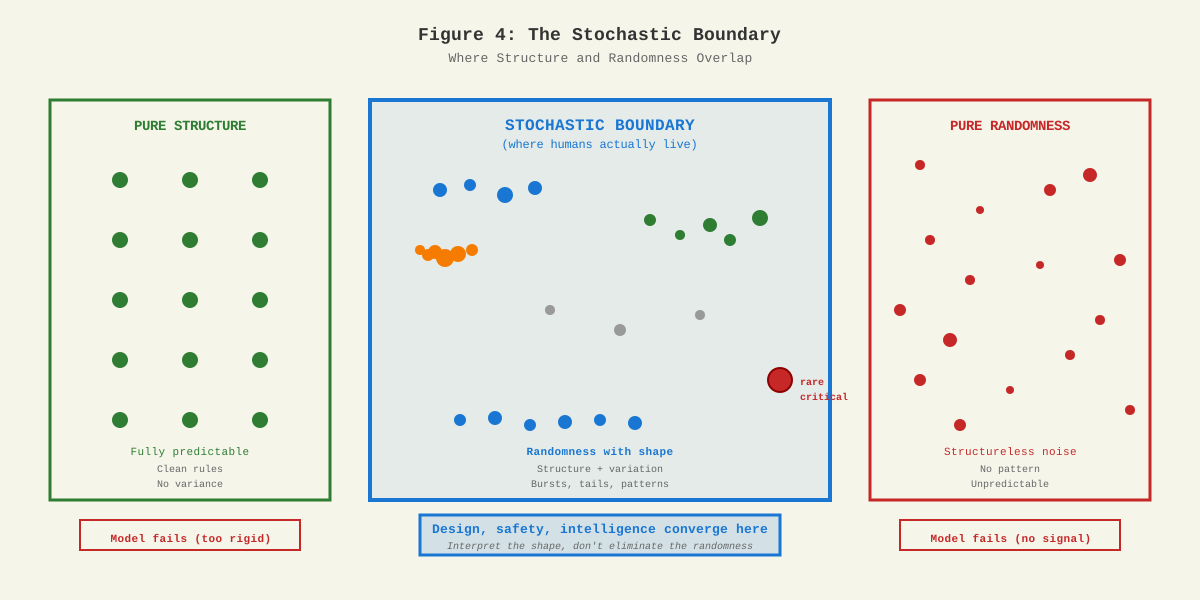
Figure 4: The Stochastic Boundary. Human behavior exists neither in pure structure (perfectly predictable) nor pure randomness (structureless noise), but in the boundary where structure and randomness overlap. This is where design, safety, and intelligence converge. Models must interpret the shape of randomness rather than eliminate it.
6. Can We Model Without Reduction
This brings us to the core question: can we model the microstructure of choice without reducing people to probabilities.
Some possibilities:
- Hybrid models that combine deterministic structure with stochastic variation
Instead of pure prediction, represent the likelihood landscape of possible actions. - Behavioral manifolds that preserve rare events
Distinguish between variability that is harmless and variability that signals risk or adaptation. - Sensor networks that capture fine temporal structure at scale
High frequency surfaces, like those in Scanalytics deployments, provide temporal detail that reveals stochastic signatures without needing identity. - Representations that track uncertainty explicitly
Let the model indicate where variance is meaningful rather than treating it as noise. - Behavioral categories defined by pattern, not demographic proxies
Group people by rhythm and microstructure rather than by age or role.
The goal is to respect the stochastic nature of human behavior rather than flatten it.
Closing Thought
Human behavior looks messy on first inspection, but the mess is patterned. Randomness is laced with structure, and structure is softened by randomness. Bursts, tails, pauses, hesitations, and rare divergences are not artifacts to discard. They are the signature of how people think and adapt.
If we want to build spaces, systems, and models that serve real humans, we have to read the signature rather than erase it. The stochastic detail serves as the map of how behavior becomes meaning, revealing structure rather than noise.