The next decade of healthcare AI will be decided by who can make advice verifiable.
Medicine is already a system of verification. A symptom becomes a hypothesis. A hypothesis becomes an order. An order becomes evidence. Evidence becomes a decision. A decision becomes documentation. Documentation becomes continuity. Continuity becomes accountability.
Generative AI enters this chain in an awkward place. It speaks like a confident clinician while living upstream of the evidence pipeline. That creates a mismatch: high rhetorical certainty sitting on top of partial data.
So the real design problem is governance of uncertainty.
This post is a two-piece essay about that shift.
Part One argues that medical AI needs a verification layer the same way the internet needed TLS: a standard interface for trust.
Part Two argues that outputs need medical receipts: structured provenance packets that make verification fast, defensible, and learnable.
⸻
Part One: The Verification Layer
1) Trust scales when verification becomes a workflow
In many domains, trust is social. In medicine, trust is procedural.
Clinicians trust a recommendation when they can quickly answer a few questions:
- What evidence supports this?
- What evidence would refute it?
- What happens if we do nothing?
- What is the downside if we act?
- What would I need to see to escalate?
Patient-facing AI advice often arrives without those hooks. It provides a plan but not the checks. In a safety-critical setting, that pushes risk downstream into the patient's behavior and the clinician's cleanup.
A verification layer is a way to pull risk back upstream.
It is a system that takes AI output and routes it through a designed sequence of:
- triage
- uncertainty handling
- escalation
- audit
- feedback
The key idea: verification becomes a product surface, not an ad hoc human task.
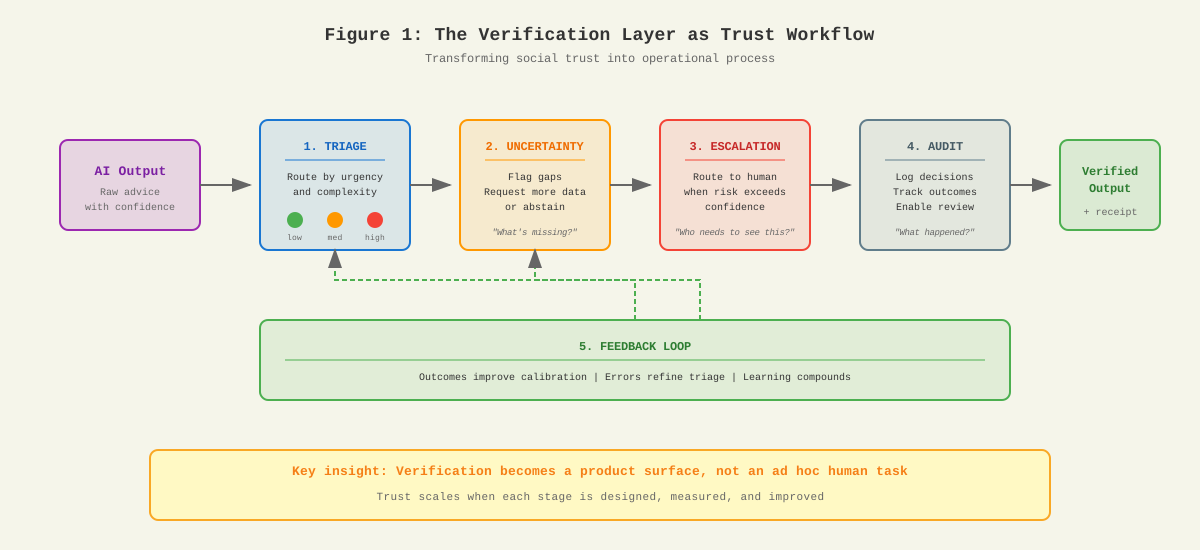
Figure 1: A verification layer transforms trust from a social judgment into an operational workflow with explicit stages for triage, uncertainty handling, escalation, audit, and feedback.
2) Calibration and abstention are the core primitives
Every medical AI system eventually confronts the same reality:
Some questions are safe to answer quickly. Some should trigger more data collection. Some should escalate to a clinician. Some should stop the flow entirely and recommend urgent care.
That boundary needs to be explicit.
Two primitives create it:
Calibration
When the system claims confidence, it should correlate with correctness in that setting and population. Confidence drives behavior, so confidence must mean something.
Abstention
A competent system declines to answer in contexts where the model is out of distribution, the input is incomplete, or the cost of error is high.
Abstention is a safety valve that enables scale. It turns the system into a triage layer rather than a forced-bet oracle.
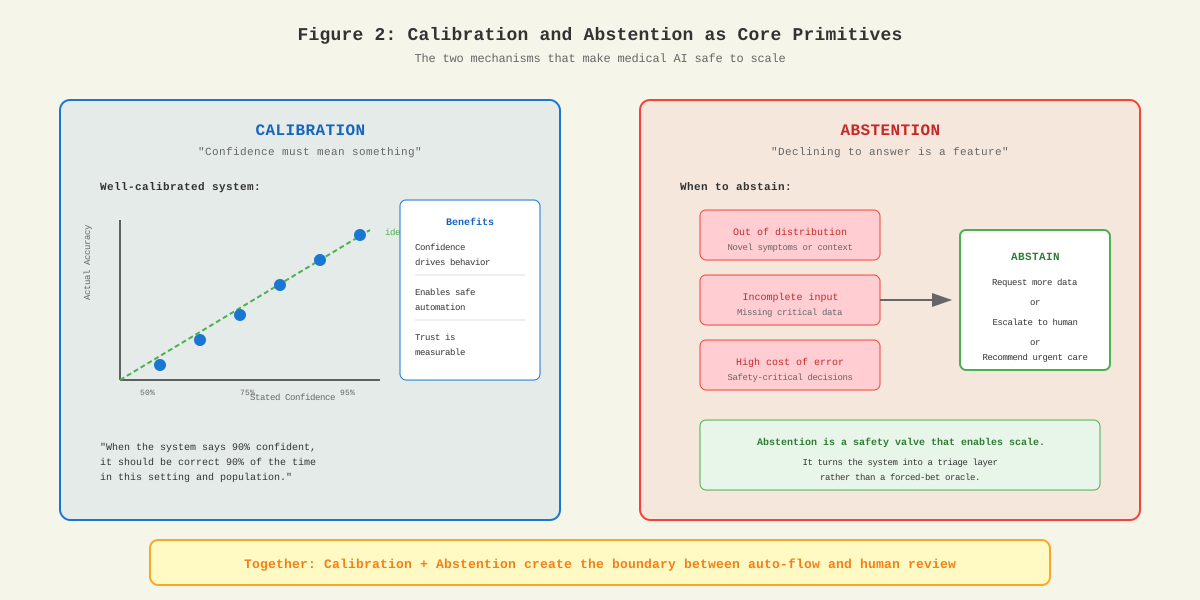
Figure 2: Calibration ensures confidence correlates with correctness. Abstention creates a safety valve that enables scale by declining to answer when the cost of error is high.
3) Verification is an interface between time and risk
One of the quiet truths in healthcare is that many failures are timing failures.
Bad outcomes come from:
- delayed escalation
- delayed recognition
- delayed follow-up
- delayed handoff
A verification layer should be designed around time.
Think of it as a routing system that optimizes for:
- speed when low risk and evidence is strong
- friction when risk is high and evidence is thin
- urgency when red flags appear
That framing changes the product conversation. The output is a schedule of actions with an escalation policy.
4) Human review works when the model hands you the right shape of work
In practice, clinicians want a compact decision object.
A verification layer succeeds when it reduces clinician review time by transforming a narrative into:
- the top differential
- the evidence for and against
- the missing fields that would materially change the conclusion
- the red flags and safety triggers
- the recommended next step with rationale
This is where the system starts to feel like a good resident: it organizes, it structures, it prepares.
5) The unit economics follow the error budget
There is a simple economic structure hiding underneath.
Every deployment creates three buckets:
- Bucket 1: high-confidence auto flow
- Bucket 2: review-required flow
- Bucket 3: silent wrongness
Bucket 3 is where costs explode: harm risk, liability, reputational damage, and clinician distrust that shuts adoption down.
A good verification layer shifts mass away from silent wrongness into review-required flow. That can look like extra human work, but it is an investment that buys safety and trust.
Over time, as the system learns from reviewed cases, work migrates from bucket 2 into bucket 1 without growing bucket 3.
That is the growth model for safe medical AI. The system compounds because verification is designed to create learning.
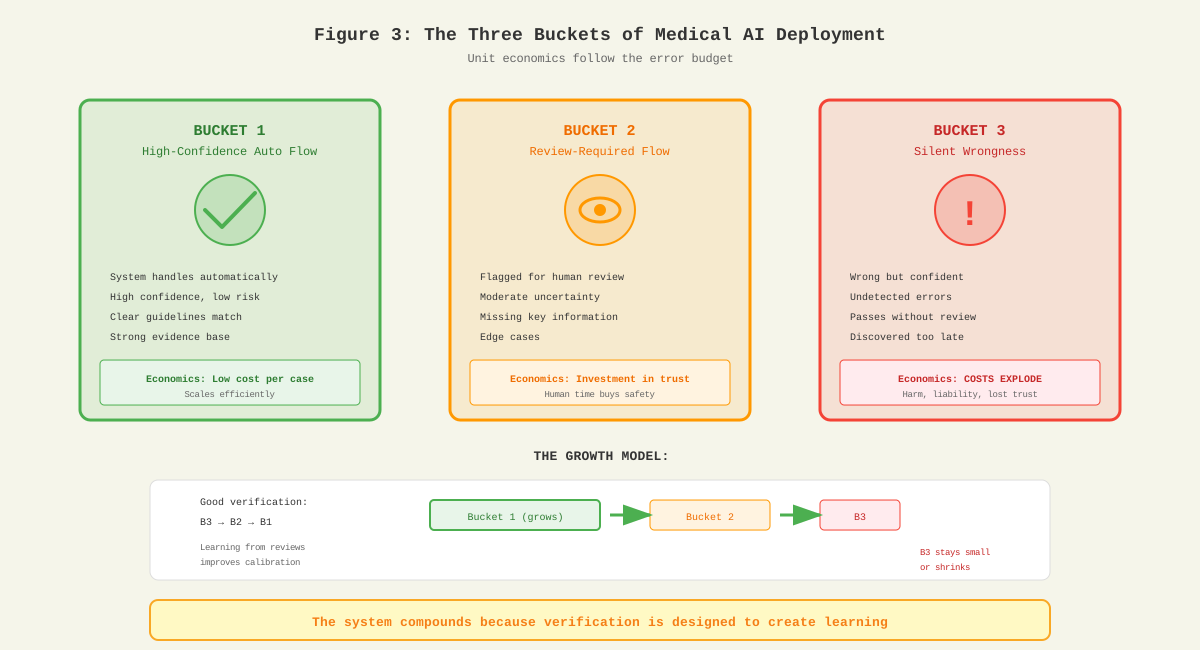
Figure 3: The unit economics of medical AI deployment. A good verification layer shifts mass away from silent wrongness (Bucket 3) into review-required flow (Bucket 2), then gradually into high-confidence auto flow (Bucket 1) through learning.
⸻
Part Two: Medical Receipts
A verification layer needs fuel. That fuel is provenance.
In a world saturated with AI-generated content, the scarce resource is traceable justification.
Medical receipts are the missing artifact.
A receipt is a structured packet attached to an output that answers:
- what the system relied on
- what it assumed
- what it could not see
- why it chose its action
- what would change its mind
Receipts turn AI from a persuasive narrator into an accountable participant in an evidence pipeline.
1) A receipt is a structured decision object
A list of links offers little in the moment of care. The clinician needs to know how the model used information, and which uncertainties matter.
A useful receipt looks more like this:
- Input summary: key facts extracted, with uncertainty markers
- Assumptions: what the system inferred, and what it treated as unknown
- Decision path: top hypotheses and the discriminating features
- Safety triggers: conditions that override everything
- Counterfactuals: what new info would flip the recommendation
- Evidence anchors: guidelines, known contraindications, and standard-of-care references when appropriate
- Confidence shape: the reason for uncertainty (missing data, conflicting data, novelty), beyond just the number
This makes review fast, and it makes disagreement productive. A clinician can point to the assumption that was wrong rather than arguing with the conclusion.
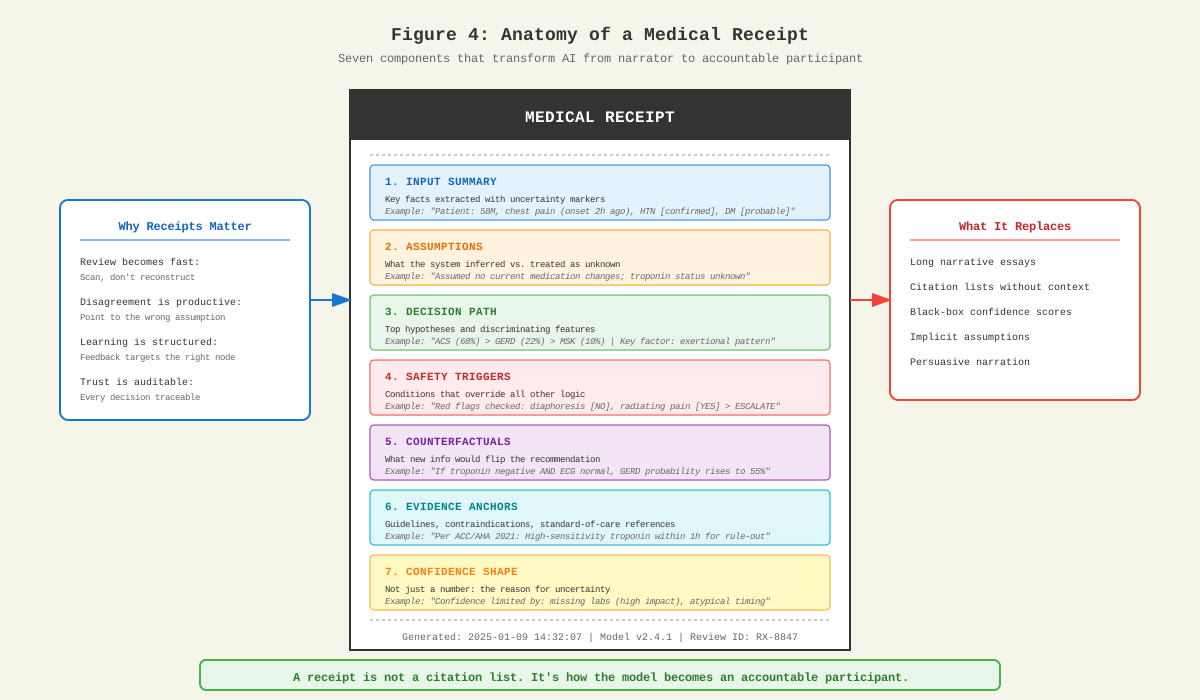
Figure 4: Anatomy of a medical receipt. Seven components transform AI output from a persuasive narrative into an accountable, reviewable decision object.
2) Receipts solve the "chart is a maze" problem
Clinical truth is scattered.
It lives in:
- notes written in different voices
- labs with time lag
- imaging reports with qualifiers
- medication lists with duplicates
- problem lists that never die
- social context that matters and is rarely structured
When AI operates in that environment, the dangerous failure mode is confident synthesis over incomplete retrieval.
Receipts force the system to show what it actually saw.
That does two things:
- it protects patients from hallucinated completeness
- it teaches teams where their data infrastructure is weak
A receipt becomes a diagnostic tool for the organization's information flow.
3) Receipts create a clean learning loop
Healthcare ML teams often struggle with training data that matches clinical reality. Receipts create a new kind of labeled signal:
- the review outcome
- the exact assumption that failed
- the missing field that mattered
- the boundary where abstention should have triggered
This is high-value learning data because it lives at the edge of decision-making, where errors are both likely and costly.
If you want continuous improvement without destabilizing deployment, you need this kind of structured feedback.
Receipts make it possible.
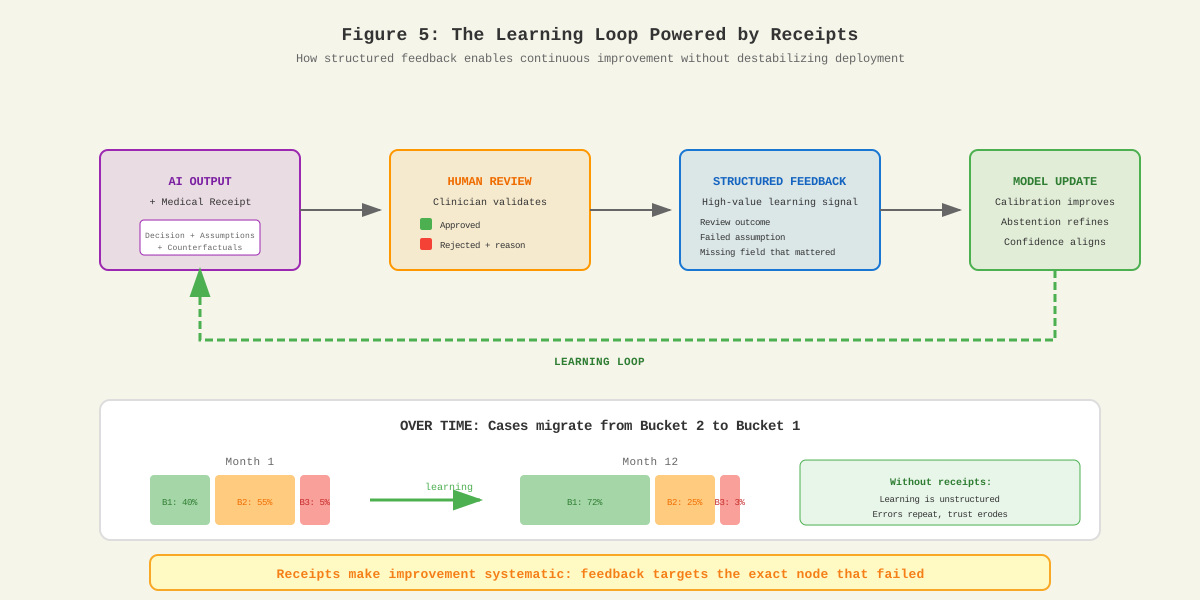
Figure 5: Receipts create a clean learning loop. Structured feedback from reviews flows back into model improvement, shifting cases from review-required to high-confidence over time.
4) Receipts are how you keep trust without slowing care
There is a common fear: adding verification adds friction, friction slows care.
Receipts invert that.
They allow verification to be fast because the work is shaped correctly. Review becomes scanning a structured packet instead of rereading an entire conversation and reconstructing context from scratch.
In other words, receipts remove ambiguity.
Ambiguity is what truly slows care.
5) The deeper implication: provenance becomes a clinical vital sign
In the coming years, patients will arrive with AI-generated interpretations of symptoms, labs, and diagnoses. Some will be helpful. Some will be wrong. Many will be impossible to evaluate quickly because they are detached from provenance.
The systems that win will treat provenance as a first-class signal.
Receipts are a concrete way to operationalize that value.
They also future-proof medical AI against the synthetic archive problem: when the world fills with generated content, the only stable ground is traceability.
⸻
Closing Synthesis: Safe Scale Comes from a New Kind of Infrastructure
Put the two parts together:
- The verification layer makes trust operational.
- Medical receipts make verification efficient, auditable, and learnable.
This is how medical AI becomes safe enough to scale without becoming brittle.
The frontier in healthcare AI is shifting away from clever outputs and toward disciplined systems.
Accuracy still matters, of course. But the decisive advantage will come from the architecture around the model: calibration that means something, abstention that protects people, workflows that respect clinicians, and receipts that make truth reconstructable.
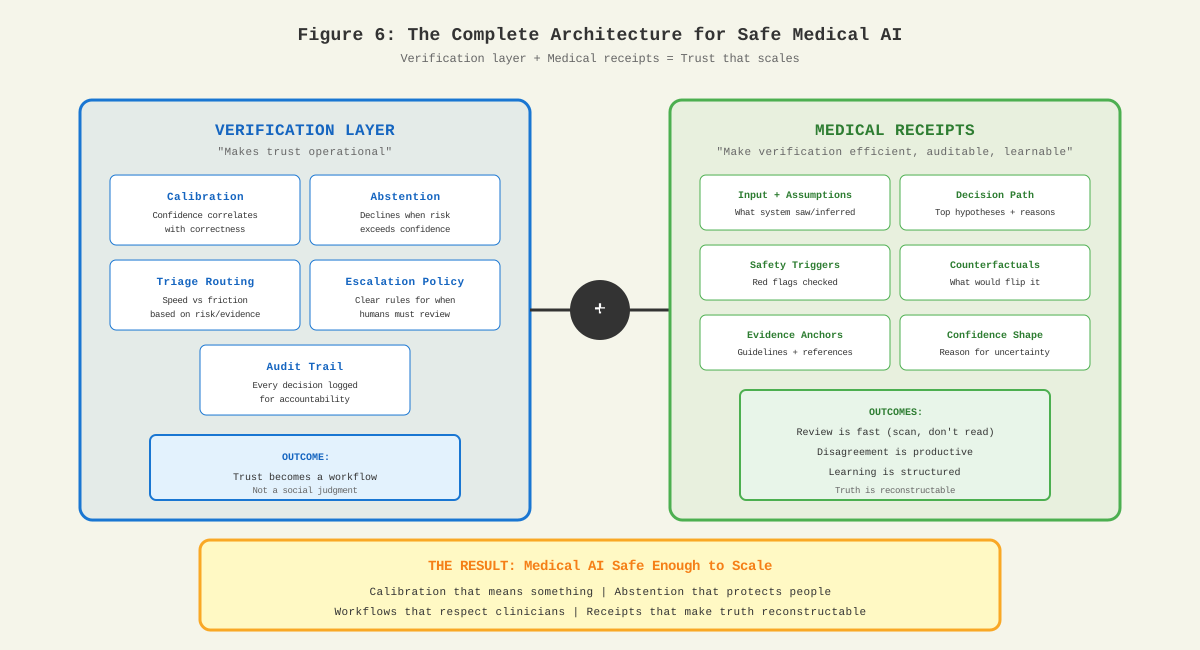
Figure 6: The complete picture. A verification layer provides operational trust infrastructure, while medical receipts provide the provenance fuel that makes verification efficient, auditable, and learnable.
In medicine, the future belongs to systems that can answer a harder question than "What should we do?"
They can answer: "How do we know?"